RMB Photo:VCG
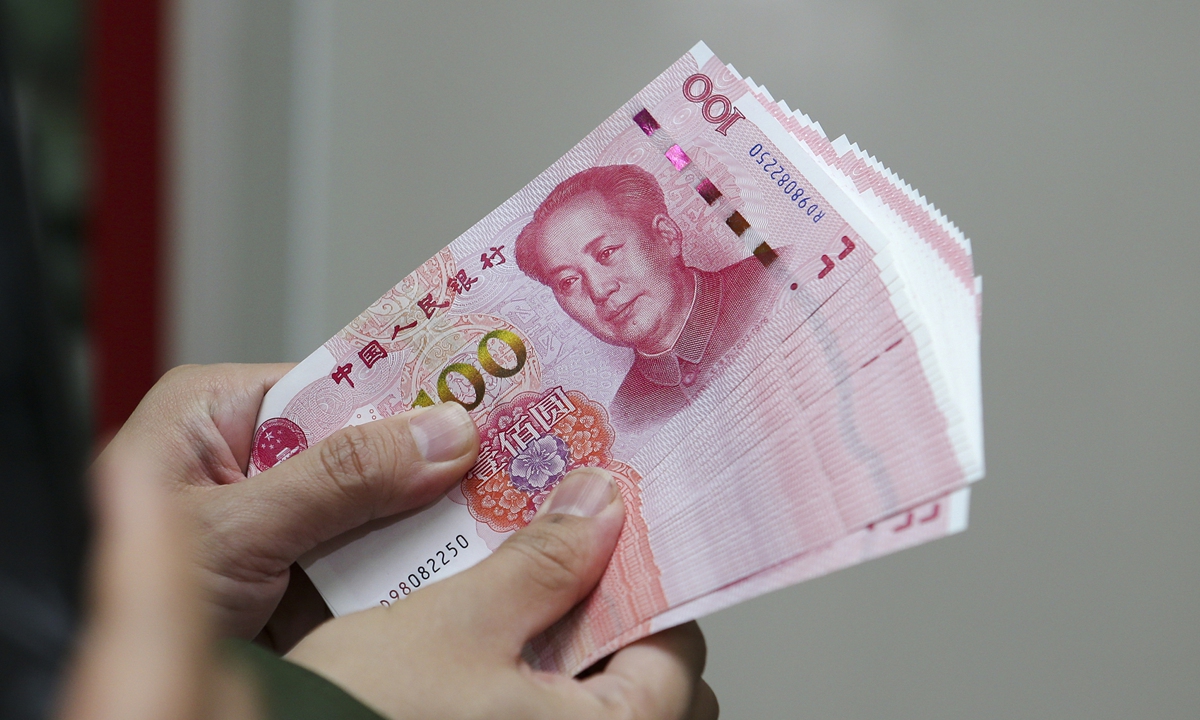
Following the recent EU summit, German Chancellor Friedrich Merz stirred controversy over the renminbi exchange rate, claiming that the currency was undervalued by as much as 30 percent and citing the 1985 "Plaza Accord" - which plunged Japan into its "lost decades" - as a solution. Meanwhile, the EU is discussing trade defense tools in response to its trade deficit with China, industrial competition, and supply chain dependence, with some European politicians attempting to portray China-EU economic and trade relations as a "systemic threat." This trend is not an isolated phenomenon; it reflects anxiety within the European manufacturing sector, protectionist impulses, and the self-imagined dilemma of strategic autonomy.The pressures facing European manufacturing stem not only from long-term factors - such as high energy prices, insufficient investment in innovation, and sluggish industrial policies - but also from immediate shocks like the spillover effects of the Ukraine crisis and the "siphoning" of US industrial subsidies. The enhanced competitiveness of Chinese enterprises arises from a comprehensive industrial system, sustained investment in technology, a massive market, and robust market competition - not from the so-called "artificially manipulated" exchange rates. Targeting the renminbi will not solve the challenges facing Germany's manufacturing sector, nor will it address the shortcomings in Europe's innovation chain.
The call to repeat the "Plaza Accord" is, in essence, not an economic solution but a form of political pressure. After the US reached the "Plaza Accord" with its major trading partners in 1985, the yen appreciated significantly, the economy fell into a prolonged recession, and the dollar depreciated sharply; yet this did not resolve the US trade imbalance. Statistics showed that the US goods trade deficit with Japan stood at around $46 billion in 1985; rather than decreasing, the deficit actually increased to over $55 billion in both 1986 and 1987.
Essentially, the root cause of the US trade imbalance lies in domestic economic imbalances resulting from "high consumption and low savings." Furthermore, as the dollar serves as an international currency, the US is compelled to import goods and expand foreign investment to export dollars - the so-called "Triffin Dilemma" - which cannot be resolved by exchange rate policy alone. Today, certain European politicians are co-opting this narrative to shift the blame onto China for economic challenges that should be addressed through industrial upgrading, market opening, and institutional reform. This not only defies economic principles but also runs counter to Europe's long-term interests.
China-EU trade should not be held hostage by trade deficit figures, nor should it be dominated by protectionist logic. The essence of China-EU economic and trade ties is mutual benefit and win-win outcomes. In 2025, China-Germany trade volume reached over 250 billion euros ($287 billion). Around 5,200 German companies operate in China, and China remains a key market for Germany's automotive, mechanical engineering, and electrical industries. According to a latest survey by the German Chamber of Commerce in China, about 61 percent of German companies surveyed plan to increase their investments in China within the next two years.
Europe imports a large volume of high-quality, affordable goods from China, which has reduced costs for consumers, stabilized corporate supply chains, and supported the green transition and digital transformation. If one looks only at the trade deficit on paper, without considering the profits of European companies in China, intermediate goods, trade in services, investment returns, and the division of labor within global value chains, one will easily reach a one-sided conclusion. Distorting "de-risking" into "reducing dependence," and then sliding toward "erecting barriers," will ultimately harm the efficiency of European companies, consumer welfare, and the stability of industrial and supply chains.
China will not accept using exchange rates as a pretext for oppression, nor will it return to the old era of great powers coordinating the fate of a few countries. Today's China is not the Japan of the past; the scale of China's economy, the depth of its market, the integrity of its industries, and its policy autonomy are all on a different level. In addition to the domestic demand market of over 1.4 billion people, China has become the major trading partner for over 160 countries and regions worldwide. The formation mechanism of the renminbi exchange rate has its own logic, and China has never pursued a surplus to develop its relations with Europe. Pointing fingers at external "competitors" may be much simpler and more convenient than deeply reflecting on one's own policy gains and losses. However, elevating trade relations to institutional confrontation and stigmatizing industrial advantages as "unfair" will only compress the space for cooperation and exacerbate mutual misjudgments.
In the past, Europe occupied a high-end position in the global value chain, accustomed to treating technology, branding, and rules as natural advantages. Now, China is accelerating its catch-up and is partly leading in areas such as electric vehicles, batteries, machinery, and green products. China's development is unstoppable, and international trade is a two-way choice; there is no such thing as forced transactions. Rather than asking China to slow down, it is better to accelerate one's own reforms; instead of interpreting market competition as a "threat," it is more effective to enhance resilience through open cooperation.
The world does not need a new "Plaza Accord"; what it needs is a new consensus based on mutual respect, respective reforms, and joint development. China and Europe are not so-called "systemic rivals," nor are they zero-sum opponents that must weaken each other. Looking ahead, there is still ample space for cooperation in China-Europe relations, and the key lies in whether the European side can maintain a rational and pragmatic bottom line, view China's development with an equal perspective, and address competitive differences through open means.
RELATED ARTICLES