The EU should neither engage in nor afford a ‘trade war with China’: Global Times editorial
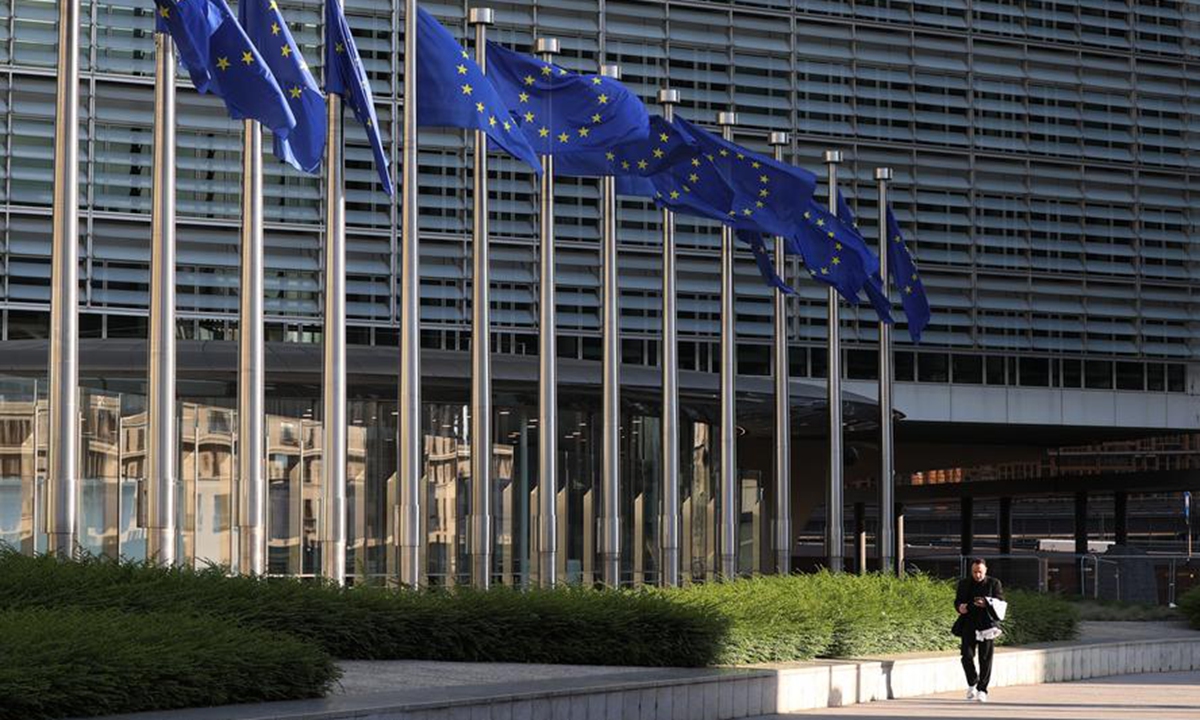
European Union flags fly outside the European Commission headquarters in Brussels, Belgium, on May 23, 2025. Photo: Xinhua
Spain, France, Italy and the Netherlands, together with Lithuania, have circulated a joint policy paper aimed at pressing for tougher trade measures against China at a key European Commission meeting scheduled for Friday, targeting what they describe as "unfair trade practices." The paper advocates for "assertive trade defense" through higher tariffs, while French President Emmanuel Macron even suggested following US-style measures akin to the "Section 301" tariffs. These developments have drawn widespread attention, with narratives claiming that Europe's "trade war with China looms" gaining increasing traction.
A major source of this latest wave of the so-called "China shock" narrative is the claim that the EU's trade deficit with China reached 360 billion euros in 2025. Some in Europe are attempting to spread panic among the public by portraying a scenario in which large volumes of "low-priced excess Chinese goods" are flooding the European market. According to this narrative, unless immediate action is taken, European companies will suffer severe damage, livelihoods will be affected, and European industries could eventually be "colonized by Beijing."
Such claims are riddled with errors. If a trade surplus were equivalent to "overcapacity," then Europe - which has long maintained an overall surplus in goods trade and exports large quantities of aircraft, automobiles, pharmaceuticals, and luxury goods - would itself already be exporting "overcapacity" to the rest of the world.
In fact, the growth of China's exports to Europe is significantly concentrated in areas such the "new trio" from China, including electric vehicles, photovoltaics and lithium batteries, which largely reflect the EU's own structural demand.
To a considerable extent, this growth has actually supported the EU's competitiveness. At present, nearly half of China-EU trade consists of intermediate goods. European companies purchase high-cost performance Chinese semi-finished products, upgrade and process them into high value-added end products, and then sell them globally for substantial profits. Such value-added gains, however, are not reflected in customs statistics on the trade deficit.
Taking French automaker Renault as a representative example, by adopting the rapid-response mechanisms and modular development approach of China's supply chain, Renault successfully shortened the development cycle for the Twingo E-Tech by one year, and R&D investment was halved. As a result, the Twingo E-Tech has become a highly competitive benchmark product in Europe's under-20,000-euro pure electric vehicle market. Similar cases can also be widely seen in sectors such as machinery and electrical equipment.
Not to mention that the EU has long maintained a clear advantage in trade in services with China. In 2024, the EU recorded a surplus with China of more than $50 billion. Intellectual property licensing fees alone generate tens of billions of dollars in profits from China every year for Europe. The real picture of China-Europe trade is therefore "the surplus is in China, while the profits are in Europe." From another perspective, if Europe were willing to export more advanced equipment such as high-end lithography machines to China, reducing the trade imbalance would not be difficult at all.
There is no denying that Europe's industrial competitiveness has declined, but its problems are largely self-inflicted. Strategic misjudgments toward Russia triggered an energy crisis, leaving EU energy costs two to three times higher than those in the US. The EU decision-making mechanism is lengthy, inefficient, and overly regulated, with industrial project approvals taking an average of one to three years, and in some cases more than six years. Long-term underinvestment in research and development has also caused Europe to fall significantly behind China and the US in technological innovation. Which of these problems can truly be solved simply by relying on trade barriers? In fact, there is much opposition within the EU to such measures.
It has been reported by European media that Germany, the EU's largest economy, did not sign the document. Spain, one of the submitters of the policy paper, has consistently sought Chinese investment, while the Netherlands is also skeptical of trade protectionism.
The EU cannot afford a so-called "trade war with China." This is because mutual benefit and win-win cooperation are the essence of China-EU economic and trade relations. The claim of a "China shock" on European industries is essentially a result of the optimal allocation of market resources under a globalized division of labor, which is a voluntary choice that benefits both sides. Under this globalized division of labor, China and the EU have already formed a pattern of complementary advantages and shared interests.
Trade protectionism cannot solve the inherent problems of declining competitiveness in European industries and sluggish economic growth; it will only cause Europe to miss opportunities once again. In contrast, when the US previously initiated a trade war against China, the costs of the increased tariffs were largely borne by American companies and consumers, severely damaging the global industrial chain. It seems that Europe has not fully learned this profound lesson.
Europe has long been a staunch advocate of free trade and multilateralism, while US measures such as "Section 301" investigation have been criticized in Europe for being "unilateral," "bullying," and "undermining the rules-based multilateral trading system." In recent years, when the US initiated trade investigations into steel and aluminum imports from the EU, the EU's aircraft subsidies, and digital services tax, European leaders strongly condemned these actions as "illegal." France President Emmanuel Macron lambasted US' decision to impose tariffs as "brutal and unfounded." Now, however, the EU is attempting to create a "European version of Section 301," which is not only regrettable but also makes it clearer that Europe's fundamental problem lies not in the so-called "China shock," but in a lack of confidence in itself due to competitive anxiety.
China has always regarded Europe as a sincere partner and has shown sufficient goodwill toward the EU. However, this goodwill is not limitless; any unilateral measures that harm the legitimate interests of Chinese enterprises will inevitably face strong countermeasures from China.
Historically, both sides have successfully resolved friction through dialogue on multiple occasions. The Friday meeting should not serve as a call to mobilize for a trade war, but should instead be an opportunity for rational risk assessment and the pursuit of pragmatic paths. Only by returning to dialogue and cooperation can China and Europe jointly address global challenges and achieve mutual benefit and win-win outcomes.
RELATED ARTICLES