China's major science facility achieves rare isotope observation, extends boundaries of nuclear landscape
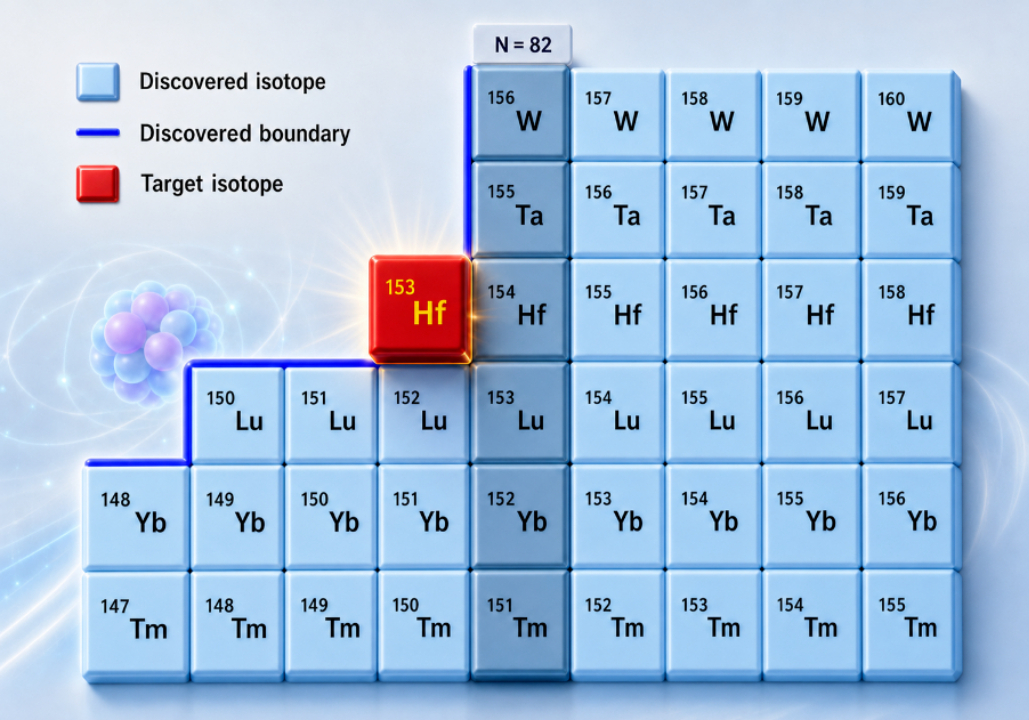
Location of hafnium-153 on the nuclear chart. Blue lines show the boundaries of the known nuclides around it. Photo: Official website of Chinese Academy of Sciences
Researchers from the Institute of Modern Physics (IMP) under the Chinese Academy of Sciences (CAS) and their collaborators have observed an extremely rare isotope, hafnium-153, with the help of the newly completed high intensity heavy-ion accelerator facility (HIAF), a major national science and technology infrastructure project, the CAS said in a release on its official website. The research was published in Science Bulletin.
The observation marks the first physics result achieved during HIAF's commissioning phase, highlighting the facility's capability to explore the boundaries of the nuclear landscape.
Exploring unknown isotopes and determining the limits of nuclear existence are key frontiers of nuclear physics. Located in the neutron-deficient heavy nuclear region, hafnium-153 offers a unique window into the evolution of nuclear structure and the limits of nuclear stability. Its observation and precise measurement provide critical experimental information for testing nuclear models and advancing our understanding of nuclear structure, the CAS said.
Despite an extremely low production cross section, the researchers observed a total of ten hafnium-153 ions. The results indicate that hafnium-153 is a bound or weakly bound isotope, consistent with predictions from various nuclear mass models.
This new achievement not only marks an important advance in probing the limits of nuclear existence but also opens the door to broader scientific exploration at HIAF, the researchers said. With further improvements in beam intensity and experimental efficiency, HIAF is expected to play an increasingly important role in the discovery of new isotopes and the investigation of nuclear properties under extreme conditions, they added.
HIAF, one of China's major national science and technology infrastructure project passed its technological acceptance review on July 21. The facility is now commencing trial operations.
Located in Huizhou, in South China's Guangdong Province, HIAF is a multifunctional accelerator with leading beam parameters for heavy-ion physics and applications. It was designed and developed by the Institute of Modern Physics of the CAS.
Heavy-ion accelerators serve as a "super microscope" for scientific exploration, enabling researchers to probe fundamental interactions, the structure of matter, and the evolution of the universe. Advances in these facilities have consistently deepened our understanding of the world and led to a wide range of technological applications.
HIAF is one of the few accelerators worldwide capable of accelerating a wide range of ion species, from hydrogen to uranium, and producing thousands of species of unstable atomic nuclei. It focuses on three major scientific goals: exploring the limits of nuclear existence, unraveling nuclear astrophysics processes, and advancing the interdisciplinary applications of heavy ions.
As one of the world's most powerful accelerators, HIAF will operate as an international scientific user facility, the CAS said.
The facility is expected to help advance global research in cutting-edge nuclear physics, nuclear astrophysics, and atomic physics. Furthermore, it will support advanced heavy-ion beam applications in diverse fields such as healthcare, materials science, and biological breeding.
Global Times
RELATED ARTICLES