SAIC, GM extend joint venture by 20 years; Chinese market remains key, as US restrictions pose obstacles: expert
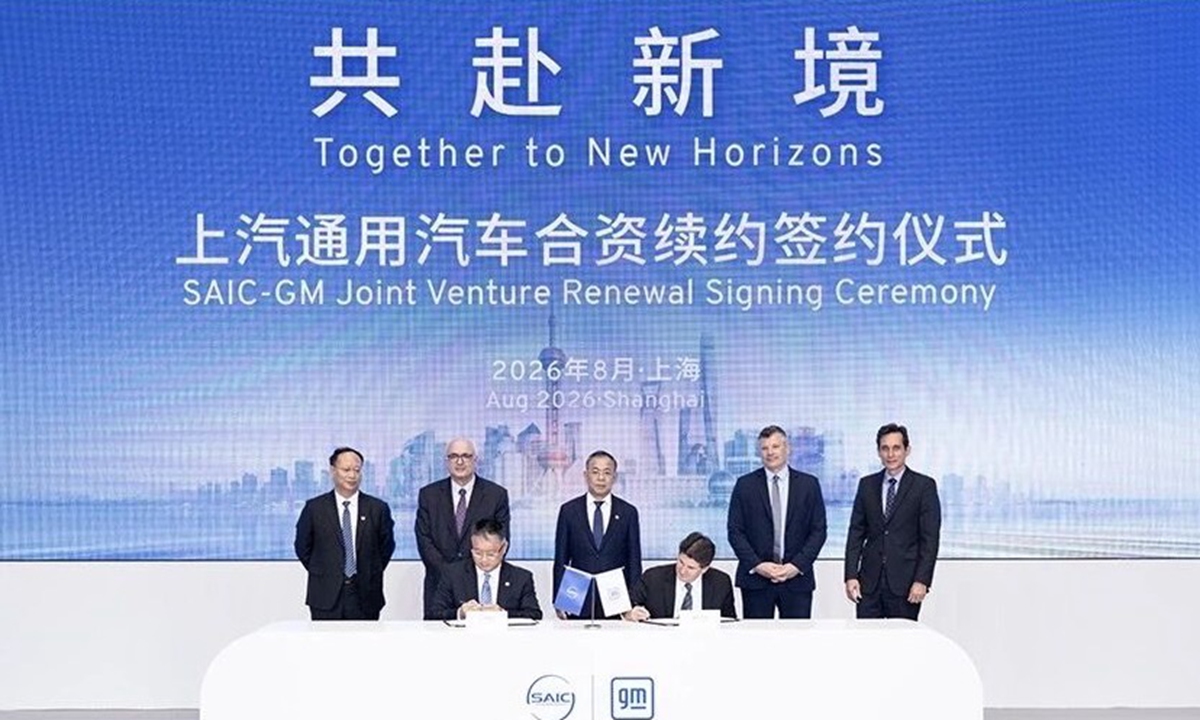
General Motors and SAIC Motor sign an agreement extending their joint venture partnership by 20 years to 2047 on August 5, 2025. Photo: General Motors official WeChat account
Chinese auto giant SAIC Motor and the US automaker General Motors have signed an agreement extending their joint venture partnership by 20 years to 2047, the companies said in an official statement on Wednesday.
Building on nearly three decades of cooperation, the renewed agreement aims to accelerate SAIC-GM's transition toward intelligent electric vehicles (EVs) and advance its global expansion, the statement said.
According to Reuters, the agreement came as GM has seen its sales in China crater over the past decade, as Chinese domestic automakers have grown more sophisticated and the market has moved sharply to EVs.
Chinese experts noted that amid the transformation of the auto industry, multinational companies continue to view the Chinese market and industrial chains as a key part of their global strategies, with brand synergies and technological complementarity helping both sides secure market shares and expand business. Meanwhile, they also warned that trade restrictions imposed by the US could become a major obstacle to cooperation among multinational companies.
GM reportedly holds positive expectations for the renewed partnership, including seeking to expand its global export footprint by leveraging China as a key hub.
According to Reuters, GM said the company would focus on its Cadillac and Buick brands in China, where it would discontinue sales of its Chevrolet brand. The terms also will allow GM to use China as an export hub to ship Buicks and Cadillacs to the Middle East, Africa, South America, Mexico and elsewhere in Asia, the Detroit automaker said, per Reuters.
GM was one of the first global automakers to enter China when it won a coveted partnership with SAIC in 1997 and grew to become one of the country's top-selling carmakers, the report said.
Zhang Xiang, a visiting professor in the engineering department of Huanghe Science and Technology University, told the Global Times on Wednesday that the renewed SAIC-GM partnership serves the interests of both sides, as SAIC has accumulated strengths in new-energy vehicles and supply chains, while GM brings global operational experience and overseas market channels.
The cooperation is expected to generate greater benefits than ending the partnership, he said, noting that SAIC's export performance, particularly in higher-end markets such as North America, is closely linked to GM's global network and brand resources. The joint venture partnership would provide a strong boost to both companies' market expansion and competitiveness, the expert said.
According to the Economic Information Daily, traditional joint venture models have been reshaped in recent years, as cooperation between Chinese and foreign automakers evolves. China is transitioning from a technology "recipient" to a technology "provider," with two-way empowerment becoming a new feature of industry collaboration.
According to the report, Xpeng's cooperation with Volkswagen has accelerated its expansion of sales channels in Europe, while Leapmotor and Stellantis established the joint venture "Leapmotor International," which had exported more than 100,000 vehicles as of February 2026.
Experts said the auto industry is moving from one-way flows of capital and products to two-way exchanges of technology and capabilities. As cooperation evolves from simple joint production to deeper collaboration in supply chains and R&D ecosystems, closer integration between Chinese and foreign automakers is paving the way for a more open and mutually beneficial global mobility industry.
Notably, SAIC-GM reportedly holds a cautious outlook on the overseas expansion of some new models, with US tariff restrictions on Chinese passenger vehicles preventing certain models from entering the US market.
The joint venture last year launched the China-developed Buick Electra sub-brand of electric and hybrid vehicles. Its Electra E7 SUV recorded more than 10,000 sales in its first month and is set to become the joint venture's first premium model sold overseas, starting in October, according to Reuters Wednesday report.
However, GM said the company has no plans to export to the US, where tariffs and national security policies targeting China-developed technologies have effectively kept Chinese automakers out of the market, the report said.
Such a decision is undoubtedly regrettable for major multinational companies, an industry observer said, noting that artificially created barriers could undermine the prospects of cross-border cooperation and harm the interests of multiple stakeholders, Zhang said, calling for more rational market rule-making and genuine win-win measures to foster a stable and open business environment.
RELATED ARTICLES