ARTS / CULTURE & LEISURE
Chinese podcaster Zhong Shu explains how ‘Nolan’s best global press tour interview’ was made
Authenticity core reason for popularity: podcaster
By Published: Aug 05, 2026 09:45 PM

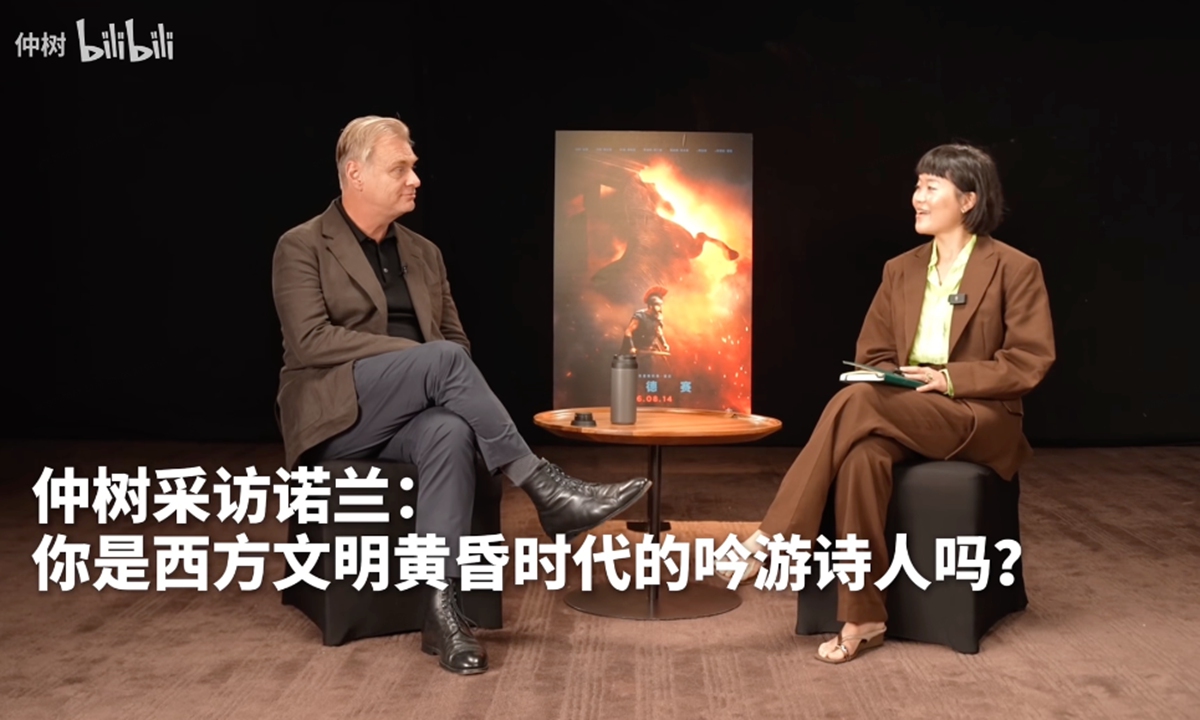
Screenshot of the 17-minute viral interview between Christopher Nolan and Zhong Shu Photo: Bilibili
As The Odyssey dominates global headlines and director Christopher Nolan navigates a string of promotional interviews across Hollywood and Europe, a compact 17-minute viral interview between the acclaimed filmmaker and young Chinese scholar Zhong Shu during the film's Beijing press tour has sparked frantic global sharing and heated public debate, leaving countless overseas observers questioning why mainstream Western reporters can no longer deliver thoughtful, in-depth cultural dialogues.The interview was first released on the Chinese video platform Bilibili and later quickly snowballed, surging past tens of thousands of views on domestic platforms and exploding to tens of millions of views across overseas social media.
Widely hailed online as "Nolan's best global press tour interview," the unscripted conversation broke every rule of conventional Hollywood promotional journalism, triggering sweeping self-reflection among global audiences and media practitioners alike.
In an exclusive interview with the Global Times, Zhong Shu, a political theorist, cultural columnist and podcaster, opened up about her unexpected viral success and shared her insights into why the casual academic dialogue has resonated so deeply across global cultural and media circles.
Zhong Shu revealed that she never anticipated this conversation would trigger worldwide resonance and cross-cultural discussion, and this opportunity, in fact, came entirely by chance.
She recalled that a Chinese employee at Universal Pictures, the movie's production company, stumbled across her podcast episode discussing how to interpret Homer's Odyssey and emailed her to offer an interview opportunity with Nolan. Initially hoping for a 45-minute to one-hour in-depth exchange to ensure thorough discussion, she finally settled for a tight 15-minute slot granted by Nolan's publicist.
Without knowing the conventional routines of press tour interviews, Zhong Shu approached the exclusive talk with pure academic sincerity. "I treated the interview like how I would ask a professor or a fellow academic after a lecture, because that is the 'convention' in which I am trained," Zhong Shu explained.
Having studied ancient Greek literature and the Odyssey since the age of 15, she abandoned trivial entertainment-focused questions about film techniques, casting or on-set anecdotes. Instead, she raised profound questions spanning classical civilization, heroism, and the nuances of contemporary film criticism, prompting Nolan to drop his polished promotional script and engage in genuine reflection on his own artistic practice.
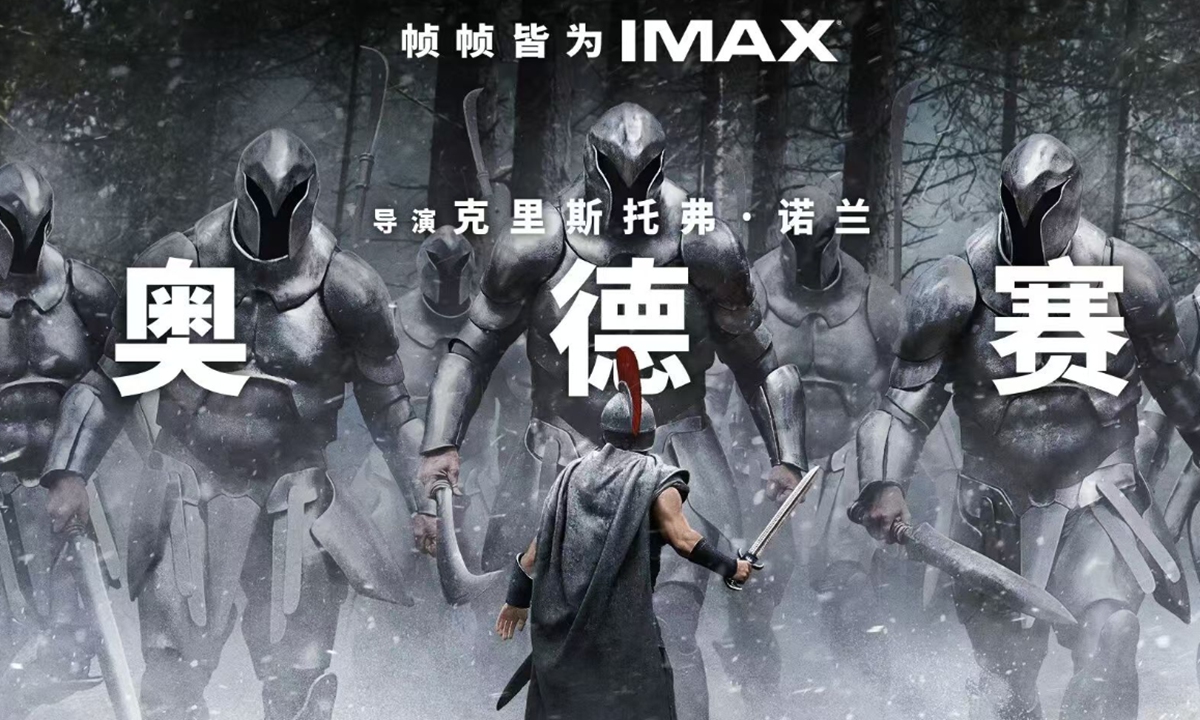
The Odyssey
Explaining why Nolan repeatedly smiled warmly and offered high praise for their dialogue, Zhong noted, "I approached him as an artist who thinks through form, narrative and history. Filmmakers on promotional tours are frequently asked about scale, technology, casting and spectacle. Those are legitimate subjects, but they do not always leave room for the deeper intellectual concerns that make someone devote years of his life to a particular story. My questions did not 'unlock' something hidden in him. They gave him the space to speak about dimensions of his work that are often present but not always invited into the conversation."Long before the interview went viral globally, Zhong was already deeply immersed in the on-site genuine dialogue. She repeatedly shared her excitement with her accompanying friend, describing the conversation as extremely "invigorating and refreshing." In her view, the core reason for the interview's global popularity lies in its rare authenticity, which stands out sharply against the prevalent formulaic and homogenized modern media content.
"Viewers could see genuine thought taking place in real time," Zhong Shu explained. "Nolan was not promoting a film, and I was not trying to extract a headline; we were two people seriously engaging with a story that has crossed languages and civilizations for nearly 3,000 years." Regardless of cultural or academic backgrounds, audiences worldwide can easily perceive the sincere intellectual curiosity, equal mutual respect and unscripted human connection absent from most modern press interviews.
The viral clip has triggered diverse interpretations across global online communities, with many Western netizens using it to launch fierce introspection on their own media ecosystem. Numerous commentators have lamented that Western entertainment journalism has long been trapped in commercial inertia, overly catering to film promotion needs and abandoning independent critical thinking.
Zhong Shu has watched the pile-on with a mixture of curiosity and caution. "Once an interview travels beyond its original context, people inevitably interpret it through their own cultural concerns," she said. She noticed that the criticism was not limited to America. "On X, I saw reporters from South Korea, India, Argentina, Russia, Turkey and Arab countries lamenting that they rarely receive the opportunity or time to conduct this kind of interview."
The episode, she suspects, had accidentally exposed a structural critique, that is, "why contemporary media environments allow shallow content to proliferate while making sustained serous conversation increasingly difficult."
Against the backdrop of fragmented, entertainment-oriented global internet content, the interview proves that audiences are never tired of complex, profound ideas - they are merely underserved by mainstream media. "Audiences do not reject complexity; sometimes they are simply offered too little of it."
She stressed that qualified cultural interviews should explore the "human experiences" behind artistic works rather than merely focusing on production details, with interviewers turning professional knowledge into open questions to inspire artists' in-depth reflection.
As a young content creator, Zhong embodies the unique value of non-institutional cross-cultural communication. "A voice can travel before the person behind it has status, access or connections. Cross-cultural exchange can sometimes begin very modestly—with one person speaking sincerely, another person listening, and an email that brings them into the same room," she said.
RELATED ARTICLES