China-Russia cooperation helps Amur tigers roam freely across border, boosts wild population recovery, expert tells GT
By Published: Aug 06, 2026 11:46 AM


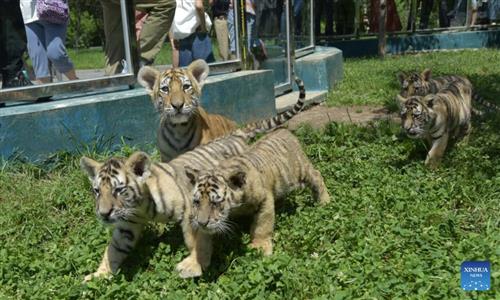
Amur tiger cubs play at the Hengdaohezi Siberian Tiger Park in Mudanjiang, northeast China's Heilongjiang Province, July 28, 2025. A total of 40 Amur tiger cubs have been born at the park since March. (Photo by Zhang Chunxiang/Xinhua)
By improving cross-border ecological corridors, expanding joint monitoring, sharing scientific expertise and coordinating anti-poaching efforts, China and Russia have helped protect the movement of Amur tigers between the two countries, a Chinese expert with years of experience working with Russian counterparts told the Global Times, noting that such cooperation had strengthened habitat connectivity and provided critical support for the recovery of the species in the wild.China's Northeast China Tiger and Leopard National Park has established a long-term partnership with Russia's Land of the Leopard National Park, carrying out joint population surveys, coordinating cross-border patrols, and sharing information of the Amur tiger. Together, the two sides have created a transboundary protected area covering nearly 17,000 square kilometers. Officials say 21 Amur tigers and 27 Amur leopards now regularly move across the China-Russia border, according to China's National Forestry and Grassland Administration (NFGA) on July 29, the International Tiger Day.
This year, China and Russia primarily compared data collected through their respective monitoring programs before jointly publishing the results on the cross-border distribution and population status of the Amur tiger, Jiang Guangshun, a professor at Northeast Forestry University, who has decades of experience in cooperating with Russia on protecting Amur tiger, told the Global Times.
Although China and Russia have long maintained close communication and mutual support in cross-border tiger and leopard monitoring and conservation, the joint monitoring of the same species across their shared border using identical identification methods, monitoring protocols and mutually agreed measurement standards marks the first such effort of its kind, both internationally and domestically, the Global Times learned from NFGA.
Completed in less than eight months, the joint China-Russia monitoring project brought together the full process of data collection, comparison, verification and analysis within a relatively short time frame. That helped avoid problems seen in earlier surveys conducted over longer periods, including the risk of counting animals that had died before the survey was completed, according to the NFGA.
NFGA said the findings provided the most precise and comprehensive assessment on record of Amur tiger and Amur leopard populations along the China-Russia border.
Discussing specific areas of China-Russia cooperation on Amur tiger conservation, Jiang said that the two countries' shared commitment to cross-border protection has helped strengthen ecological connectivity and create conditions for tigers to move more freely across national boundaries. Given the species' vast range, an individual tiger may roam in Russia one day and enter China the next, making it difficult to assign it to a single country and underscoring the need for coordinated cross-border conservation, he said.
Since 2023, China and Russia have begun opening wildlife migration corridors along their shared border on a trial basis to facilitate the movement of Amur tigers, leopards and other wild animals. The move has transformed what were once difficult border crossings into unobstructed routes for wildlife migration, according to NFGA.
Along these migration corridors near the China-Russia border, sections of the wire fences that once served as physical barriers between the two countries have been opened, allowing wildlife to move freely, expand their ranges, maintain genetic exchange and access more opportunities for breeding.
The expert added that China and Russia continue to cooperate in areas such as infrared camera monitoring, genetic monitoring and behavioral research, while sharing real-time data to track the cross-border movements of Amur tigers.
In practice, Russian experts uses satellite collars to track tigers' movements in real time and shares their location data and movement patterns with Chinese researchers in a timely manner. Based on the information, Chinese scientists conduct continuous monitoring and take preventive measures to reduce potential human-tiger conflicts, said Jiang.
Through years of data sharing and communication, researchers from both countries have gained a deeper understanding of the movement patterns of Amur tigers across the border, Jiang noted.
Jiang also said authorities in China and Russia have carried out long-term cooperation in joint monitoring, technical exchanges, experience sharing and coordinated anti-poaching efforts, which have helped strengthen cross-border conservation efforts.
He added that some of the most pressing questions in biology conservation require joint research by scientists from both countries. These include assessing the risk of disease transmission as tigers cross national borders, managing potential human-tiger conflicts as the animals expand into new areas, and building shared cross-border databases - efforts that require sustained cooperation over the long term.
RELATED ARTICLES