Takaichi makes ‘hollow political posture’ at Hiroshima memorial; context of nuclear explosions should all the more be remembered: FM
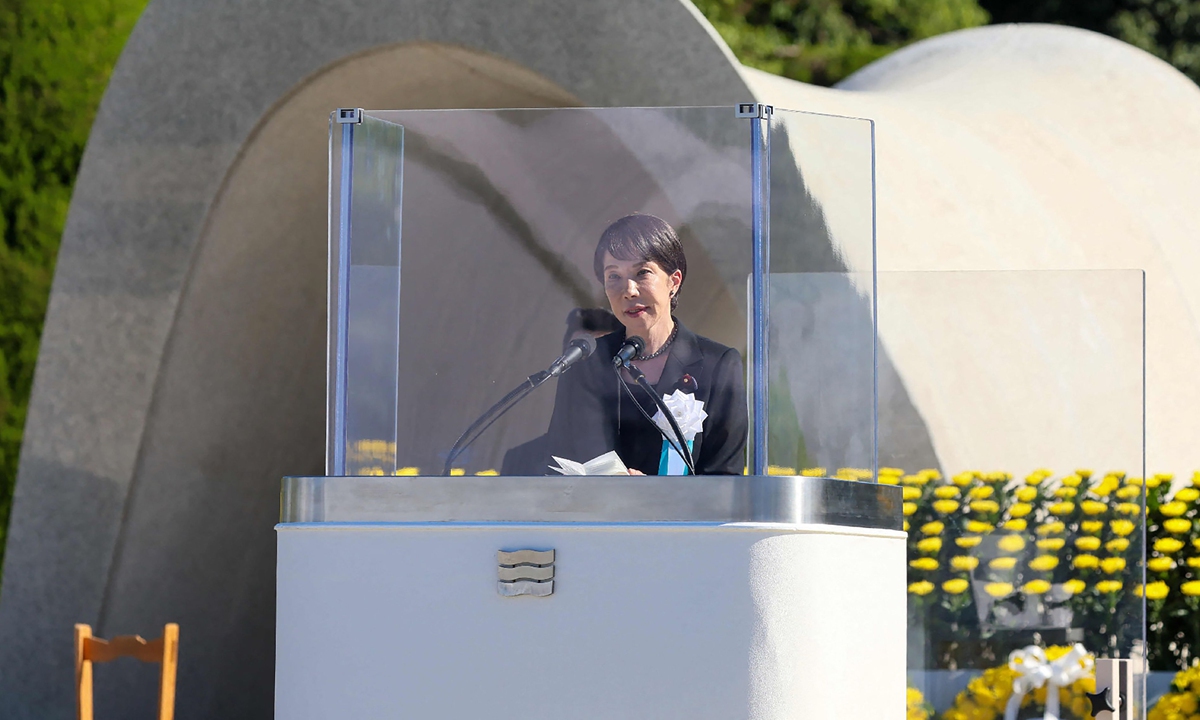
Japanese Prime Minister Sanae Takaichi speaks during a memorial at the Peace Memorial Ceremony, on the 81st anniversary of the dropping of the atomic bomb, at the Peace Memorial Park in Hiroshima on August 6, 2026. Photo: VCG
As Hiroshima observed the 81st anniversary of the US atomic bombing of the city on Thursday, Japan's Prime Minister Sanae Takaichi stood at the Peace Memorial Park to emphasize that Japan pledges to achieve a world free of nuclear weapons while upholding the Three Non-Nuclear Principles, despite Japanese media noted that she has left the door open for its future revisions.
The devastation and tragedies brought by nuclear weapons should never repeat themselves. That said, the particular context of the nuclear explosions should all the more be remembered and the lessons of Japanese militarism's aggression and expansion must forever serve as an alarm, said Chinese Foreign Ministry spokesperson Lin Jian on Thursday, responding to a question concerning the Japanese authorities are rebuilding Japan's war machine, seeking to revise the Three Non-Nuclear Principles, and pursuing nuclear sharing with the US, even the possession of nuclear weapons.
Right-wing forces in Japan have long been distorting historical facts, politically exploiting the nation's identity as a nuclear bombing victim for sympathy and deliberately downplaying Japan's invasion that killed and wounded tens of millions of people in Japan's neighboring countries, in an attempt to escape accountability for the war, Lin added.
A Chinese expert said a narrative that speaks only of victimhood while remaining silent about past acts of aggression is, in essence, exploiting the public's desire for peace to provide moral justification for accelerating remilitarization. If verbal pledges to uphold the non-nuclear principles come alongside practical preparations to ease relevant restrictions, Japan's so-called pledges delivered in Hiroshima will turn into nothing more than "hollow political posturing," he added.
A moment of silence was observed at 8:15 am local time, the exact moment when an atomic bomb dropped by a US bomber detonated over the city on August 6, 1945, killing around 140,000 people by the end of that year. Three days after the world's first-ever nuclear attack decimated Hiroshima, a second atomic bomb was dropped on Nagasaki in southwestern Japan, according to the Xinhua News Agency.
As the only country in the world to have suffered atomic bombings, Japan has long upheld the Three Non-Nuclear Principles, which prohibit possessing, producing or permitting the introduction of nuclear weapons into Japanese territory.
Takaichi's first appearance at the ceremony as the nation's leader comes as the government prepares to revise its key national security documents later this year, raising questions over whether the Three Non-Nuclear Principles will remain intact, The Japan Times reported on Thursday.
Although she claimed that she pledges to devote every effort to achieving a world without nuclear weapons and lasting peace, reiterating that Japan is firmly upholding its long-held Three Non-Nuclear Principles, The Japan Times noted that Takaichi left the door open for revision by noting immediately after this that the global security environment "is becoming increasingly severe."
Kyodo News also reported on Thursday that Takaichi "avoids clearly pledging Japan will maintain non-nuclear principles." She failed to explicitly pledge that Japan will maintain its non-nuclear principles, simply saying the government "is upholding" the long-held policy.
While seemingly restating the Three Non-Nuclear Principles in Hiroshima, Takaichi only stressed Japan's so-called present adherence instead of pledging sustained compliance going forward, reserving room to adjust the rules later, Zhan Debin, director and professor of the Center for Korean Peninsula Studies at the Shanghai University of International Business and Economics, told the Global Times on Thursday.
This stance is consistent with her advocacy for revising the "no introduction of nuclear weapons" provision and relaxing restrictions under revised security policies, the expert added.
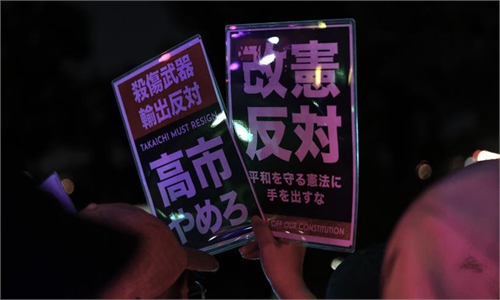
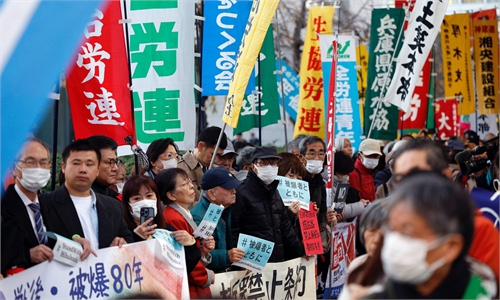
Since Takaichi took office in October last year, at least 128 local assemblies across 36 prefectures have submitted written opinions to the Diet, Japan's parliament, urging the government to uphold the country's Three Non-Nuclear Principles, local media reported.
Notably, the prefectural assemblies of Nagasaki and Hiroshima and the city assembly of Hiroshima are among these bodies, previously unanimously adopting statements urging the principles to be adhered to, per Xinhua.
"Takaichi's hollow verbal maneuvering to endorse the Three Non-Nuclear Principles is just a defensive political posture. Yielding to record resistance from local assemblies, falling approval ratings and the uniquely sensitive Hiroshima venue, the statement carries no real resolve to safeguard Japan's non-nuclear stance," Zhan said.
In her speech, Takaichi emphasized Hiroshima's nuclear suffering, yet avoided Japan's wartime aggression. Her one-sided victim narrative is used as a moral justification for accelerated remilitarization, the expert noted. Tokyo has long presented itself purely as a victim, but efforts to achieve a world free of nuclear weapons ought not to exploit tragedy and evade historical responsibility, which the world must recognize, he emphasized.
The international community should therefore judge the Japanese government by its concrete actions rather than its political rhetoric delivered on specific occasions. If verbal pledges to uphold the non-nuclear principles go hand in hand with tangible preparations to ease relevant restrictions, its vows made in Hiroshima will amount to nothing more than "hollow political posturing," Zhan continued.
RELATED ARTICLES