Record high Japanese local assemblies call for upholding non-nuclear principles; expert warns right-wing forces testing waters to relax nuclear taboos
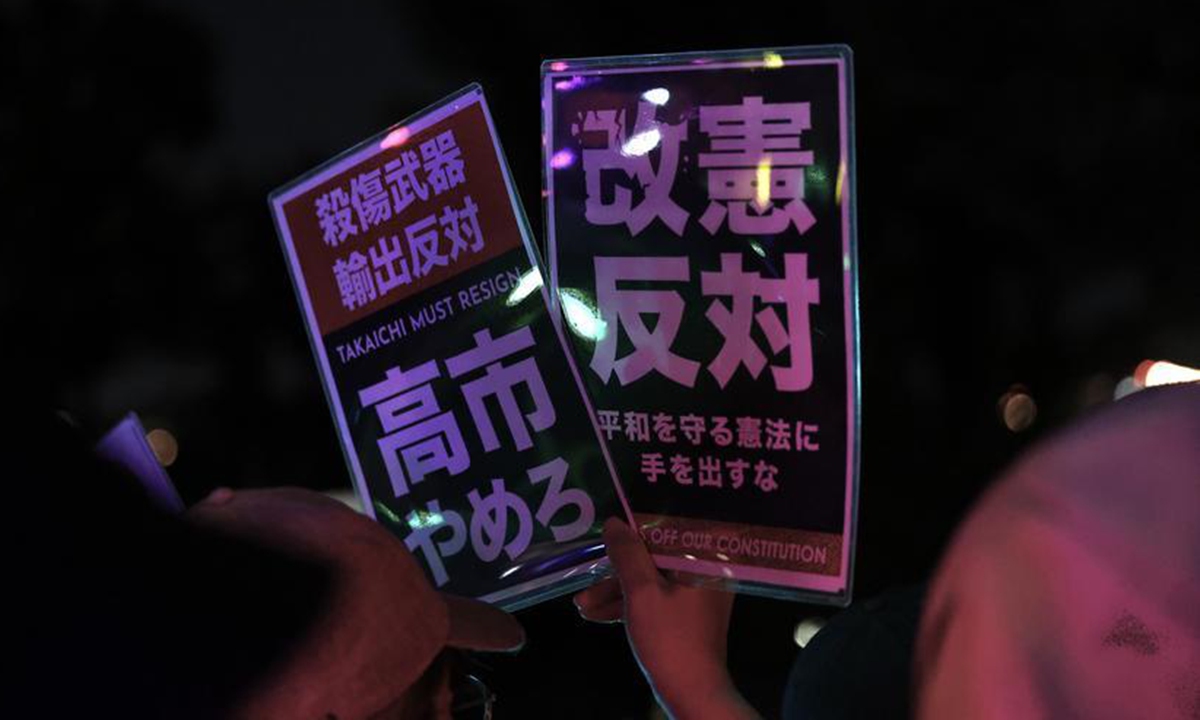
People holding signs attend a protest rally in front of the National Diet Building in Tokyo, Japan, on July 10, 2026. Photo: Xinhua
As the 81st anniversary of atomic bombing on the western city of Hiroshima approaches, domestic rifts in Japan over nuclear policy and defense strategies keep deepening, while the rightward tilt of the Prime Minister Sanae Takaichi administration has triggered widespread concerns across all sectors of society. For example, ahead of the planned year-end revision of Japan's three key national security documents, a record 128 local assemblies across 36 prefectures have submitted opinion papers calling for the country to uphold its Three Non-Nuclear Principles. These submissions were made between the inauguration of Takaichi's cabinet on October 21 last year and July 28 this year, as concerns mount that Takaichi could review the policy, media reported on Wednesday.
Public sentiment rooted in Japan's past experience shows no fundamental shift in opposition to nuclear possession, yet a Chinese expert warned Japanese right-wing forces are gradually testing the waters to relax its Three Non-Nuclear Principles, with dismantling the ban on not permitting the introduction of nuclear weapons into its territory.
Since the inauguration of the Takaichi administration, the number of local assemblies in Japan submitting opinion statements to the National Diet calling for upholding the country's Three Non-Nuclear Principles has increased sharply, according to Japanese newspaper Tokyo Shimbun on Wednesday.
According to the Secretariat of the House of Councillors, between October 21, 2025, when the administration took office, and July 28 this year, at least 128 local assemblies across 36 prefectures have submitted statements. This is the highest number recorded under any administration since the Diet began accepting such opinion statements from local assemblies in July 2000, the report said.
A report by Japanese media outlet The Mainichi reported on June 6 that opinion papers calling for the continued adherence to the principles had been submitted by at least 73 local assemblies across 24 prefectures since Takaichi took office.
The prefectural assembly of Nagasaki has already urged the Japanese government in a written opinion to adhere to the country's non-nuclear principles, and it stressed that the non-nuclear principles form the foundation of regional stability and should continue to be strictly upheld, the Xinhua News Agency reported in July, citing Kyodo News.
In December last year, the Hiroshima prefectural assembly, representing the other city that suffered an atomic bombing, likewise adopted a similar written opinion calling on the government to adhere to the non-nuclear principles, per Xinhua.
By comparison, no such opinions were registered under the administrations of Shigeru Ishiba and Yoshihide Suga, and only three were submitted during Fumio Kishida's tenure. The number under Takaichi, however, stands out conspicuously among recent administrations led by the Liberal Democratic Party, Tokyo Shimbun reported.
Lian Degui, director of the Center for Japanese Studies at Shanghai International Studies University, told the Global Times on Wednesday that the Japanese government appears to be gradually testing the waters for a possible relaxation of the country's Three Non-Nuclear Principles.
The country's Defense Minister Shinjiro Koizumi previously suggested that Japan needs to promote discussions on future national security policies, including nuclear deterrence, amid the severe security environment, The Japan Times reported on July 23. "I think this is only natural," he said.
Lian said that certain politicians in Japan are showing a growing tendency to take a phased approach to nuclear-related issues. Concerned that the US-Japan alliance may become a less effective deterrent and leave Japan's security less assured, some politicians advocate first relaxing restrictions on the introduction of nuclear weapons into Japan, with the longer-term possibility of debating whether the country should possess its own nuclear deterrent, the expert added.
Despite recent provocative claims from within the government, mainstream public opinion in Japan, some political parties and many local assemblies remain opposed to Japan possessing nuclear weapons. Public sentiment shaped by the country's experience as the only nation to have suffered atomic bombings has not fundamentally changed, Lian continued.
Even so, nuclear issues are now being discussed more openly in Japan than in the past, with some right-wing and militarist elements arguing that changing security environment justifies revisiting a debate that was once largely off limits, the expert said. Such growing willingness to raise the issue still marks a notable development that warrants close attention.
RELATED ARTICLES