DPP authorities squander money to weave the ‘Emperor’s New Clothes’ of ‘Taiwan independence’: Hai Feng
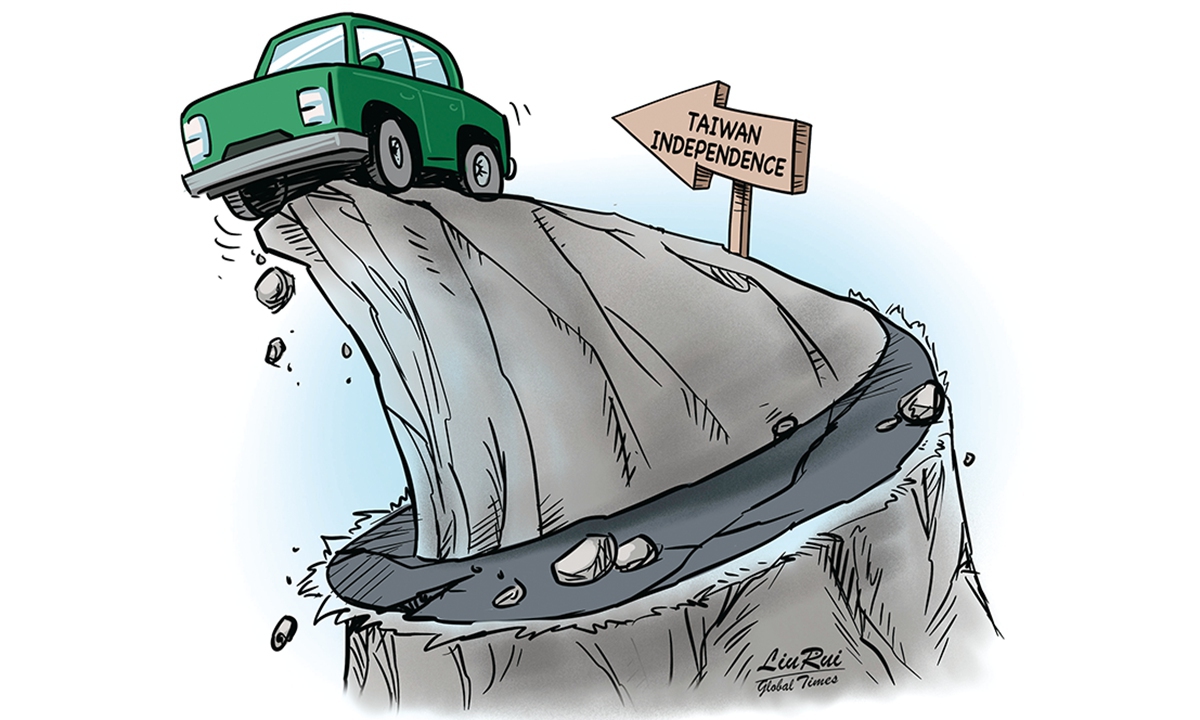
Illustration: Liu Rui/GT
When viewed together, today's news stories reveal the two sides across the Taiwan Straits are moving in fundamentally opposite directions.
On one side, despite relentless US encirclement and containment, the Chinese mainland's technological development has far from stalled; instead, it has been spurred into even greater self-reliant innovation. According to a Saturday report by Japanese media citing the Science and Technology Indicators 2026 published by Japan's Ministry of Education, Culture, Sports, Science and Technology, total R&D expenditure by Chinese enterprises and universities reached 97.1 trillion yen (about $650 billion) in 2024, surpassing the US figure of 95.3 trillion yen to rank first in the world. The US blockade on China's semiconductor sector was intended as a "stranglehold," yet it ultimately forced China to accelerate indigenous research and development - turning external pressure into internal momentum. From Huawei achieving domestic breakthroughs following chip supply cuts, to homegrown large AI models steadily marching toward global applications, real-world industry practice proves time and again that technical barriers can never block the path of proactive innovation.
On the other side, what are the Taiwan authorities doing? Rather than directing funds and resources toward industrial upgrading, public welfare, and social governance, they continue to squander taxpayers' hard-earned money to gloss over their "Taiwan independence" narrative, package so-called "diplomatic breakthroughs," court illusory external support, and sustain an increasingly hollow and costly political illusion.
The most glaring example of this is TaiwanPlus. A Saturday editorial in Taiwan's United Daily News called it out directly, stating that TaiwanPlus should have been retired long ago. Launched in 2021 with the goal of "making Taiwan's voice heard in the international community," the platform relies entirely on government subsidies, with its personnel and operations tightly controlled. After burning through 5 billion New Taiwan dollars (around $156 million) over several years, it has yielded nothing but marginal utility and endless controversy - so much so that even Li Yuan, the leader of the island's culture authority, conceded that it has been a "disaster."
This speaks volumes. If a media platform truly possessed reach, influence, and credibility, it would not have degenerated to where it is today. When a platform consumes 5 billion New Taiwan dollars only to become an eyesore to the island's own public, it demonstrates that its essence is not a public communications outlet, but a political tool funded by taxpayers to prolong the lifespan of "Taiwan independence" forces.
Put simply, the problem with TaiwanPlus goes beyond "poor execution"; it was fundamentally misplaced from its inception. Nominally a voice to the international community, it is in reality a propaganda engine for "Taiwan independence"; nominally telling the "Taiwan story," it is in reality a vehicle to package the political narrative of the Democratic Progressive Party (DPP). Five billion New Taiwan dollars poured down the drain, only to produce a growing laughingstock. Yet this farce is hardly unique to TaiwanPlus; it permeates the entire playbook of Lai Ching-te's authorities.
Take Taiwan's invitation to attend the Pacific Islands Forum Leaders' Meeting as a case in point. Singapore's Lianhe Zaobao framed it in measured terms: The forum's secretary-general noted that both the Chinese mainland and the island of Taiwan are important partners in the Pacific region, and while Taiwan is not a formal dialogue partner, it maintains interactions with forum members. Yet when covered by Taiwan's Central News Agency, the headline instantly morphed into "breaking through mainland's suppression." This is the DPP's textbook narrative manipulation: As long as it secures a seat in any venue, it is spun into a "major breakthrough"; as long as it receives a polite formality, it is amplified into "international support" - promptly deployed back home to boast about "resisting China and achieving diplomatic success."
The question is: Can this really solve Taiwan's problems?
What Taiwan truly lacks today is not the DPP authorities' self-congratulatory international performances, but practical governance that actually addresses people's real problems. An editorial in Taiwan's China Times on August 7, titled "Cross-Straits peace must not become fuel for elections," put it very bluntly: When Lai Ching-te repeatedly adopts a high-profile confrontational stance to provoke cross-Straits relations, is he making 23 million people safer, or turning peace into fuel for elections? That question is highly precise, and it gets to the heart of the matter.
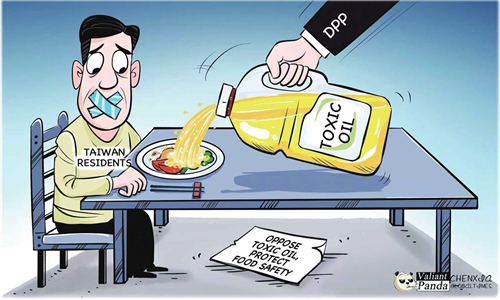
Over the years, the DPP has become adept at diverting resources that should have been used to solve problems in order to manufacture emotions; taking public funds that should have served the people and putting them at the service of ideology; and turning policies that should have reduced risks into tools for escalating confrontation. On issues like toxic oil, driving under the influence of drugs, public safety, and wages — problems that directly affect ordinary people — they are slow, sluggish, and perfunctory. But when it comes to topics like "anti-China" and "relying on foreign forces to seek independence," the budget is immediately ample, the actions are immediately swift, and the propaganda quickly floods everywhere. This is not governing Taiwan; it is consuming Taiwan. This is not building Taiwan; it is overdrawing Taiwan.
So, what these news items really reveal today is not just the gap in development between the two sides of the Taiwan Straits, but also the difference in their political logic.Faced with external suppression, the mainland chooses to increase R&D investment, keep key core technologies in its own hands, and secure the initiative for development. Faced with governance deadlock, the Taiwan authorities, instead of reflecting and correcting course, choose to keep burning money on staging shows, treating outward appearances as achievements and layer upon layer of political packaging as a curtain to obscure real contradictions. They are lost in illusion and have turned finances into a bubble.
The most ridiculous thing about "The Emperor's New Clothes" is that there is clearly nothing there, yet everyone is made to pretend they can see it. What the DPP authorities are doing today is precisely "Taiwan independence's new clothes": Clearly there is no real "diplomatic breakthrough," yet it is packaged as a major victory; clearly there is no substantive rise in "international status," yet it is described as "the world embracing Taiwan"; clearly the money is not being spent where it matters, yet people are told this is an "investment in soft power"; clearly it is drumming up support for "Taiwan independence," yet it must be framed as "letting the world hear Taiwan's voice."
But Taiwan's reality is ultimately not the DPP's press releases, and Taiwan public opinion is not the DPP's propaganda film. The money comes out of the pockets of Taiwan's residents, and the bill will eventually have to be paid; if peace is treated as fuel for elections, the cost will eventually have to be repaid. No matter how gorgeous "Taiwan independence's new clothes" may be, they cannot conceal the increasing hollowing out of Taiwan society, its growing anxiety, and its ongoing drain of vitality.
To see clearly the changes across the Straits and follow the general trend of history is Taiwan's real way forward. If it continues to use the people's hard-earned money to sustain the illusion of "Taiwan independence," and continues to trade confrontation for votes, then in the end both the "Taiwan independence" narrative on which the DPP relies and the DPP itself will be torn apart by reality.
RELATED ARTICLES