From wind turbines to naval drones: UK media’s persistent ‘China threat’ narrative hype risks eroding mutual trust, expert warns
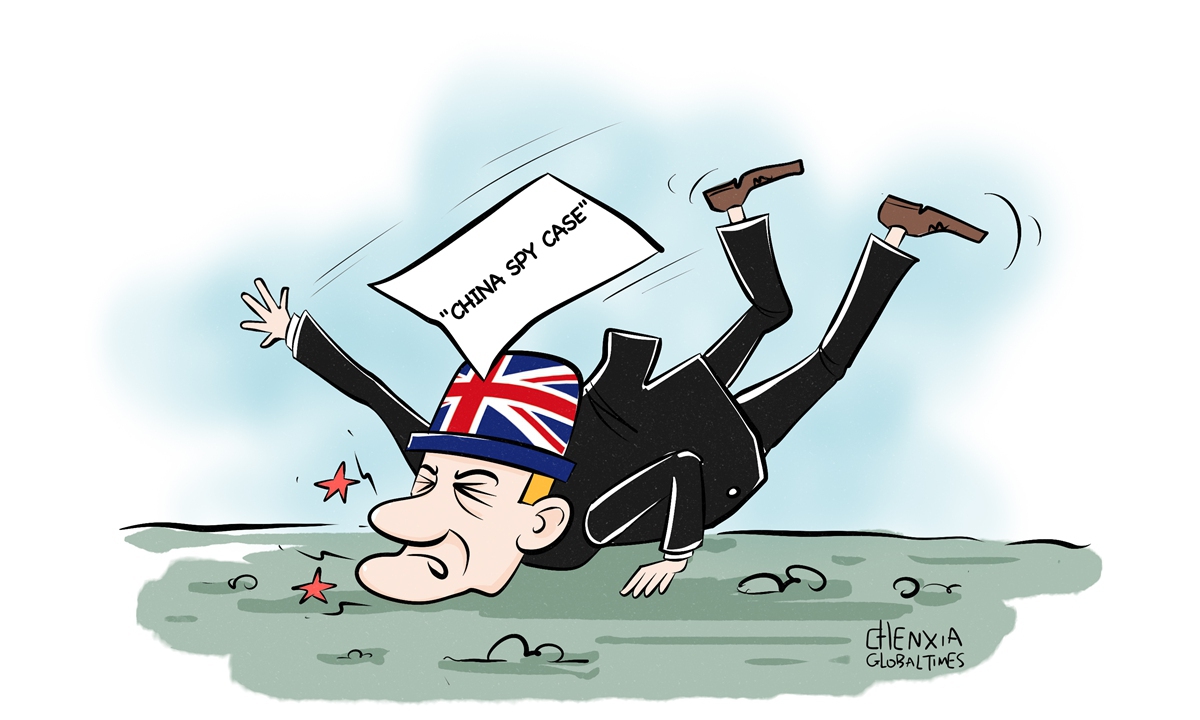
Illustration: Chen Xia/GT
Recent reports from the Telegraph - that a Chinese wind turbine maker previously barred from the UK under national security pretext is seeking to overturn the decision, and that components in Royal Navy drones allegedly transmitted data to China - represent another episode in which some British media and some politicians have amplified the "China threat" narrative. Chinese experts said some British institutions are projecting their own practices onto China and making unsubstantiated claims about the security risks of Chinese equipment, while political pressures, defense priorities and efforts to preserve Britain's strategic relevance are also shaping the debate. They warn that sustained negative rhetoric could gradually erode mutual trust and complicate UK-China relations.
In March, the Labour banned the Chinese wind turbine maker Ming Yang over so-called "national security concerns," thwarting the company's plans to build a factory in the Scottish Highlands. The company is now attempting to persuade the British government to review that position after Andy Burnham's arrival in No 10 and the appointment of Miatta Fahnbulleh as the new Energy Secretary, according to the Telegraph.
The Telegraph report also cited Aman Wang, Ming Yang's UK head, as saying that "the company's proposed factory could create 1,500 direct jobs, with up to 8,000 more in the supply chain." He added: "We are committed to supporting the growth in every postcode that this government wants to see, to re-industrialisation and to lowering energy bills."
The report claimed the wording appeared to be a direct appeal to Prime Minister Andy Burnham, who pledged to deliver "growth in every postcode" in his first major policy speech after taking office. The report also claimed that the company's potential entry into the UK market triggered "alarm bells", with officials from the Ministry of Defense reportedly fretting that it "would create opportunities for spying."
When asked to comment on UK's moves to block plans by Ming Yang Smart Energy to build a wind turbine factory in Scotland on national security grounds, Chinese Foreign Ministry spokesperson Lin Jian said during a press conference on March 26 that China-UK economic, trade and green cooperation is in nature mutually beneficial. Such cooperation should not be viewed as political and security issues.
"It is hoped that the UK will provide a fair, just and non-discriminatory business and investment environment for companies of all countries, including Chinese companies," the spokesperson added.
Ming Yang had not responded to a request for comment from the Global Times as of press time on Monday.
Founded in 1993 and headquartered in Zhongshan, China, Ming Yang Smart Energy is a leading global wind turbine manufacturer and clean energy provider, according to the company's website. The Telegraph previously reported that the company had unveiled plans to build a factory in Scotland to manufacture wind turbine blades for the UK and European markets.
Ming Yang's push for eased restrictions under the new government is a legitimate commercial move. However, certain Conservative-leaning media outlets have used the case to amplify the "China threat" narrative. The case also highlights concerns that the UK has increasingly resorted to so-called national security reviews to restrict Chinese companies and supply chains, Li Guanjie, a research fellow with the Shanghai Academy of Global Governance and Area Studies under the Shanghai International Studies University, told the Global Times.
Prolonged reviews, limited disclosure and the absence of formal rulings can leave firms in regulatory limbo, increasing costs and effectively pushing them out of the market without an explicit ban, said Li.
Also on Sunday, another report from the Telegraph claimed that the cameras on the K3 Scout surveillance drones of the Royal Navy had components made in China which "were secretly transmitting information to a device in the country." The Royal Marines have been using the £12m fleet since March and the Ministry of Defence (MoD) was forced to remove all internet connectivity from the cameras after discovering the breach.
British media coverage of Chinese-made camera components carries distinct Cold War overtones, said Zhang Junshe, a Chinese military affairs expert. He noted that US and UK intelligence agencies have faced allegations of exploiting technical vulnerabilities for intelligence-gathering purposes.
Against this backdrop, Zhang said some Western governments and media are projecting their own historical practices onto China, presuming without evidence that Chinese companies or equipment pose similar risks and repeatedly portraying Chinese technology as a security threat.
Li said some British politicians and government departments may play up national security concerns to bolster the case for higher defense spending, with narrative of China-related threats offering an especially effective way to attract public attention and justify larger budgets.
He added that Burnham is likely to retain the former Starmer administration's framework of "cooperate, compete and challenge" until the next general election amid Britain's constrained national capacity, narrower global ambitions and growing diplomatic focus on Europe. However, continued hyping of China-related security risks may further fuel negative perceptions of China among the British public and business community.
RELATED ARTICLES