Israel’s public rejection of US-led 15-point Gaza peace plan lays bare conflicting priorities, widening alliance rift: experts
By Published: Aug 10, 2026 09:46 PM

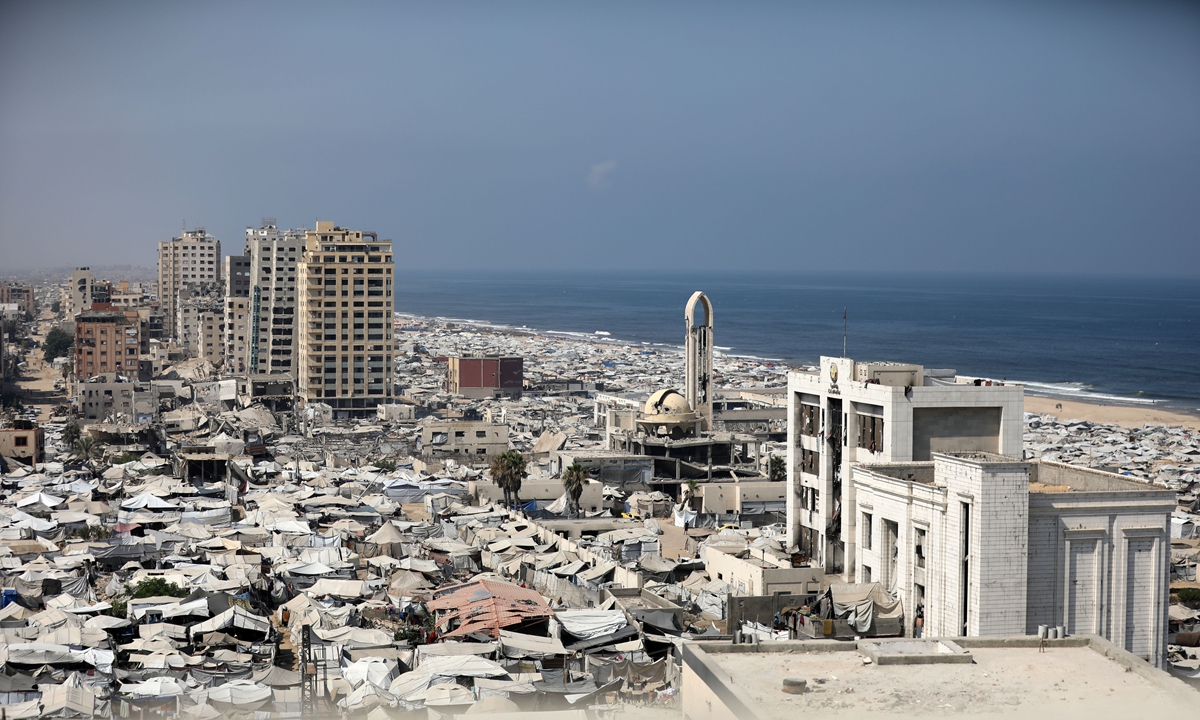
Displacement tents crowd Gaza City coast amid widespread destruction. A general view shows tents sheltering displaced Palestinians crowded along the coast of Gaza City and among buildings damaged during the war, on August 10, 2026. Families have sought refuge in makeshift shelters after their homes were destroyed, amid difficult living and humanitarian conditions. Photo: VCG
As the conflict between the US‑Israel and Iran drags on, divisions between the two allies on another Middle Eastern front have drawn growing global attention. Multiple media outlets have reported that Israeli Prime Minister Benjamin Netanyahu announced on Sunday that Israel rejects a 15-point Gaza peace roadmap plan presented by the US-led self-styled "Board of Peace."Although a senior US official reportedly said the White House "is not bothered" by Israeli's statement and sees it as part of the election season in Israel, analysts pointed out that Netanyahu's public rejection laid bare conflicting priorities between the US and Israel, casting uncertainty over the prospect of the US‑led peace initiative. Against the backdrop of rising tensions and growing complexity in the Middle East, the US has to strike a difficult balance between maintaining its fundamental support for an ally increasingly acting as a trouble‑maker and avoiding being dragged deeper into a further quagmire in multiple fronts.
Interest‑driven cracks
According to the Times of Israel, during a weekly cabinet meeting on Sunday, Netanyahu pushed back against claims the country has accepted the US-backed proposal.
He said Israel is still in talks with the US about the roadmap. "They have ideas. Some of them are acceptable to us and some are unacceptable to us, and we know how to stand up to these things," the media outlet reported.
Netanyahu also said that while he values US President Donald Trump, he is "unafraid to push back" against him when circumstances necessitate it, the report said.
There was no immediate response from the White House. Citing a senior US official, Axios reporter Barak Ravid said in an X post on Monday that the White House "is not bothered" by Netanyahu's statement and sees it as part of the election season in Israel.
Citing another US official, Ravid's post also noted that last week, Netanyahu spoke on the phone with President Trump's envoy Jared Kushner and promised to give the 15-point plan a chance despite his skepticism and curb attacks on Gaza so that the process of the demilitarization of Gaza can begin.
For former top Fatah official Mohammed Dahlan Nethan, who has served as a key go-between in negotiations involving the Palestinians, Netanyahu's words were a "challenge, disdain, and deception toward the American administration and President Donald Trump's team," the Times of Israel reported.
Regarding the latest development, an Al Jazeera reporter said that Netanyahu is playing a "very dangerous game" with Trump.
Zhu Yongbiao, a Middle East affairs expert with Lanzhou University, told the Global Times on Monday that the latest incident reflected the interest‑driven rifts between the US and Israel, as well as Washington's ongoing predicament in Middle East affairs.
Washington needs to deliver a peace proposal to the international community to soothe the Arab world and defuse public pressure, which makes it a top priority at present to contain the intensity of conflicts in the Middle East and avoid being dragged into deeper hostilities by Israel, said Zhu.
Although Washington's frustration with Israel acting as a "trouble‑maker" has been growing, constrained by its domestic election cycle and deep‑seated ties with the country, the US cannot afford to press Israel too hard, said Zhu. "Hence its approach might be to publicly downplay Netanyahu's outright rejection while continuing private diplomatic outreach toward Israel."
For Netanyahu's government, electoral pressures rule out any show of weakness. It also seeks to resolve its "security concerns" through the Gaza conflict and is even prepared to ratchet up pressure to force concessions from the US, which has given rise to substantial bilateral divergences, according to Zhu.
CNN pointed to Israel's general election, which is less than 12 weeks away, saying that Netanyahu would "need his far-right allies to join him if he has any chance of remaining in charge."
According to CNBC, Israel's far-right Finance Minister Bezalel Smotrich praised Netanyahu afterward, saying that Israel "went to war with a central goal: the destruction of Hamas… The (military) cannot withdraw even a millimeter from the Gaza Strip."
"Open divisions between the two allies create strategic friction," said Zhu, adding that Washington may have to divert diplomatic resources to manage these rifts, which risks eroding the effectiveness of joint US‑Israel pressure on Iran, another frontline faced by the US.
Against the backdrop of rising tensions and growing complexity in the Middle East, the US has to strike a difficult balance between maintaining its fundamental support for Israel and pushing for de‑escalation in Gaza, Wang Jin, an associate professor at the Institute of Middle Eastern Studies at Northwest University in Xi'an, told the Global Times.
Deadlock unresolved
The 15-point peace plan rejected by Netanyahu was drafted in May by Nickolay Mladenov, "high representative for Gaza" of the "Board of Peace," and officially announced by Trump in late July, who claimed back then the board had reached an agreement on the "complete disarmament" of Hamas and other armed groups in Gaza.
A day after Trump's announcement, Hamas said it had agreed to the "latest version of the roadmap" for the second phase of the Gaza ceasefire agreement after "fierce" negotiations, but conditioned weaponry arrangements on a complete halt to "aggression," Israeli withdrawal from the enclave, and progress on reconstruction.
The Israeli prime minister said on Sunday that Israeli forces will not carry out any withdrawal until Hamas is disarmed. "And when I say Hamas must be disarmed, I mean the heavy weapons, the less-heavy weapons, all weapons. And we are talking about genuine disarmament, not a fictitious one," Netanyahu said, per the Times of Israel.
Hamas's response to Netanyahu's remarks was sober. Basem Naim, a senior Hamas official, told Reuters on Sunday that the group remained committed to the roadmap agreed in Cairo 10 days ago. He said Hamas expects the mediators and the US guarantor "to press Netanyahu and his government to adhere to the roadmap and not obstruct the process for internal political and electoral reasons."
The 15‑point plan itself faces inherent flaws, as it was largely externally drafted without full‑fledged participation of Palestinian stakeholders and lacks solid anchoring in the UN‑endorsed two‑state solution, analysts pointed out.
It is more of a political blueprint than a peace agreement ready for implementation, said Wang, "It cannot resolve in the short term a host of the most intractable issues, including internal power restructuring in Gaza, Hamas' disarmament, Israeli troop withdrawal, post‑war governance and security guarantees."
According to the expert, it may stall amid ongoing battlefield conflicts.
The "Board of Peace" and the 15-point plan are, for the US administration, a political initiative with potential political benefits but significant short-term implementation challenges, said Wang, "If the US fails to resolve the issues concerning Hamas's political and military status, or to convince Israel that its troop withdrawal will not bring new security threats, this initiative will easily fall into an impasse and be hard to move forward."
Israel's rejection of the plan once again demonstrates that externally‑devised peace roadmaps cannot work without genuine consensus among the conflicting parties, experts noted.
According to Al Jazeera, despite the cease-fire deal with Hamas last October, Israel has continued to carry out near-daily deadly attacks across the Gaza Strip, killing at least 1,258 people with 4,139 wounded and more than 800 bodies recovered from rubble.
The media outlet also reported that Israeli forces and settlers continue to launch near daily attacks across the occupied West Bank, to "court the settler vote" before Israel's general elections.
The overall death toll in Gaza since October 2023 is at least 73,386 and 174,250 wounded, Al Jazeera reported, citing data from Gaza's health authority.
China has stated its position on the Palestine-Israel issue on multiple occasions, and its stance has been consistent and clear. Chinese Foreign Ministry spokesperson Guo Jiakun stated on October 10, 2025 that China hopes that a comprehensive and permanent ceasefire in Gaza will be realized as early as possible, the humanitarian crisis will be effectively eased, and tensions in the region will be diffused.
China upholds the principle of "the Palestinians governing Palestine" and promotes the implementation of the two-State solution. We stand ready to work with the international community to make unremitting effort toward an early, full, just and lasting resolution of the Palestinian question and a peaceful and stable Middle East, Guo said.
RELATED ARTICLES