Illustration: Liu Xiangya/GT
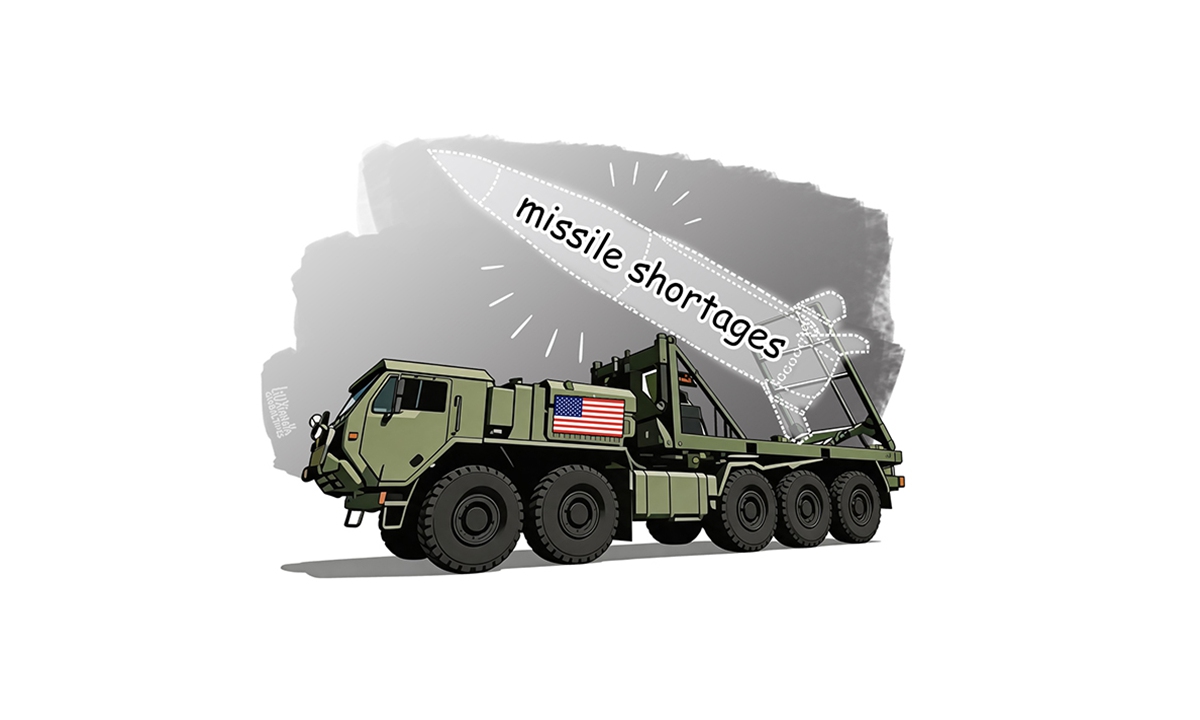
Politicians can change their talking points overnight. Missile stockpiles cannot. That reality is now impossible to ignore - the US is running critically low on weapons it has been firing at Iran.
Against that backdrop, US President Donald Trump's new line on Sunday hits differently - "We are low-keying it" with Iran. Not "the biggest attack since WWII." Not "last chance" for Tehran to forge a deal." Just "low-keying it." It is the first time the US has used this language since the war started on February 28.
Washington did not suddenly discover the virtue of restraint. The Pentagon's warehouses made the decision for the White House. A strategic pullback is not necessarily the result of long calculation. When the ammunition starts running low, the policy softens by itself.
On Sunday, CNN reported that "The Pentagon has asked the US defense industry to ramp up production as stockpiles run low during the Iran war." More reports over the past days have shown stark numbers. The global inventory of Patriot missiles had fallen from about 2,200 before the war to fewer than 827, while THAAD stocks dropped from 452 to less than 278. Long-range precision missiles, according to Reuters, are "virtually all" gone.
Under this pressure, the US military is reportedly letting some Iranian projectiles through its defenses amid diminishing munition supply. Halfway through the war, it is not the opponent's will that is breaking first - it is the US' own ammunition stocks.
Ramping up production sounds simple. It is not. It takes 24 months - from contract award to delivery - to create a Patriot missile. Tomahawks take about three years. These are products whose production one cannot suddenly ramp up by converting a civilian production line for a few weeks. Critical materials, engines, electronics, and certification all take time.
Behind the shortages lies a deeper problem: an industrial base showing clear signs of strain.
In mid-July, a video circulated of a US Navy Arleigh Burke-class destroyer firing its main gun - only for the barrel to rupture and fly straight into the sea. And then there is the practice the US military calls "cannibalization" which is described as a vital practice in aircraft maintenance - a process of salvaging parts from one aircraft that already has a problem to revive a different aircraft. It is the aviation equivalent of a family that owns only a couple of pairs of pants - whoever has to leave the house that day gets to wear them.
These cases sketch a military machine that once prided itself on unmatched industrial mobilization - now slowed by fragile supply chains, aging equipment, and vanishing spare parts.
Then come the critical minerals. Rare earths and tungsten sit at the heart of almost every advanced weapons system. The US is now trying to recover tungsten from industrial waste and scrap. It recalls Japan's earlier scramble to extract rare earths from discarded air conditioners. When a superpower begins mining its own waste streams for strategic metals, supply-chain anxiety is no longer an abstract concern - it has become operational reality.
The ammunition shortage is only the surface. What is really running low is an empire's ability to keep overdrawing its military strength.
For a long time, the US has projected power across multiple theaters. It is now learning the hard way that military strength is a strategic reserve to be conserved and accumulated - not a resource that can be drawn down without limit.
A growing number of assessments now point to the possible risk: The US is locked in two wars of attrition it may be losing - against Russia in Ukraine and against Iran in the Middle East. Some observers even say the war against Iran may be remembered as one of the more costly strategic episodes in recent US military history, with consequences that surpass that of the Iraq War.
The lesson is clear. The greatest threat to hegemony has never been a rival power. It is the quiet habit of spending down your own strength until little remains.
RELATED ARTICLES