Foreign automakers’ market share shrinks in China – why are they doubling down on the country?: Global Times editorial
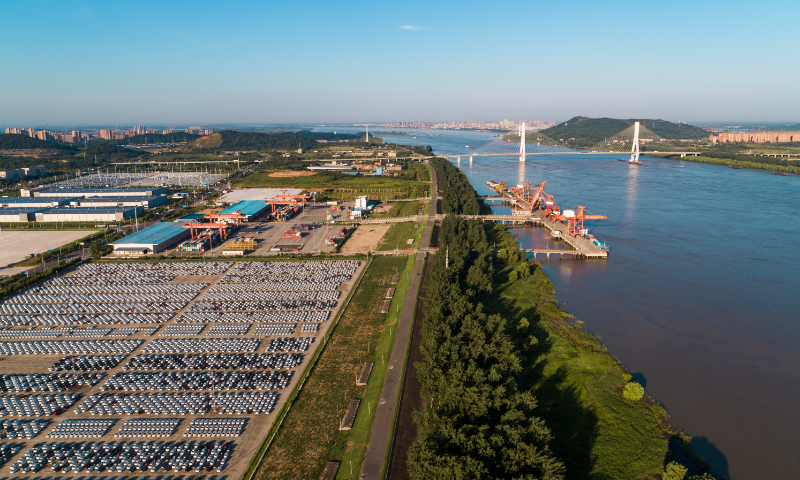
Newly produced vehicles fill a parking lot at a SAIC-GM industrial park in Wuhan, Central China's Hubei Province on July 10, 2022. Photo: VCG
With the rapid rise of Chinese automakers and the trend of "China redefining the automobile," the question of whether foreign automakers will stay in or leave the Chinese market has been the focus of intense international attention for some time. Some foreign media outlets have claimed that international automakers are "moving away from the Chinese market," while alarmist voices even go so far as to declare that global car brands have "reached the end of the road in China." The "evidence" cited to support these claims primarily consists of the simultaneous decline in market share and profits among some long-established Western multinational automakers in China.
On the surface, this logic seems plausible, but the reality does not support such a conclusion. On August 5, SAIC Motor and General Motors (GM) signed a joint venture renewal agreement, extending the term of SAIC-GM for another 20 years through 2047. In fact, multinational automakers are collectively "doubling down" on the Chinese market and strengthening their partnerships with Chinese companies. In July of this year, GAC and Honda renewed their agreement, extending their partnership through 2038; SAIC Group and the Volkswagen Group completed their second renewal, extending the joint venture term to 2040; BMW announced an additional 20 billion yuan ($2.76 billion) investment in China, while Volkswagen builds its largest overseas R&D center in Hefei. Clearly, the supposed causal chain - mounting competition, falling market share and shrinking profits, followed by a foreign brand exodus - simply does not hold up to reality.
It is true that foreign automakers are grappling with fierce competition, sliding market share and shrinking profits in China. In 2020, joint-venture and foreign brands accounted for 61.6 percent of China's passenger vehicle market; by June 2026, that share had fallen to 24.5 percent, effectively halving.
Japan's top three automakers have fared particularly poorly: Honda has posted negative growth for 29 consecutive months and reported its first annual loss since going public in 1957; the overall market share of Japanese brands has fallen from 23.1 percent to less than 10 percent. Meanwhile, GM, which recently renewed its 20-year partnership with SAIC, sold 1.8 million vehicles in China in 2024 - less than half the peak volume it achieved in 2017. What, then, is driving these companies to deepen their cooperation in China instead of fleeing the market?
The answer is Chinese technology. To a certain extent, China's advanced technologies and concepts in the new energy vehicle sector are not only "redefining the automobile" but also "redefining the future." In this sense, whoever can take the lead in partnering with China - and learn from a range of innovative achievements, from the core three-electric (battery, motor, and electronic control) technology and intelligent driving systems to R&D models - is likely to gain a competitive edge in the next phase of the race. In other words, despite the current pressure of shrinking market share, cooperation with China offers the potential to unlock greater opportunities and access additional markets.
Take GM as another case in point. Reports indicate GM is giving its Chinese teams lead responsibility for product definition and the technical roadmap of several new models, particularly its new energy vehicles. What's more, technological breakthroughs pioneered in China are now being deployed back into GM's global vehicle lineup. This strategic shift alone answers all lingering questions.
This is not an isolated case. Data from the German Chamber of Commerce shows that the proportion of R&D conducted by German automakers in China rose from 12 percent to 33 percent over a two-year period. A new model developed by Audi in collaboration with SAIC took only 18 months from development to market launch, with a significant portion of its core capabilities - including batteries, electric drive systems, in-vehicle software, and driver-assistance systems - coming from Chinese partners. Renault has similarly upgraded its Chinese R&D center into a global hub for technology transfer. Whereas in the past, foreign automakers brought technology to China in exchange for market access, China has now become an important "engine of innovation" for traditional automakers. China's role has changed.
A remark by Hildegard Müller, president of the German Association of the Automotive Industry, is worth pondering: Cooperation and competition are like two sides of the same coin. The redistribution of market share is, in itself, the result of industrial upgrading and vigorous competition. It is the rapid rise of Chinese companies and the accelerated advancement of electrification and intelligent technologies that have not only brought pressure and challenges to established international automakers but have also shown them the direction for the future and the potential for collaboration.
It is no wonder that Volkswagen CEO Oliver Blume refers to China as "a fitness center for the automotive industry," because without China - the market with the most intense competition and the most vibrant source of innovation - companies risk falling further and further behind in the current industrial revolution.
Against the backdrop of a new round of technological revolution and industrial transformation, there are deeper reasons for China's appeal to multinational corporations.
Over the past few decades, China has not only built a comprehensive industrial system and cultivated a pool of innovative talent, but has also fostered an innovation ecosystem where rich application scenarios, efficient supply chains, and rapid technology validation capabilities mutually reinforce one another. At the same time, Chinese consumers' demand for digital and smart products provides companies with a "testing ground" to observe future industry trends and compete in cutting-edge innovation, while also driving them to continuously reduce costs and refine their products amid fierce competition before expanding globally.
Consequently, an increasing number of multinational corporations are relocating their R&D centers, innovation hubs, and even global product development operations to China. They're essentially choosing to align themselves with the pulse of Chinese innovation and capitalize on this wave of "innovation dividends" driven by China. The automotive industry is merely a microcosm of this trend.
Today, the attractiveness of the Chinese market to foreign investment can no longer be measured solely by sales volume and market share; it must also be assessed in terms of China's position within the global industrial innovation chain. The choices made by foreign automakers such as GM and Volkswagen show that companies will choose to invest where they are closest to the future of the industry.
This seemingly contradictory move to "double down against the trend" is, in fact, a vote of confidence cast by these long-established giants in the future development of China's industries - and a ticket they have secured for themselves to participate in the next round of industrial transformation.
RELATED ARTICLES