Whom do 41 countries think they are scaring? China's missile tests don't need permission: Global Times editorial
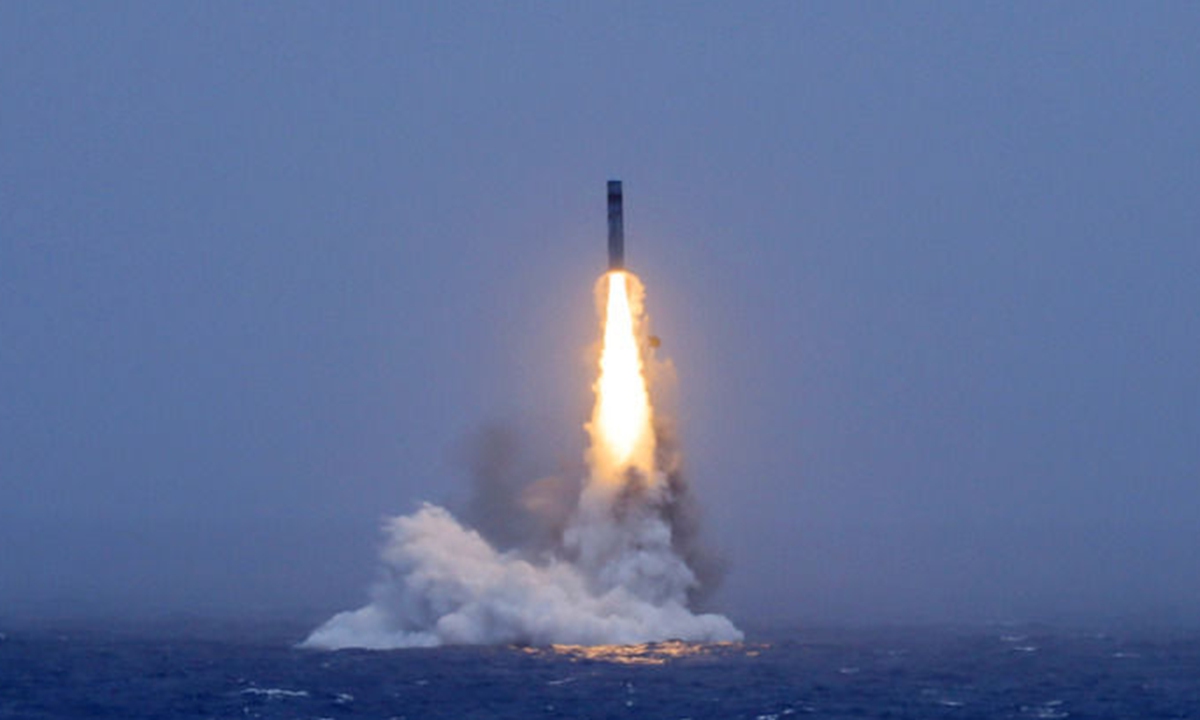
The Chinese People's Liberation Army (PLA) Navy successfully conducted the test launch of a strategic missile by a submarine on July 6, 2026. Photo: Xinhua
What Washington truly seeks is by no means "reducing miscalculations," but rather to keep China's nuclear forces firmly under its control. Some analysts believe this is an attempt to probe military secrets regarding China's nuclear weapons development by extending the "notification period." Guided by its own defensive nuclear strategy, China needs no one's "permission slip."Yet another political farce of "a thief crying 'stop thief'" has taken the stage. On Tuesday local time, the US rallied 40 countries to concoct a so-called joint statement on "notifications of ballistic missile launches" targeting China as well as a separate statement. Pointing directly at China's lawful ballistic missile test conducted over the open waters of the Pacific Ocean last month, the statement claimed that China's actions were "incompatible with the responsibilities" and "undermined global stability and security." Meanwhile, in stark contrast, the document painted the US - the country with the highest military spending and the most wars waged in the world - as a "positive role model," touting its "military transparency" to explain why "the US approach to its missile testing and space launch activity does not generate the concerns that China's approach has."
It seems those in Washington who drafted this "statement" were well aware that the US itself conducts intercontinental ballistic missile tests more frequently than any other country. Why else would they seize the opportunity of fabricating this bogus declaration to whitewash the US' own record? While the statement claims 41 signatories, it had only a single author: Washington. Furthermore, these 41 countries represent barely one-fifth of the UN's 193 member states and roughly 17 percent of the global population. Most of them neither test ballistic missiles nor are affected by China's launches; they were brought in simply to act as rubber-stamp extras. This is entirely a ragtag assembly staged by the US.
The statement relies heavily on the Hague Code of Conduct against Ballistic Missile Proliferation (HCOC), accusing China of failing to provide advance warnings according to "standard practices." Yet China is not a party to the HCOC. Moreover, the HCOC is a voluntary political document, not a legally binding international treaty. In practice, even among its signatories, there are numerous instances of failing to fully implement its notification clauses. Acting out of a responsible attitude, China took prudent and reasonable measures by issuing advance diplomatic notifications to relevant parties, including the US. These were goodwill gestures aimed precisely at ensuring that the test would not harm the interests of any country.
When it comes to launch notification mechanisms, there is simply no "universal standard" observed by most nations. The "high-standard notifications" that Washington self-righteously boasts about are primarily bilateral arrangements between the US and Russia, designed solely to serve the two countries' strategic stability rather than universal notifications for all affected countries. In 2015, when the US Navy conducted a test launch of a Trident missile from a ballistic submarine off the coast of Southern California, vague advance notifications triggered widespread panic and speculation both domestically and internationally. We must not forget the South Pacific has long been viewed by the US as a dumping ground for nuclear tests. To this day, the Marshall Islands government continues to demand compensation and a comprehensive cleanup of nuclear contamination from the US government, yet Washington refuses to give them the time of day.
Whether through coercion or inducement, the US has gone to great lengths to rope in some 40 countries to play along with it, all for a single purpose: to do everything in its power to portray China's exercise of its legitimate sovereign rights as "illegitimate" and "irresponsible," in an attempt to disrupt the development of China's nuclear capabilities. Behind this lies not only the US' hegemonic mindset of self-proclaimed "security guarantor in the Western Pacific," but also anxiety over its relative military decline.
The US' own "nuclear triad" strategic force structure is aging. The Minuteman III missiles have been in service for over 50 years, beyond their intended lifespan. Its follow‑on Sentinel program faces an 80 percent cost overrun, and its planned entry into service in 2029 has been delayed. At sea, the Ohio-class submarines are gradually being phased out, while the commissioning of the lead Columbia-class submarine has been pushed to around 2031. In the air, the B-21 program is so costly that large-scale deployment is out of reach.
As China's ability to deter external interference and maintain regional peace and stability continues to grow and the US' industrial capacity steadily declines, it is hardly surprising that Washington is seeking to assert its presence by nitpicking over the "word count" of China's test launch notifications.
When a sovereign state conducts lawful military tests on its own territory or on the high seas, it is exercising its legitimate sovereign rights. Li Chijiang, China's Ambassador for Disarmament Affairs, has already made this point clear in Geneva: China has conducted only three intercontinental ballistic missile tests to date, the fewest among the five nuclear-weapon states; the US, which conducts the most frequent tests, is the most eager to renege on treaties and withdraw from international bodies, the most aggressive in promoting nuclear sharing and extended deterrence, and has no grounds to criticize China's voluntary advance notification.
The US refuses to heed this because what Washington truly seeks is by no means "reducing miscalculations," but rather to keep China's nuclear forces firmly under its control. Some analysts believe this "statement" is an attempt to probe military secrets regarding China's nuclear weapons development by extending the "notification period." Guided by its own defensive nuclear strategy, China needs no one's "permission slip."
This "statement" by 41 countries is nothing more than a worthless piece of paper; double standards, hypocrisy and fear are its three core elements. If the US truly cares about strategic stability, it might as well start by laying out its own "Sentinel" missile development timeline, archiving years of original pre-launch notifications under its "norms," and disclosing records of test-launch notifications to Latin American and Pacific Island Countries.
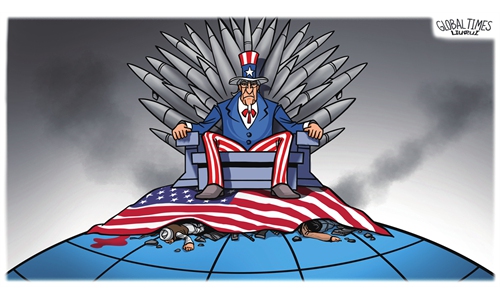
It is not the majority of the international community that fears Chinese missiles, but rather the hegemonic powers bent on interfering in and dominating the region. For a long time, the US has been the world's greatest source of turmoil, and this "statement" serves no other purpose than to drive that point home once again.
RELATED ARTICLES