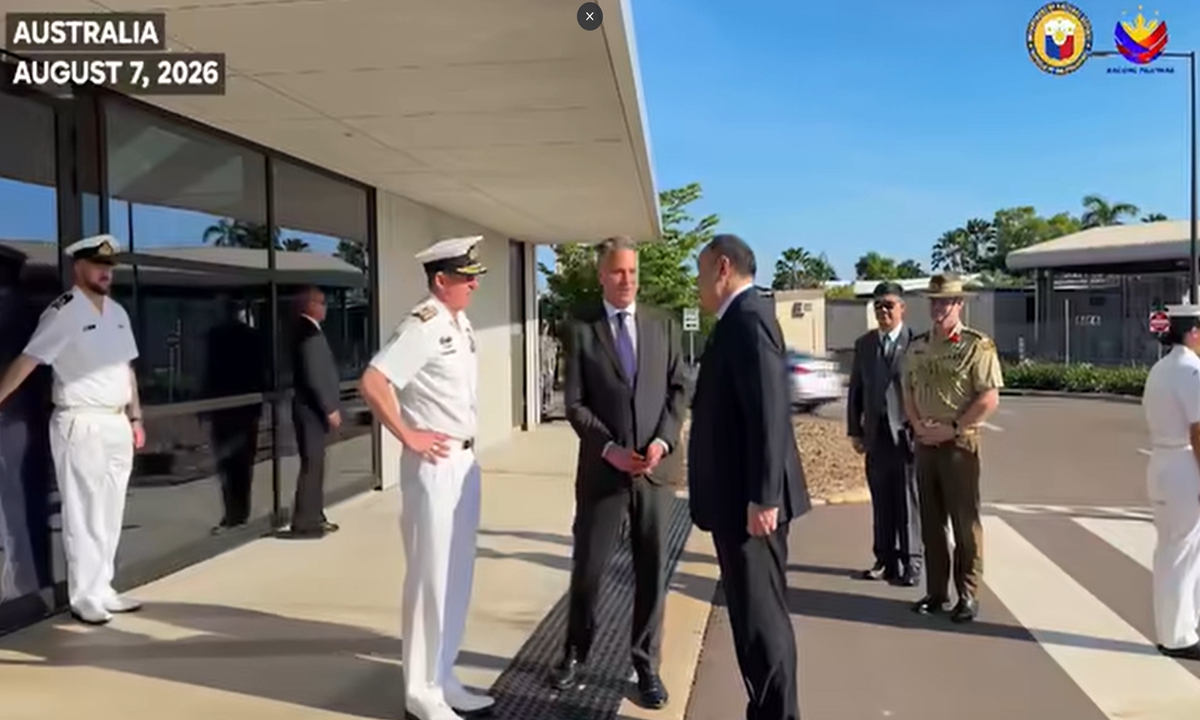
Screen shot: Philippine Secretary of National Defense Gilberto C. Teodoro Jr. and Australian Deputy Prime Minister and Minister for Defence Richard Marles met for the 3rd Philippines-Australia Defense Ministers' Meeting in Darwin, Northern Territory, Australia, on August 7, 2026. Photo: Philippine Department of National Defense
The joint statement issued by Australia and the Philippines in Darwin on Friday may appear to be a bilateral defense document, but in substance, it is a templated narrative of "threat convergence" that bundles together five issues: the South China Sea, the Taiwan question, Ukraine, the Middle East and the Korean Peninsula. Such a patchwork statement is hardly an original creation of Manila and Canberra; rather, it follows a standard template within the US alliance system since 2022. The Japan-Australia 2+2 Foreign and Defense Ministerial Consultations and the trilateral statements issued by the US, Japan and the Philippines essentially follow the same playbook. Their purpose is not to resolve any specific security issue but to repeatedly project an image of unity among the "values-based camp" to the international community. Yet the more issues are crammed into the same template, the more glaringly absurd the patchwork becomes.
The most obvious problem is the statement's structural flaws, which expose the unequal distribution of influence in its drafting. The section on the South China Sea and Ren'ai Jiao, complete with specific dates, locations and details of injuries, clearly bears the imprint of the Philippine side. By contrast, the sections on the Taiwan Straits, the Middle East and Ukraine are highly formulaic, giving the impression that Australia has used the Philippines' voice to insert its own global agenda.
Most noteworthy is the fact that it is the first time that the Australia-Philippines Defense Ministers' Joint Statement addresses the Taiwan Straits, while using the word "reaffirmed." A review of the two previous joint statements of the Defense Ministers' Meeting between Australia and the Philippines in 2024 and 2025 shows that neither made any mention of the Taiwan Straits. It is logically impossible to "reaffirm" a position that had never appeared in the bilateral documents in the first place, unless the two sides acknowledge that this language was not the product of negotiations based on their respective diplomatic positions, but rather a template borrowed from the US-led alliance discourse framework.
The Philippines has long adhered to the one-China policy. Given its proximity to Taiwan and the presence of more than 100,000 Filipino workers there, Manila has historically exercised considerable restraint on the Taiwan question in bilateral documents.
The decision this time to proactively insert a position on the Taiwan Straits into a defense document objectively reflects a further intrusion by the alliance system into the Philippines' diplomatic autonomy, rather than an independent judgment based on Philippine interests. China's position is consistent and clear: The Taiwan question is purely China's internal affair, and there is no justification whatsoever for third parties to intervene through bilateral defense ministers' statements. Any attempt by external countries to link the Taiwan question to the South China Sea issue is an artificial effort to manufacture regional tensions rather than reduce risks.
From the perspective of interest exchange and bargaining, the statement's "patchwork" structure is essentially a backroom deal. The Philippines appears to have traded away its ability to define its own positions on the Taiwan Straits, Ukraine and the Middle East - none of which constitute its core interests - in exchange for Australia's explicit alignment with Manila on the South China Sea, as well as infrastructure investment under the Defense Cooperation Arrangement. Australia, meanwhile, has used the bilateral document as a vehicle to insert its existing Western-bloc positions on Ukraine, the Middle East and the Korean Peninsula into an "Indo-Pacific" bilateral document thousands of miles away from those theaters. In doing so, it seeks to project the status and relevance of a "global middle power."
Both sides get what they want, but the statement's crude construction is laid bare. It is a classic case of copy-paste diplomacy, using an off-the-shelf template without even bothering to adapt it to local circumstances. The problem with such an approach is that it turns what should be professional judgments based on the specific security dynamics of the region into a fill-in-the-blank exercise based on existing alliance vocabulary.
It undermines precisely the credibility and persuasive power that the statement seeks to project, effectively exposing the emptiness and absurdity of the narrative itself.
The repeated use of bilateral defense documents by external countries to reinforce accusatory narratives against China does nothing to resolve the issues at hand. Instead, it further internationalizes and securitizes the South China Sea issue, increasing the risk of miscalculation. This runs directly counter to the statement's own declared goal of reducing the risk of escalation and miscalculation.
China's position on the South China Sea has been consistent and unequivocal: The so-called South China Sea arbitration award is illegal, null and void, and cannot serve as a basis for asserting rights.
The law-enforcement activities of the China Coast Guard in the waters around Huangyan Dao and Ren'ai Jiao are responses to the Philippines' illegal intrusions and deliberate provocations, and are aimed at safeguarding China's territorial sovereignty, maritime rights and interests. It is precisely those who piece together such absurd narratives who are undermining regional stability. The facts are written down in black and white.
The author is a research fellow at the Institute of Peaceful Development under the Chinese Academy of Social Sciences. opinion@globaltimes.com.cn
RELATED ARTICLES