The development story behind morning songs in China
By Published: Aug 12, 2026 10:07 PM
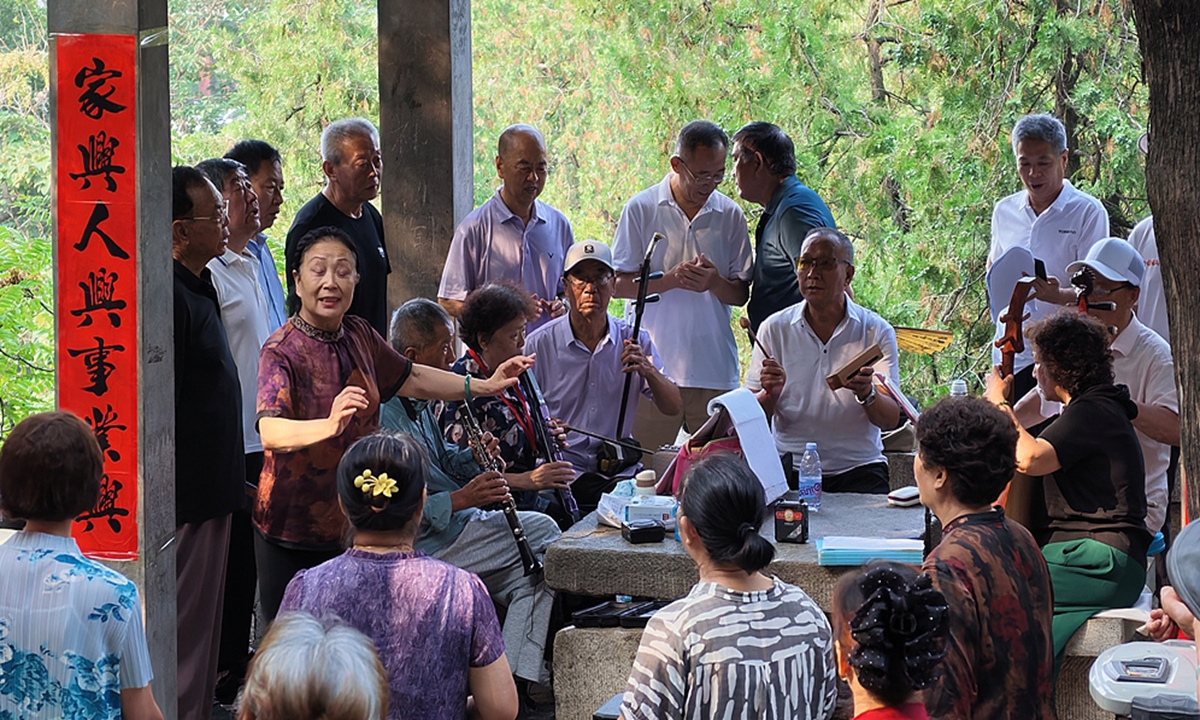
A group of elderly residents perform a collective chorus in a park in Tai'an, Shandong Province, on July 20, 2026. Photo: VCG
Every morning, when I walk in the park near my home, I hear them before I see them. A cluster of retirees, standing in loose rows under the trees, working through a chorale with more determination than polish. Someone brings a small speaker. Someone else conducts with a rolled-up newspaper.
I have seen this same scene in cities across the country - Shanghai, Chengdu, Xi'an, Qingdao, even a small town in Guizhou - in the early morning or at dusk, in a park, on a riverside promenade, sometimes in the plaza outside a shopping mall. I've seen children practicing solfège with their mothers standing nearby, and I've seen groups of young office workers, many still in their work clothes, gathering to sing four-part harmony.
Nobody organized this from above. They decided, among themselves, that this is how they want to spend their time.
When I heard that more than 50 Chinese choirs traveled to Helsingborg, Sweden, for the 14th World Choir Games, and that several of them won their categories, I wasn't surprised. I had already watched the raw material of that result forming in parks and squares for years.
What strikes me isn't the medal count. It's the deep sense of community and personal fulfillment that comes from ordinary people spending time together making music - no medals needed, just the joy of participation.
That is not a small thing. Singing in a group takes discipline. It takes someone willing to learn to read music, someone willing to show up on time, someone willing to fund their own travel to a competition on the other side of the world. None of that happens in a society still worried about where the next meal is coming from.
I think about my parents' generation, who sang in officially organized choruses decades ago - work-unit choirs, assigned repertoire, performances scheduled by someone above them.
What I see now in the park is different in kind, not just in degree. These are self-organized choirs that formed themselves, chose their own music, sometimes European choral songs or folk pieces sung in languages the singers don't otherwise speak, and paid their own way to Sweden to sing them.
That last detail matters to me more than any trophy. A retired woman told me that she'd saved for a year to join her group's trip abroad. She wasn't boasting. It was simply a fact of her life now, like saving for a trip is a common part of life for people with disposable income and free time.
I don't think this makes China extraordinary. Other countries have gone through similar periods - Germany's choral societies in the 19th century, Japan's choral boom during its own years of growth.
What I find particularly noteworthy is that this phenomenon is unfolding right before my eyes, at this very moment. It is occurring tangibly and openly, in the familiar green spaces and public parks that I regularly traverse during my routine morning strolls, making it a distinctly observable and immediate occurrence within my everyday environment.
I don't walk past those singers thinking about GDP figures or national rankings. I think about the fact that an hour of self-organized joy is now something millions of ordinary Chinese people can afford. The fact that more than 50 choirs made their way to Helsingborg is not, in itself, the most surprising thing. The real surprise is that so many people still gather to sing in parks every morning, and that some of those singers later go on to leave their mark on the wider world.
The author is a senior editor with the People's Daily and currently a senior fellow with the Chongyang Institute for Financial Studies at Renmin University of China. dinggang@globaltimes.com.cn. Follow him on X @dinggangchina
RELATED ARTICLES