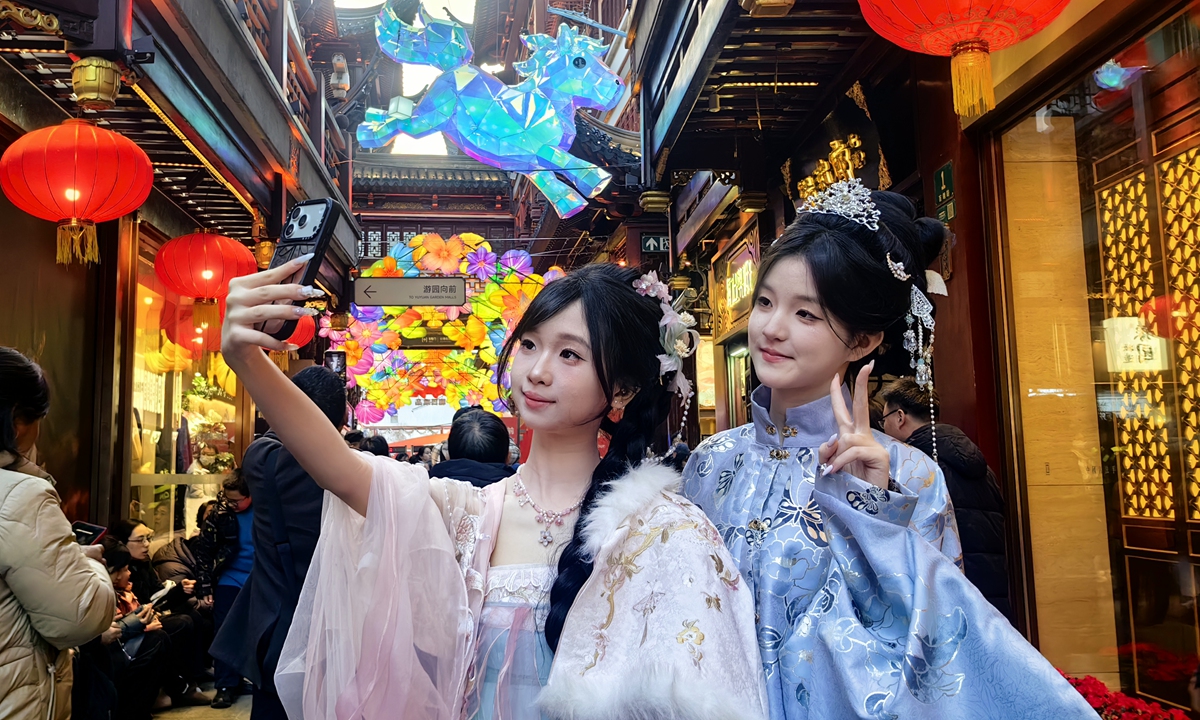
Two South Korean tourists wearing Hanfu, the traditional Chinese attire, pose for photos at Yu Garden in Shanghai on February 12, 2026. Photo: VCG
Summer bookings for China trips have surged remarkably for South Korean travel agencies, fueled by China's visa-free entry policy, ultra-short flights, improved travel experience and expanding air capacity. The surging demand has prompted local tour operators to launch a wider array of packages to various destinations.
ModeTour, a leading South Korean travel operator, has posted explosive growth in China-related reservations. Its summer travel bookings to China have soared 105 percent year-on-year, according to a press release.
The agency attributed the travel boom to short-haul flights, affordable on-site spending, visa-free entry policies and enlarged airline capacity. To meet differentiated consumer needs, the agency has reinforced classic scenic routes to such locations as Changbai Mountain, Northeast China's Jilin Province and Zhangjiajie, Central China's Hunan Province, while rolling out new city and nature-focused itineraries.
Data from ModeTour showed that Changbai Mountain accounts for 41 percent of its China summer packages, followed by Zhangjiajie at 21 percent, Qingdao, East China's Shandong Province, at 8 percent, North China's Inner Mongolia Autonomous Region at 5 percent and Shanghai at 4 percent.
Scenic mountain destinations remain favored by middle-aged travelers, while Inner Mongolia's unique grassland and desert landscapes draw a new wave of younger visitors. Qingdao and Shanghai feature all-round urban travel offerings that integrate food tours, shopping experiences, and immersive city exploration, ModeTour said.
HanaTour, another top-tier South Korean travel enterprise, reported 650,000 bookings for its package tours in the first quarter of 2026, up 12 percent year-on-year. Its China package tours rose 35 percent, outpacing the firm's overall package tour growth, according to its official first-quarter earnings.
HanaTour attributed the strong China travel momentum to China's ongoing efforts to revitalize inbound tourism, as well as its own efforts to enrich destination portfolios and diversify travel offerings across China.
"Traveling to China has never been easier with the visa-free policy, and the flights are really short," one South Korean tourist in Shanghai told the Global Times. "I also love how convenient public transit and mobile payments are around the city. Lots of my friends back home have been raving about Chinese milk tea, so I made it one of my top priorities on this trip."
Jeju Air's China‑South Korea routes achieved strong growth in 2026, the carrier told the Global Times on Thursday.
The carrier reported an impressive average passenger load factor of 86.4 percent on China‑bound services from January to July, outperforming industry benchmarks. Growth has been fueled by the visa‑exemption policy, surging demand for self‑guided tours and new regional flights.
While the airline has increased seat capacity, passenger demand is rising more rapidly, according to Jeju Air.
Since China introduced the visa-free policy for South Korean citizens in November 2024, cross-border travel has increased notably. Data released by China's National Immigration Administration showed that South Korea was the country's top source of inbound tourists in the first half of 2026.
A total of 22.914 million foreign visitor entries were recorded in China, up 20.4 percent year‑on‑year. Entries made under the visa‑exemption policy accounted for 77.7 percent of all foreign visitor arrivals, up 30.6 percent year‑on‑year.
RELATED ARTICLES