Issuing ‘digital passport’ in Panama – US overreach goes too far: Global Times editorial
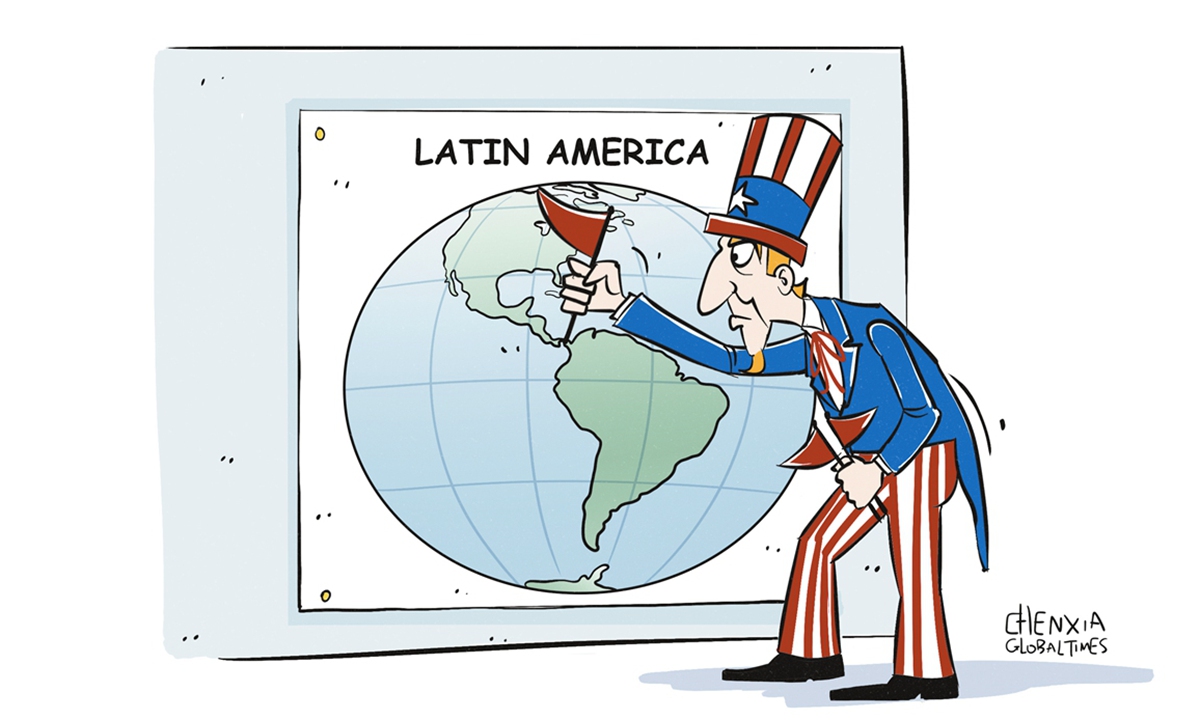
Illustration: Chen Xia/GT
The US is preparing to pilot a so-called "digital passport" in Panama. In essence, this is an attempt to extend the tentacles of its tech containment against China into international shipping lanes by using third countries. Washington is trying to package its "Pax Silica" initiative tightly with a "new Monroe Doctrine," which is a wishful and unworkable fantasy.
The US' malign tech containment against China is now reaching beyond chip factories and into the world's major waterways. Recently, the US government issued a $50 million tender to create a pilot AI supply chain credentialing and provenance platform in Panama to verify the origin, custody, and compliance status of high-value cargo for AI infrastructure, semiconductors, and critical minerals that are transiting allied trade corridors, claiming to fast-track trade in products essential to AI. On the surface, this is meant to streamline customs clearance for allies and safeguard supply-chain "security." In reality, it is a hegemonic tool designed to serve the US' tech blockade of China and enforce a "digital Monroe Doctrine."
Washington has named it "Pax Pass." Some media have aptly called it a "digital passport." A passport is supposed to verify identity and facilitate travel. Now it has become a "pass" that Washington issues to products according to its own geopolitical standards.
The old "small yard, high fence" approach was aimed at controlling technology inside the fence. The new "digital passport" seeks to push that fence into the global logistics system. The Panama Canal connects about 170 countries and regions, and roughly 1,920 ports worldwide, handling about 5 percent of global trade. Embedding US-led supply-chain standards into such a highly public artery of global commerce means that the US' tech containment of China is shifting from "blocking a few key technological nodes" to trying to rewrite the operating rules of entire supply chains.
This move is not isolated. It is a coordinated scheme that tightly binds the US "Pax Silica" initiative with a "new Monroe Doctrine."
Under the "Pax Silica" initiative, Washington is recruiting over 20 economies in AI, semiconductors, critical minerals, and related high-tech fields to form a US-led "trusted supply-chain cooperation mechanism," aiming to build a so-called small circle that excludes China. The 2025 US National Security Strategy explicitly designated the Western Hemisphere as the US' "core interest zone" and stressed preventing extra-regional powers from controlling strategic assets in the region.
The Panama Canal sits precisely at the intersection of these two strategies. Washington intends to first pilot the traceability platform, complete digital control of shipping lanes in the Americas, and, once the model is mature, replicate it across all "Pax Silica" members - constructing a technological and logistics "digital fortress" covering the Western Hemisphere and radiating to global allies.
Washington wants to use the "digital passport" to re-register the global supply chain under a new registration system and restrict China through third countries. However, this is a wishful and unworkable fantasy. The AI supply chain is deeply intertwined under economic globalization. Even when the US previously promoted "Pax Silica," it still had to bring in Australian and Norwegian minerals, Japanese and South Korean semiconductors, Singapore's hub capabilities, and the capital, markets, and manufacturing capacity of other countries. This in itself proves that no country can "go it alone" in the AI supply chain. The industrial ecosystem that has taken shape over decades of economic globalization cannot possibly be rearranged according to a list drawn up in Washington.
The facts have shown that, from successive rounds of tariffs on China, entity lists, and semiconductor restrictions to the supply-chain tracing now, US restrictions have become increasingly detailed and their scope increasingly broad. Yet in the end, Washington has found that containment only pushes China's technology sector to develop faster. Moreover, while such policies may appear to expand the reach of US rules, they could in fact shrink the market footprint of American technology companies. Washington should not only calculate how to keep a particular chip from reaching China; it should also calculate how much market feedback, economies of scale and opportunities for innovation US companies are losing as a result.
Panama, of course, has the right to choose its partners based on its own interests, just as any country has the right to safeguard legitimate supply-chain security. But when "security" is elevated to the political level in a far-fetched way, it often becomes a farce. This episode exposes two major obsessions in Washington today: first, its determination to draw a "silicon curtain" that divides the world; and second, its insistence on treating Latin America as an extension of US sovereignty - its "backyard" - while extending its geopolitical hegemony into sectors such as semiconductors, computing power, and critical minerals. If Washington believes that $50 million is enough to create an "express lane" for the global AI supply chain, it is likely underestimating both the power of global industrial specialization and the determination of Global South countries to pursue independent development.
Latin America should not be the US' "backyard," and global technology supply chains should not be reduced to a chessboard for the US to recklessly exercise its hegemony.
The Panama Canal is important precisely because it connects the world, not because it divides it. If the US truly wants its technology to reach farther, the first thing it should do is remove a few barriers - not force its own barriers onto other countries.
RELATED ARTICLES