Illustration: Liu Rui/GT
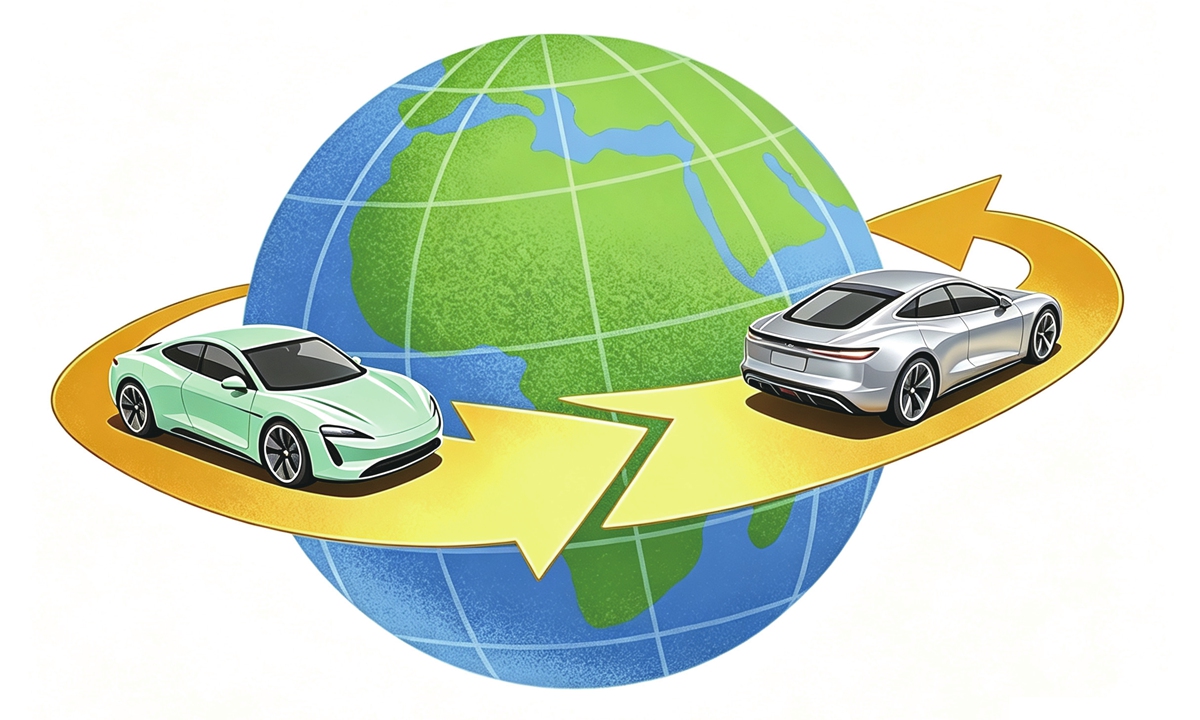
China's auto exports are entering a new phase. In July, China exported 1.043 million vehicles, up 81.3 percent year-on-year, marking the second consecutive month that monthly exports exceeded 1 million units. The surge has come at a time when some economies are seeking to slow the global expansion of Chinese automakers through protectionist measures. Why, then, are Chinese vehicles continuing to gain ground? Africa may offer part of the answer.
For Chinese automakers, Africa is not simply an export destination, but a market where deeper industrial links can be developed. This trend has already attracted attention from international media outlets. The Associated Press recently reported that Chinese automakers are increasingly shifting from exporting vehicles to producing them in Africa, as they seek to manufacture closer to local consumers rather than rely solely on imports.
The significance of this shift lies in how Chinese automakers are engaging with the markets they enter. In Africa, companies are adopting more localized approaches as electric mobility develops. This follows a familiar path in industrial development: exports often create the first connection, while deeper cooperation emerges as markets expand. This is why the million-unit export milestone matters beyond mere numbers. As exports reach a larger scale, cooperation is moving into a deeper phase, shaped by localized production and closer industrial links.
For many South African consumers, Chinese-brand vehicles offer something new: the chance to experience smart cabins and electric driving at more affordable prices. As Chinese automakers have gained a stronger foothold in Africa, some have developed the capacity to tailor their products more closely to local needs. For example, some Chinese models offer voice-control functions in both English and isiZulu, addressing the practical challenges of a multilingual environment in South Africa. Meanwhile, some Chinese automakers are working with local partners, including shopping malls and hotels, to expand public charging facilities and gradually strengthen the infrastructure supporting electric mobility.
One challenge facing electric vehicle (EV) adoption in Africa is the shortage of charging infrastructure. Media reports show that fewer than 1,000 charging stations were operating across 26 African countries as of early 2025, compared with more than 600,000 public charging points in Europe as of the end of 2023. Chinese automakers' involvement in Africa - from localized production to charging infrastructure - shows how companies can grow alongside a market while helping expand it.
Some forecasts suggest that Africa's EV market could grow at an annual rate of 10.6 percent, reaching $314 million by 2029. Chinese automakers' involvement in Africa is helping accelerate this emerging market by expanding vehicle supply, investment and charging infrastructure. For the global EV industry, unlocking the potential of markets such as Africa could open an exciting new chapter of growth.
Expanding markets do not mean competition will become any less intense. China's million-unit monthly export milestone was achieved through years of competition. Chinese automakers are now moving beyond vehicle sales toward localized production and industrial cooperation, growing alongside markets from Africa to other parts of the world, each with its own conditions.
For some time, some Western economies have introduced trade restrictions on Chinese EVs. Yet these measures have done little to slow Chinese automakers' global expansion. Instead, companies are moving toward deeper integration with local markets. After reaching the million-unit monthly export milestone, Chinese automakers are entering a new stage in which production, supply chains and industrial partnerships are becoming increasingly global. This expansion is not simply reshaping where vehicles are sold; it is also helping expand the global EV market itself.
The expansion of the EV market is also changing the global automotive landscape. As supply chains evolve rapidly, some Western economies' protectionist measures look increasingly short-sighted. Some global automakers are already taking a more pragmatic approach, viewing China not only as a competitor, but also as a partner for cooperation, a hub for innovation and a testing ground for technologies that can support their expansion into global markets. This could mark the beginning of a different path.
The author is a reporter with the Global Times. bizopinion@globaltimes.com.cn
RELATED ARTICLES