Beijing Auto Show: Supply chains move from backstage to spotlight
Technology innovation fuels industrial upgrade, says expert
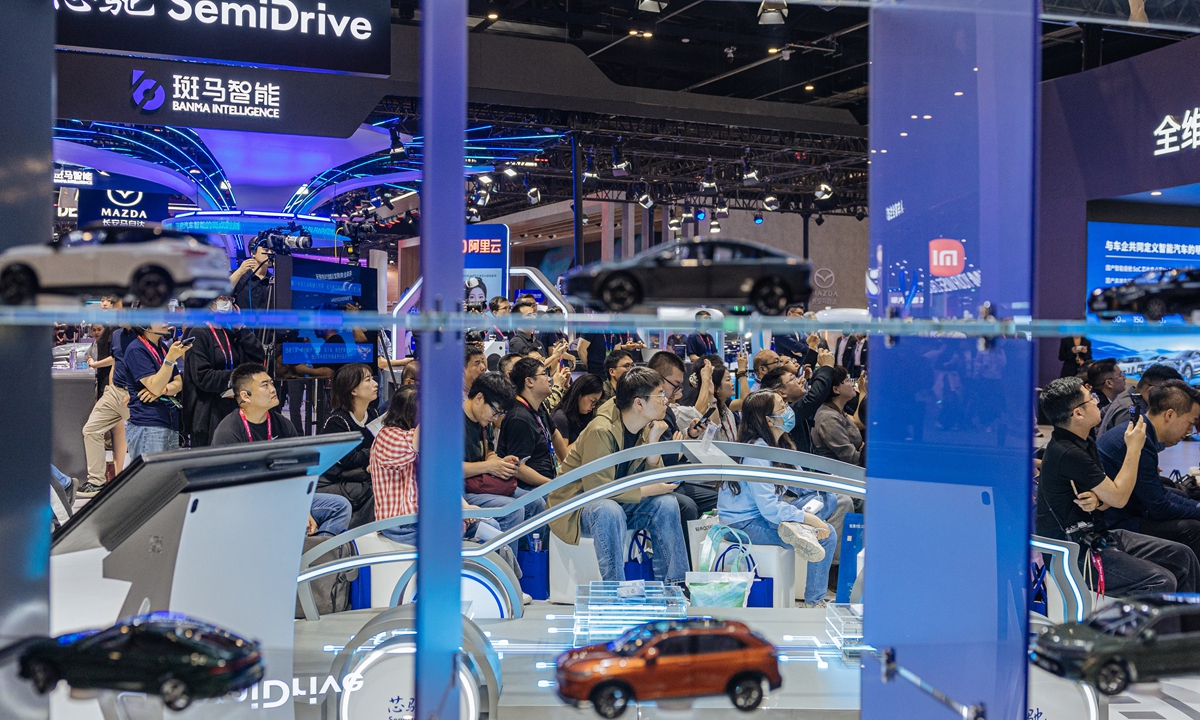
A corner of the 2026 Beijing Auto Show on April 24, 2026 Photo: Li Hao/GT
Cui Dongshu, a veteran market watcher, still vividly recalls a small detail from the Beijing Auto Show years ago.
If he wanted to visit parts suppliers, he had to take a shuttle bus from the main venue of Shunyi near the Beijing Capital International Airport to the old exhibition hall in the central part of the capital city, a nearly one-hour journey each way, he told the Global Times on Sunday.
The old model was clear: Automakers were protagonists, suppliers played supporting roles — small booths, remote locations, largely unnoticed by ordinary visitors.
Meanwhile, that "supporting role" treatment became history this year, with core suppliers entering the main halls for the first time to share the floor with vehicle brands. Behind the suppliers' move into the spotlight lies a fundamental shift in where the core competitiveness of automotive products resides, Chinese market observers said. The reshuffling of booths is no caprice of the organizers but a signal of a changing power structure across the industry chain, with the auto show serving as its physical mirror, they added.
According to organizers, the parts and components at the auto show covers 21 countries and regions, up from 13. Non-traditional suppliers — including chipmakers, cloud computing firms, high-definition mapping providers, and artificial intelligence (AI) algorithm companies — also joined the show, with some co-exhibiting alongside vehicle brands.
In Hall A2, Bosch sits adjacent to Audi and Cadillac on the same side, directly across from the booth of Hongqi. In Hall B3, Horizon Robotics, WeRide, and iFlytek have become neighbors to Toyota and Changan.
Momenta brought its R7 reinforcement learning world model to Hall B4, where it neighbors with Harmony Space, Leapmotor, and Volvo.
A most eye-catching presence, however, belongs to CATL. In Hall W4, home to luxury brands such as BMW, Porsche, and Lotus, CATL built a 1,500-square-meter energy technology experience zone at the hall's entrance. It showcases a full-chain energy solution, from cell production and battery-swapping networks to recycling and cascade utilization. The power battery giant occupies not a corner, but the main traffic gateway of the entire hall.
This layout choice highlights the growing gravitational pull of core suppliers on vehicle brands, and the core logic is that technology innovation drives industrial upgrade, Cui, who is also the secretary-general of the China Passenger Car Association, told the Global Times on Sunday.
In the fuel-vehicle era, a car's core competitiveness centered on the engine, transmission, and chassis tuning — technologies almost exclusively in the hands of automakers. In the intelligent electric vehicle (EV) era, however, industry estimates suggest that core components now account for more than 50 percent of a vehicle's total cost. Power batteries, autonomous driving chips, operating systems, and LiDAR largely define a car's core experience, Cui said.
As the determining factors of a car's product power shift from the mechanical domain — where automakers excel — to the electronics and software domains where supply chain companies have deep expertise, the transfer of industry influence becomes inevitable, Cui added.
On Saturday, Pony.ai — an exhibitor in Hall A3 — released its next-generation autonomous driving domain controller, co-developed with Nvidia. Based on the Nvidia DRIVE Hyperion platform and powered by the Nvidia DRIVE AGX Thor with integrated NVLink technology, the controller is designed for L4-level and broader autonomous driving applications, supporting the further scaling of fully driverless operations.
Two days earlier, Pony.ai unveiled a 2027 version of its fully driverless robotaxi, and the price will be under 230,000 yuan ($33,643), lower than the base price of the domestic Tesla Model 3, aiming to further tap the driverless market, the company told the Global Times.
The power shift on display is not only reshaping the domestic landscape — it is also drawing global attention.
As Chinese EVs accelerate their overseas expansion, international technology players are eager to form partnerships with Chinese automakers to help them win in foreign markets. Localizing in-vehicle intelligence has become a new battleground, and the Beijing Auto Show has become a key platform for these global players to showcase their solutions.
At the show, Yandex Auto presented a concept of its next-wave automotive AI platform for the Russian and neighboring markets, powered by its next-generation AI assistant Alice AI. The platform is ready to be integrated with automakers.
"Chinese automakers are no longer just exporting cars — they are competing for long-term user value in new markets," said Zhou Tian, senior business development director of Yandex Auto China. "This goes far beyond translating interfaces or adding local apps. It requires deep integration into the local ecosystem. We are showcasing how Yandex Auto can help Chinese automakers leap from 'product export' to 'ecosystem adaptation,' turning localization into a true competitive advantage."
RELATED ARTICLES