China’s zero-tariff policy opens wider market for Egyptian oranges, deepens trade ties
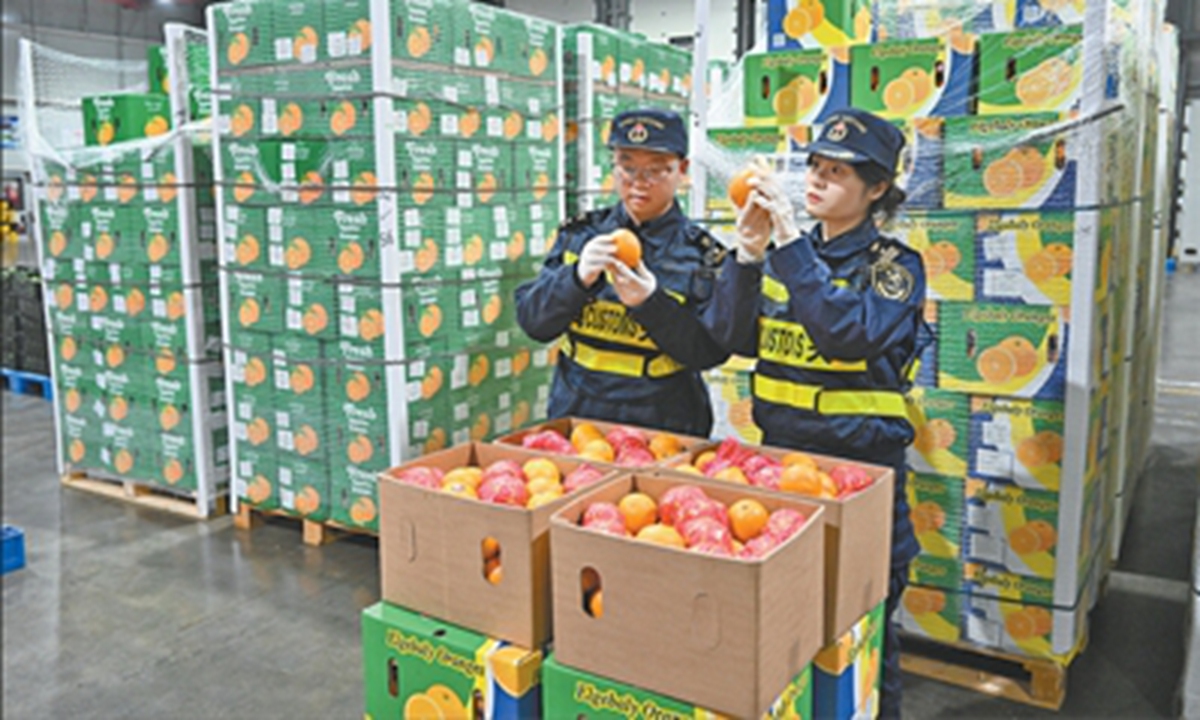
Customs officers inspect fresh oranges imported from Egypt at the Waigaoqiao port area in Shanghai on May 1, 2026. File Photo
On May 1, a shipment of fresh oranges from Egypt was released after completing all customs clearance procedures at Shanghai's Waigaoqiao Port Area, becoming the first Egyptian goods to benefit from China's zero-tariff treatment for African countries after the measure took effect.
Blessed with abundant sunshine and favorable temperature variations, Egyptian oranges are plump, juicy and sweet. Egypt has for years ranked as the world's largest exporter of fresh oranges and is also an important source of China's orange imports.
Egyptian data showed that the country exported about $26 million worth of fresh oranges to China in 2025.
Starting May 1 this year, China extended zero-tariff treatment to all African countries with diplomatic ties with China, opening up broader market opportunities for Egyptian oranges and injecting stronger confidence and momentum into China-Egypt economic and trade cooperation.
At the Gouda orchard in Sheikh Village Governorate, Egypt, workers move among the trees, picking, packing and loading fresh oranges. From here, plump oranges are shipped not only to the domestic market but also across the seas to markets around the world.
Commitment to supporting Africa
Gouda For Agricultural Products, which operates the Gouda orchard, is one of Egypt's leading vertically integrated agricultural enterprises and has a significant presence in the cultivation, processing and export of agricultural products in Egypt and across the Middle East. Egyptian fresh oranges gained access to the Chinese market in 2015, and the company was among the first Egyptian agricultural enterprises approved to export oranges to China.
"This year's weather has been favorable, and the oranges are especially good — large, bright in color and high in sweetness," said Ahmed Mohammed, 42, who has grown oranges at the orchard for more than 20 years. He said farmers tend the trees throughout the year to ensure the fruit meets high quality standards.
"I'm very proud that our oranges are exported to China and enjoyed by Chinese consumers. That recognition encourages us to keep improving the quality," Mohammed said, adding that he hoped more Chinese consumers would be able to taste Egyptian oranges in the future.
Gouda For Agricultural Products is seeking to make the most of favorable policies, including China's zero-tariff treatment for African countries, to expand exports of high-quality Egyptian agricultural products to China. Egyptian orange exports are among those expected to benefit.
Ezz El Din Gouda, chairman of Gouda For Agricultural Products, said that Gouda has been expanding orange exports to China while working to bring more high-quality Egyptian agricultural products to the market. "China is one of our most important strategic markets. Over the years, we have seen steady growth in demand for Egyptian oranges from Chinese consumers and importers," he said.
Gouda is also a member of the Egyptian Senate and the Egyptian Agricultural Export Council, and has long been committed to promoting Egyptian agricultural exports to China and agricultural cooperation between Egypt and China. He said that China's zero-tariff treatment for Africa not only enhances the competitiveness of Egyptian agricultural products in the Chinese market, but also creates new opportunities for companies from the two countries to expand cooperation in trade, investment, logistics and agricultural value chains.
"This historic measure demonstrates China's commitment to supporting Africa's development and pursuing mutually beneficial cooperation," Gouda said.
In the early hours of May 1, the first shipment of 516 metric tons of fresh Egyptian oranges entered China by sea and was cleared under the supervision of the Waigaoqiao Port Area Customs under Shanghai Customs. It was the first shipment of Egyptian goods nationwide to benefit from the zero-tariff measure, receiving a tariff exemption of about 320,000 yuan ($47,456).
Expanding presence
Inside Gouda For Agricultural Products' citrus sorting and packing facility, four modern processing and packaging lines handle the washing, sorting and grading of oranges in an orderly manner. After processing, the oranges emerge with clean, bright skins.
An automated electronic sorting system rapidly grades and screens them according to size, blemishes and other criteria. Oranges that fail to meet the standards are removed, while premium fruit proceeds to packing and boxing before being transferred to cold storage to await shipment to ports.
Egypt's fresh orange exports to China mainly include navel and Valencia varieties. To further enhance the international competitiveness of its products, Egypt has strengthened export oversight, requiring all export orchards and packing facilities to register and expanding its "coding system" to ensure full traceability from orchards to final consumers.
Fresh orange trade has emerged as a highlight of Egypt's exports to China in recent years, with a growing number of Egyptian companies actively expanding shipments to the Chinese market.
Egyptian agricultural exporter Mahmoud El Bishbishy said the Chinese market offers enormous growth potential, but only companies and exporters capable of consistently supplying high-quality products that fully meet Chinese standards can successfully enter and expand in the market.
To develop the market, Bishbishy travels to China several times a year to study the fruit market and gather customer feedback. He said that China, with its large population and strong consumer demand, is one of the world's most important markets for agricultural products, and Egyptian oranges have gained popularity in China because of their high quality and appealing taste.
"I hope to establish ties with more Chinese importers in the future, further expand the share of Egyptian agricultural products, including fresh oranges, in the Chinese market, and contribute to the continued growth of agricultural trade between our two countries," Bishbishy said.
Supporting economic diversification
To implement the zero-tariff policy for Africa, China has upgraded the "green channel" for African agricultural and food products, speeding up quarantine approval and introducing a certificate-of-origin system to facilitate customs clearance. These measures have made it easier and more efficient for high-quality African products to enter the Chinese market.
"The Egyptian orange season coincides with the off-season for domestically produced citrus fruit in China. This seasonal complementarity gives Egyptian oranges a natural competitive advantage in filling gaps in market supply," said He Xianfeng, sales manager of Shanghai Nongfu Fruit Co.
Shanghai Nongfu Fruit Co began importing Egyptian fresh oranges in 2015. He said the company has traveled to Egypt every year for more than a decade to inspect cultivation and quality-control practices, while Egyptian companies regularly visit China to better understand market demand.
With China's zero-tariff measure for Africa now in effect, import costs have fallen, and orders and overall import volumes for Egyptian oranges, grapefruit and other agricultural products are expected to increase, offering Chinese consumers a wider range of choices, He noted.
"We look forward to deepening cooperation with exporters from Egypt and other African countries and continuing to supply the Chinese market with high-quality fruit," He said.
This year marks the 70th anniversary of diplomatic relations between China and Egypt. China is one of Egypt's most important trading partners and one of the overseas markets with the greatest growth potential for Egyptian agricultural products.
Deepening agricultural and economic and trade cooperation vividly reflects the longstanding friendship and mutually beneficial relationship between the two countries.
"China's zero-tariff measure for Africa will help Egypt expand exports to China, attract foreign investment and optimize its trade structure, bringing in more foreign-exchange earnings and providing strong support for economic diversification. It is highly aligned with Egypt Vision 2030," said Ahmed Salam, member of the Egyptian Council for Foreign Affairs.
As more high-quality Egyptian products enter the Chinese market, Salam said, the public foundation and mutually beneficial nature of Egypt-China economic and trade cooperation will continue to strengthen, injecting fresh momentum into the China-Egypt comprehensive strategic partnership.
This was compiled and translated by the Global Times English edition based on an article published by the People's Daily on August 14, 2026.
RELATED ARTICLES