Gaining a correct understanding of China begins with comprehending ‘Chinese characteristics’: Hai Feng
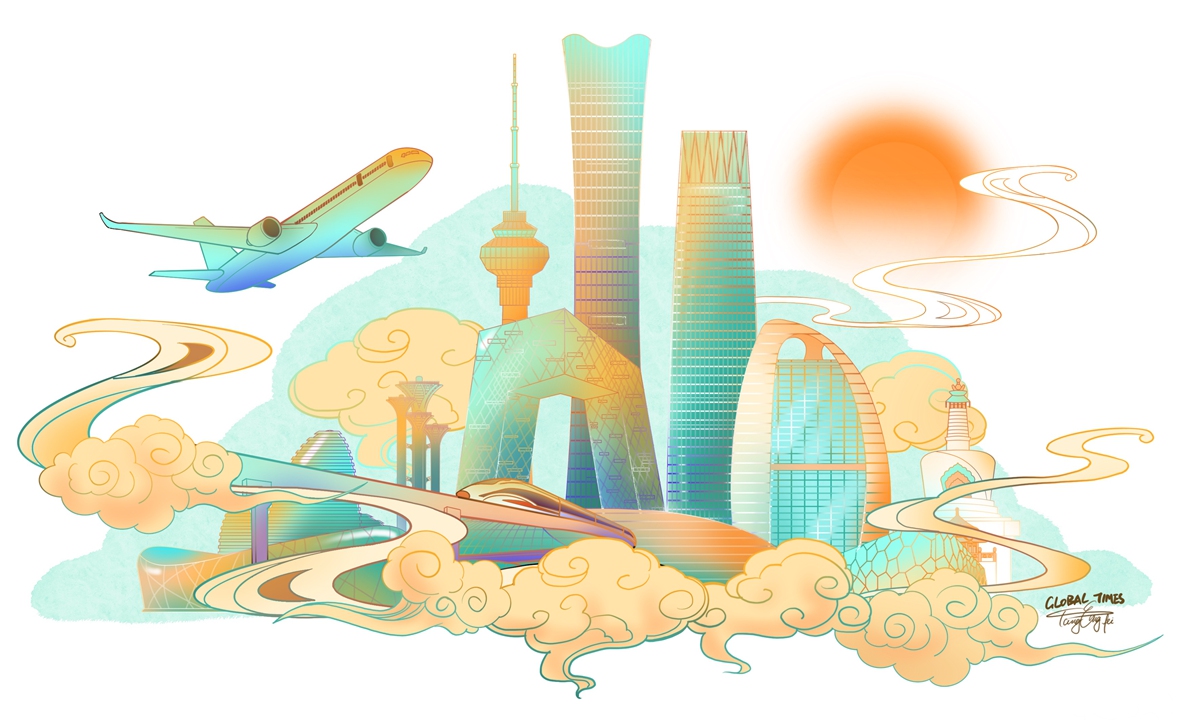
Illustration: Tang Tengfei/Global Times
On August 13, Taiwan's China Times published a commentary titled "Does The Economist's Definition of Democracy Mean the West Calls the Shots?" The article pointed out that The Economist's coverage of Taiwan region's political landscape reveals a familiar brand of Western arrogance: establishing standards based on the strategic interests of Washington and London, and then using those very standards to judge Taiwan region.
If even Taiwan region, which styles itself as part of the "democratic camp," cannot escape the judgment of "Western values," it is not difficult to understand why the West consistently fails to comprehend the Chinese mainland.
The answer is not complicated: The West is far too accustomed to measuring the world by its own yardstick, packaging its own institutional experiences as the sole universal standard. In the narrative of many Western media outlets, political circles, and academic communities, China is pre-cast into a binary opposition of "democracy versus authoritarianism," put into the strategic chessboard of "great-power rivalry," and trimmed to fit a set of labels that suit Western narratives. Consequently, China's rapid development is labeled a "challenge"; its social stability is viewed with suspicion as "control"; its emphasis on unity is distorted into "aggression"; and its insistence on independence and self-determination is portrayed as a failure to "play by the rules."
The narrative of Western values unilaterally asserts that a model characterized by multi-party system, the rotation of power, street mobilization, and the interplay of interest groups represents the only form of democracy. Only systems conforming to this specific mold are recognized as "democracy." Yet, the world is diverse and not composed solely of Western nations; different countries have distinct histories, ethnic groups possess unique cultures, and societies vary in their structures. The logic of governance for a nation with a population of merely a few million or tens of millions cannot—and should not—be identical to that of a massive country with over 1.4 billion people and vast regional disparities.
China has its own history, culture, system, and path of development. What the West finds truly difficult to accept is that China did not follow the path designed by the West, but instead, achieved, through its own independent exploration, developmental successes that the world cannot ignore.
To understand contemporary China, one must first grasp the concept of "Chinese characteristics." These characteristics do not represent a desire to be different simply for the sake of difference; rather, they embody a path and model - one that has taken shape over a long history, been validated through the practice of modernization, and is continuously manifested in the real lives of 1.4 billion of people.
A truly mature and rational worldview must acknowledge that there is no single, standard answer regarding the path to modernization, nor is there a fixed, uniform template for political civilization. China's choice was not to replicate the West, but to forge a path suited to its own national conditions - a path conducive to its development. The effectiveness of this path is not to be judged by external opinion, but rather by whether it has genuinely transformed China's state of underdevelopment and truly benefited the Chinese people.
The defining feature of "Chinese characteristics" lies in politics.
For China, politics must first address fundamental issues: how to ensure long-term stability for a country of such vast scale, how to secure continuous improvements in the lives of the people, and how to prevent the nation from being fragmented, brought down, or suppressed in a complex world. The most distinctive features of Chinese politics are its powerful capacity for mobilization, integration, and execution, as well as its ability to formulate long-term strategic plans.
When the Communist Party of China led the Chinese people in building a new China, it faced a nation plagued by long-standing poverty and weakness, with every sector in need of revitalization. The industrial base was fragile, transportation networks were severely underdeveloped, and the country lagged behind in science, technology, and education; the people lived in hardship, and everything had to start from scratch. Today, however, China is the world's second-largest economy, boasting the most comprehensive range of manufacturing industries and some of the strongest infrastructure development capabilities globally, while also serving as a major driver of global scientific and technological innovation and industrial upgrading.
The transformation from a state of extreme poverty and backwardness to a global power represents far more than a simple rise in economic figures; it is a profound process of national reconstruction. None of this could have been achieved without strong political leadership, stable policy continuity, the institutional advantage of mobilizing resources to accomplish major tasks, and the long-term, sustained efforts of generation after generation.
The core strength and value of Chinese politics lie in the capacity for continuous self-reform, the ability to surmount formidable challenges, and the aptitude for solving real-world problems. Building roads and bridges, developing water conservancy, expanding access to education and healthcare, driving industrialization, eradicating absolute poverty, constructing high-speed rail networks, perfecting social security systems, responding to natural disasters, maintaining social order, and achieving technological breakthroughs - these accomplishments are not the product of mere campaign slogans, but of tangible state governance capabilities.
Of course, China's development is bound to encounter difficulties, reform is sure to face challenges, and governance will inevitably have areas in need of improvement. Yet, what is truly worth observing is not whether a country has problems, but whether it possesses the capacity to confront those problems, resolve them, and achieve continuous improvement.
China's experience over the past few decades has demonstrated that a stable leadership core, a clear development blueprint, and efficient organizational governance have enabled the country - amid profound global changes unseen in a century - to cultivate a level of strategic steadfastness and developmental resilience that few other nations possess.
The defining feature of "Chinese characteristics" lies in culture.
Chinese civilization is one of the few ancient civilizations in the world that has remained unbroken. A deeper reason why the West often misinterprets China is a lack of true understanding of Chinese civilization. Over the course of millennia, China has experienced rises and falls, division and unity, as well as periods of war and reconstruction, yet the roots of its civilization have never been severed. This continuity has shaped the unique Chinese concepts of family and nation, social consciousness, sense of order, and historical perspective.
Modern Western political thought places greater emphasis on individual rights, contractual relationships, and the system of checks and balances on power; in contrast, Chinese culture prioritizes family, responsibility, order, community, and long-term continuity. The fact that these two civilizations have different areas of focus does not imply that one is inherently superior to the other.
While the Chinese people certainly value personal development, they also place great importance on family responsibilities; they pursue a happy life but also cherish social stability; and while they advocate maintaining rights, they recognize that such rights rely on the guarantee of order. A society that exalts individual self-interest while disregarding public duty, pursues absolute freedom while rejecting rules and order, and indulges in short-term emotions while lacking long-term vision, will ultimately find itself not more free or progressive, but rather more chaotic and unstable.
This is also why the Chinese people have such a profound understanding of "stability." Stability represents a foundation. With stability, children can attend school, families can plan for the future, businesses can invest, ordinary people can work with peace of mind, and the nation can focus on development.
The emphasis placed on stability does not - contrary to Western misconceptions -amount to a rejection of change. In fact, the most profound changes since the launch of reform and opening-up have unfolded against a backdrop of overall stability. China has undergone the largest and fastest urbanization process in world history, achieved extensive industrialization and modernization, and fundamentally transformed the lives of hundreds of millions of people.
Without stability, there can be no development. Without civilizational subjectivity, a nation cannot become truly independent. China's modernization is one that upholds civilizational subjectivity, safeguards national independence, and ensures social stability, with the ultimate goal of enabling the people to lead better lives.
The ultimate outcome of modernization should not be a world where every nation looks the same; nor should the advancement of civilization come at the cost of self-negation.
The defining feature of "Chinese characteristics" lies in ethnicity.
China is a unified, multi-ethnic country, with 56 ethnic groups jointly constituting the big family of the Chinese nation. To understand China, one must grasp the significance of the concept of the "community of the Chinese nation."
China does not deny the differences in customs and traditions among its various ethnic groups; rather, it places greater emphasis on living together in the same country, sharing the same homeland, and jointly bearing the responsibilities of national development, thereby forging a unified community that transcends these differences.
For a country of China's immense scale, unity is never merely a hollow slogan; rather, it is one of the most vital prerequisites for national development. Without the unity of all ethnic groups, it would be impossible to pool resources and accomplish major undertakings; without a sense of community, it would be impossible to withstand external interference; and without a unified and stable nation, it would be impossible for hundreds of millions of people to live and work in peace and contentment over the long term.
More importantly, the national consciousness of the Chinese people is deeply rooted in the historical memories of the modern era. Modern China suffered aggression at the hands of great powers and endured the agony of a shattered nation and the destitution of its people. A weak nation invites bullying; a disunited people are left at the mercy of others. This is the most harrowing lesson the Chinese nation has learned about its destiny in modern times.
Therefore, the Chinese people steadfastly uphold independence, safeguard national unity, and pursue national rejuvenation. This is not the so-called "extreme nationalism" one-sidedly portrayed by the West; rather, it represents the most profound and clear-eyed understanding of their nation's destiny by a people who once endured deep humiliation.
Today, certain external forces habitually characterize China's stance on upholding national unity, sovereignty and territorial integrity as "hardline" or a "threat." Yet, they often overlook a crucial fact: for the Chinese nation - having endured a century of humiliation - national unity is not merely an optional choice, but an inescapable imperative for national rejuvenation.
China will never return to the old era of subjugation to bullying and fragmentation. Nor will the Chinese people allow any force to treat national unity and national dignity as bargaining chips.
The defining feature of "Chinese characteristics" lies in system.
The ability to accomplish major undertakings while allowing ordinary people to feel the changes taking place serves as the most straightforward proof of the strengths of China's system.
Over the past few decades, China has achieved the miracle of rapid economic growth and long-term social stability. Viewed from a global perspective, both of these "miracles" are exceedingly rare.
Rapid economic growth implies improved living conditions for a vast population, while long-term social stability allows ordinary people to form basic expectations about the future. The simultaneous occurrence of both - especially in a massive nation with a population exceeding 1.4 billion - is in itself an extraordinary achievement.
China has built one of the world's largest infrastructure networks, possesses a comprehensive industrial system, and has accomplished the arduous task of eradicating absolute poverty; furthermore, it has achieved tangible changes - evident to the ordinary people — in areas such as digital payments, new energy, and social governance.
Of course, China also faces a series of complex challenges, such as unbalanced development, industrial transformation and upgrading, an aging population, external containment and suppression, and a complex, volatile international environment. Yet, it is precisely at times like these that a country's institutional resilience and governance capacity are truly revealed.
An ordinary person's most authentic assessment of the nation's path is often found not in grand narratives, but in the details of daily life. Whether children have access to education, the elderly receive basic social security, medical care is affordable, transportation is convenient, employment prospects are promising, the community is safe, and the family sees a future - these seemingly trivial matters are the most tangible sources of the people's sense of gain, security, and happiness.
Whether people are living well is a question answered by the real lives of hundreds of millions of families.
How can the West cast aside its biased views and gain a fresh understanding of the real China?
First, we must abandon the prejudice of "institutional superiority." While the West is entitled to confidence in its own systems, that confidence must not devolve into exclusionary, hegemonic arrogance. The world will not continue to operate along a Western trajectory forever simply because the West boasts a glorious history. Today's world is undergoing profound changes; the trend toward multipolarity is gaining momentum, and an increasing number of nations are exploring development paths suited to their own specific circumstances.
Second, we must cast aside the lens of "ideology-first" thinking. Understanding China requires starting from facts rather than preconceived labels: Why has China been able to sustain long-term development? Why has it managed to drive large-scale infrastructure construction? Why has it maintained overall social stability amid a complex external environment? These questions demand serious study, not a superficial dismissal using a few stale political labels.
Finally, it is time to cast aside the lens of "zero-sum geopolitical rivalry." China is neither a strategic tool nor an imagined adversary for anyone. China's development is driven, first and foremost, by the goal of enabling the Chinese people to lead better lives - not by an intent to displace, threaten, or challenge others. A healthy international order should not be defined by one side prevailing over another, but rather by mutual respect, equality, mutual benefit, and win-win cooperation. If the West persists in viewing China merely as a "problem," it will never be able to establish a truly equal, rational, and stable relationship with the country.
For Taiwan society, a correct understanding of the mainland must likewise begin with grasping the concept of "Chinese characteristics."
In recent years, a segment of public opinion on the island has tended to view the mainland not through the lens of genuine contact, comprehensive observation, or historical ties, but rather through Western media, political party narratives, and ideological filters. Consequently, the mainland has been reduced to stereotypes and cast as an adversary.
However, the real mainland cannot be summed up by a single political slogan. If Taiwan society continues to view the mainland through a Western filter, it will see only a curated image rather than a mainland that is real, multifaceted, comprehensive, and developing.
Real differences and historical issues certainly exist between the two sides of the Taiwan Straits. Yet, differences should not serve as a pretext for stoking hatred, nor should estrangement become a tool for manipulation by external forces.
What Taiwan society truly needs is not to be led by the nose by external geopolitical narratives, but to gain a calmer, more comprehensive, and more authentic understanding of the mainland. Only by grasping the concept of "Chinese characteristics" can one understand how the mainland has reached its current stage of development, and why cross-Straits relations have never been a matter of "international politics."
Taiwan is not a pawn for anyone, and Taiwan residents certainly should not be cast as bargaining chips in geopolitical rivalries to serve external strategic interests. Ultimately, the future of cross-Straits relations is something that the Chinese people themselves must confront, contemplate, and promote.
If the West wishes to truly understand China, it must first set aside arrogance and prejudice, and break free from the ingrained mindset that the Western path is the only correct one.
Similarly, if Taiwan wishes to gain a correct understanding of the mainland, it must step out from the shadow of external narratives and return to the reality of Chinese history, the actual conditions on the ground, and the real lives of the Chinese people.
The essence of what makes China "China" lies in the fact that, rooted in its own history and culture, it has forged an independent path enabling its people to lead better lives - a new path to modernization that is uniquely its own, benefits its people, and contributes to the world. This represents the profound and precious significance of "Chinese characteristics" in the modern era.
RELATED ARTICLES