ARTS / FILM
Low-budget ‘Niu Lai’ emerges as a surprise hit with its ‘disaster-level’ animation, grabbing millions in China as curiosity rivals Nolan’s ‘The Odyssey’
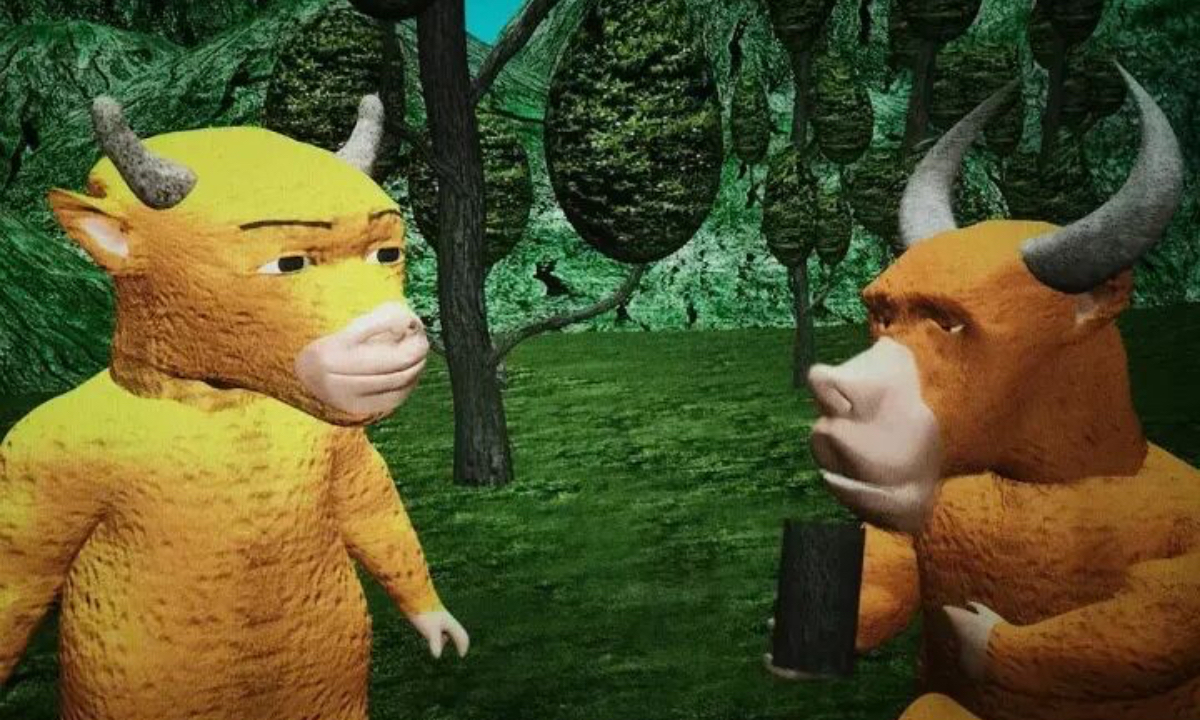
Photo: Screenshot from website
While Christopher Nolan's The Odyssey and a string of high-profile domestic and international releases compete for audiences in China's fiercely contested summer movie season, an obscure animated film has emerged as one of the period's most unexpected box-office stories.
Niu Lai, a low-budget original animation with rudimentary character modeling and an unconventional, abstract storyline, hit Chinese theaters on August 5 but earned just 7,169 yuan ($995) during its first nine days. But its cumulative box office had surpassed 2.5 million yuan as of press time.
Niu Lai opened with little of the machinery normally associated with a commercial theatrical release. It had no star-studded cast, major promotional campaign or significant pre-release buzz. Its opening-day box office was just over 3,400 yuan ($474), with fewer than 300 moviegoers watching it during its first nine days, according to Maoyan.
That changed on August 14, when a social media topic about its nine-day box office of just over 7,000 yuan went viral. Many users were drawn to its unusually rough production and two-person creative team.
Terms such as "the most basic theatrical film," "disaster-level" and "worse than AI-generated animation" circulated online, with some netizens saying they could "hardly believe it was a Chinese animated film released in 2026." Others said they wanted to see it simply to find out "just how bad it could be."
The film's title also lent itself to wordplay, as "Niu Lai" can literally mean "the bull is coming" in Chinese, prompting some netizens to joke that the bull market was finally on its way. Some even joked that stock market investors were heading to theaters after wishing for a "bull market" to arrive soon.
The film's viral attention also spawned jokes that Nolan might not have expected Niu Lai to become an unlikely rival to The Odyssey, which opened in China on August 14 amid intense competition for summer moviegoers.
The online buzz also sparked a wave of fan-made content, with netizens inserting the film's little bull character into posters for various classic movies. The playful edits have further fueled its visibility on social media, turning Niu Lai into an internet meme and a shared online joke.
The verified Sina Weibo account of the film Niu Lai said in a post, as reported by Science and Technology Daily, that the film "falls short of established industry standards for theatrical animation in terms of visuals, storytelling and other aspects." It added that the positive feedback was something the filmmakers were grateful for, while criticism should also be accepted with an open mind and regarded as valuable reminders for improvement.
Its rise stands in sharp contrast to the conventional logic of China's increasingly competitive theatrical market, particularly this summer, when a string of high-profile releases, including The Odyssey, Once Upon a Time in the Middle East and Spider-Man: Brand New Day, are competing for audiences.
"Niu Lai has been driven by curiosity and social currency, with audiences essentially paying a premium for the feeling of being part of a trending phenomenon. Curiosity can generate genuine audience interest, but social-media-driven hype is essentially a bubble built on traffic," Zhang Peng, a cultural researcher and associate professor at Nanjing Normal University, told the Global Times.
"When cinemas add screenings for Niu Lai, they may appear to be responding quickly to market demand, but in reality, they are giving in to online buzz rather than making decisions based on the quality of the film itself," Zhang said.
According to Zhang, The Odyssey's strong reception and high theater attendance in China demonstrate that high-quality content, combined with a distinctive and hard-to-replicate theatrical experience, remains at the heart of the cinema business.
"Niu Lai, meanwhile, serves as a warning that speculative filmmaking and curiosity-driven marketing should not be mistaken for a replicable formula, as relying on such tactics offers little positive value for the long-term development of the film industry," he said.
"A fleeting viral frenzy can never replace a solid creative foundation. Content quality remains the enduring value that will sustain the film industry over the long term," Zhang said.
RELATED ARTICLES