ARTS / CULTURE & LEISURE
China turns ancient TCM wisdom into high-tech personalized skincare
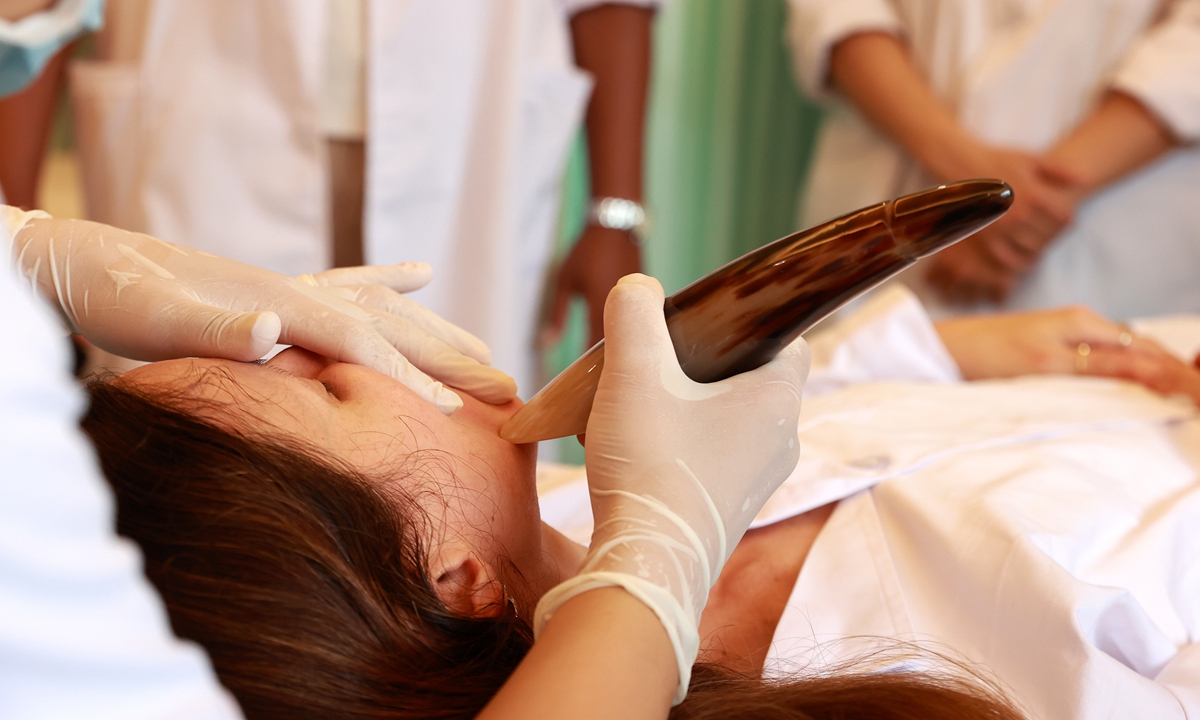
Trainees observe traditional Chinese medicine beauty techniques at the Sanya Hospital of Traditional Chinese Medicine in Sanya, South China's Hainan Province, on August 6, 2026.
A skin scan can assess dozens of facial indicators and generate a personalized skincare plan within minutes, with store staff then making small-batch adjustments from ordinary registered cosmetics. This practice is gaining ground as China expands its pilot program for personalized cosmetic services.Starting in August, eight provincial-level regions will join the second phase of the program, bringing the total number of participating provinces and regions to 23, according to the National Medical Products Administration.
Under the pilot program, cosmetic registrants and authorized domestic entities can provide personalized services by mixing or dispensing two or more cosmetics in small batches based on consumers' individual needs.
At the Beijing Tong Ren Tang personalized cosmetic service skincare experience center, for example, a skin analysis can assess more than 30 indicators and generate a personalized skincare plan, based on which consumers can order tailored products, according to the People's Daily.
Twenty-four-year-old Beijing resident Zhao Xiyao was among the early consumers to experience the service. She told the Global Times on Sunday that when buying skincare products in the past, she relied largely on the brand's advertising or online "ingredient reviews." Even when she knew what problems her skin tended to develop, it was still difficult to determine which products were truly right for her.
"Compared with simply buying a bottle of skincare product, I care more about the skin analysis that comes before the personalized service," she told the Global Times. "At least it first tells you what condition your skin is in, and then selects products based on that condition, rather than having everyone use the same set of products."
For Zhao, the appeal of the experience goes beyond the novelty of the word "personalized."
"If it's just about changing the packaging or putting my name on it, I don't think that means much. What really makes it valuable to me is whether it can actually make a difference based on my individual situation," she said.
The idea of tailoring skincare to individual needs, however, is not entirely new. It echoes the traditional Chinese medicine (TCM) principle of taking individual differences into account.
Yi Lan, a TCM physician practicing in South China's Guangdong Province, told the Global Times that people with the same skin concerns may need different approaches because of differences in their constitutions, lifestyles and living environments.
However, she noted that TCM diagnosis and modern personalized cosmetics are not the same: The former involves a comprehensive assessment of an individual's overall condition, while the latter mainly matches products to skin conditions and consumer needs.
For personalized skincare, the key lies in whether this matching process can deliver meaningful results.
"If personalized services are to become a lasting consumer service, the key will be 'precision,'" Yi said. "The test results must be reliable; otherwise, the plan that follows has little meaning."
According to Yi, if ordinary products are simply combined in a different way without being able to explain why that combination is suitable for a particular person, then "personalization" can easily become a marketing concept.
At its core, personalized skincare is less about making a product more complicated than about making the choice more relevant to the person using it. Technology is giving the traditional idea of taking individual differences into account a new expression in the consumer market. However, the real test is whether it can translate into products that are genuinely better suited to the individual.
RELATED ARTICLES