China debuts the world's first 'air skateboard,' an eVTOL using AI-powered gravity-sensing system
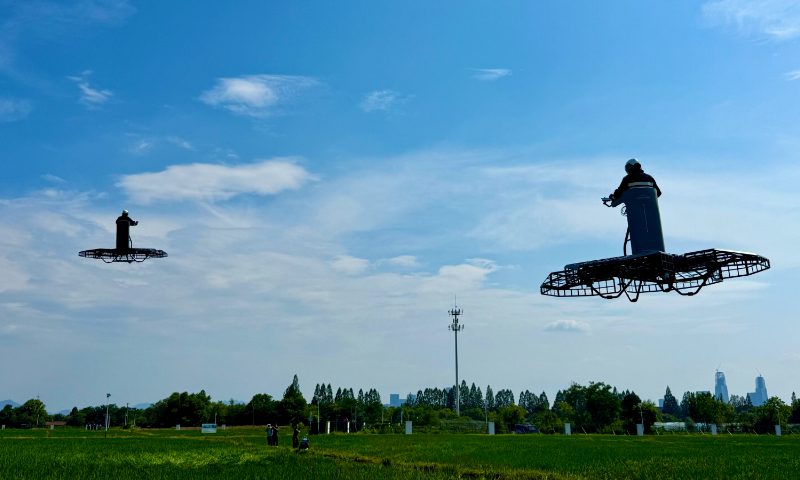
Passengers drive standing-posture manned flying vehicles in Hangzhou, East China's Zhejiang Province, on August 10, 2026. The vehicles were developed by Hangzhou-headquartered Chinese startup CoolFly. Photo: Courtesy of CoolFly
Chinese startup CoolFly Co has unveiled Urban, the world's first standing-posture manned flying vehicle, using its self-developed dual-redundant flight control system. The "air skateboard" can be mastered within minutes and is moving toward mass production this year, the company told the Global Times on Monday.
Urban looks nothing like a conventional aircraft or electric vertical take-off and landing (eVTOL) vehicle.
Instead of wings or a closed cockpit, it features a flat, flower-shaped platform roughly 3.5 meters across. Four ducted fans sit inside petal-like sections, fully enclosed by a honeycomb safety grille. A central standing area can accommodate pilots up to 1.9 meters tall and weighing up to 90 kilograms.
"The pilot simply nudges a control stick to move forward or backward and presses a button to take off. The upright stance delivers an unobstructed 360-degree view," CoolFly CEO Li Wei said during a launch event of the Urban and its seated eVTOL series Dream last week. Headquartered in Hangzhou, East China's Zhejiang Province, CoolFly is an integrated technology company spanning design, R&D, manufacturing, and sales.
The biggest technical hurdle for standing flight is the constantly shifting human center of gravity. CoolFly's solution is an AI-powered gravity-sensing system. High-precision sensors continuously track shifts in the combined human-machine center of gravity and instantly adjust thrust across the rotors, delivering intuitive feedback similar to riding a self-balancing scooter, CoolFly told the Global Times.
"It takes only about 10 minutes to get the hang of it," Li said.
Powering both Urban and Dream is CoolFly's proprietary NA80 dual-redundant flight control system - essentially two independent "brains" working in parallel. Each unit contains three aviation-grade inertial measurement units. The systems cross-check data in real time; if the primary unit fails, the backup system can detect the problem and take over within milliseconds.
Passive safety measures include airbag flight suits, a whole-vehicle parachute and impact-absorbing pads. Active protection uses lidar and computer vision to detect and avoid obstacles such as power lines and trees. Additional airbags under the base and behind the seating area further reduce secondary injury risks from the rotors.
That reliability was demonstrated during the Spring Festival Gala in February 2026. In Harbin, the iconic "ice city" in Northeast China's Heilongjiang Province, serving as a sub-venue for the gala, two Urban eVTOL vehicles carried performers into the air. They moved in sync with lights and fireworks, with an outdoor temperature of -30 C and swirling snow.
Extreme cold poses serious challenges for batteries, materials and avionics. CoolFly spent more than a month optimizing a proprietary ultra-low-temperature battery thermal-management system and adaptive flight control algorithms to make the performance possible - the first public demonstration of a near-ground electric manned flying vehicle in such harsh conditions, according to media reports.
At present, CoolFly is partnering with scenic spots and flight camps to create new low-altitude tourism experiences domestically, including a test site at Hangzhou's Grand Canal Steelworks Park. Overseas, the vehicles are positioned as personal recreational aircraft for direct consumer sales.
Multiple domestic and international dealers signed agreements at the launch event last week.
Insurance, often a missing piece for novel aircraft, is already in place. In June 2026, China Pacific Insurance's Shenzhen branch underwrote what it described as the world's first comprehensive policy specifically for standing manned flying vehicles, covering hull damage, third-party liability and passenger injury for both Urban and Dream. People's Insurance Company of China later joined in a strategic partnership.
"When insurers are willing to underwrite the product, the pace of commercialization will accelerate," CoolFly noted.
The emergence of aircraft, flight control systems, orders, distribution channels, and insurance indicates that the low-altitude economy, which has gained momentum in recent years, is beginning to show signs of commercialization in the personal passenger flight, industry insiders said.
CoolFly's journey from the Spring Festival Gala stage to planned mass production is just one example of China's booming low-altitude economy.
On July 1, 2026, the newly revised Civil Aviation Law took effect, formally establishing the legal status of the low-altitude economy in national legislation for the first time. Multiple ministries later issued a special action plan aiming to expand classified low-altitude airspace to more than 85 percent of county-level administrative regions nationwide.
According to iiMedia Research, China's low-altitude economy market size reached 480.7 billion yuan ($71.3 billion) in 2024 and is projected to exceed 3.5 trillion yuan by 2035.
Global Times
RELATED ARTICLES