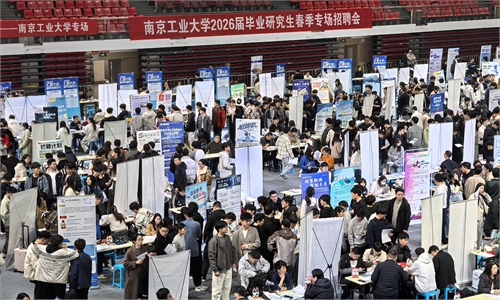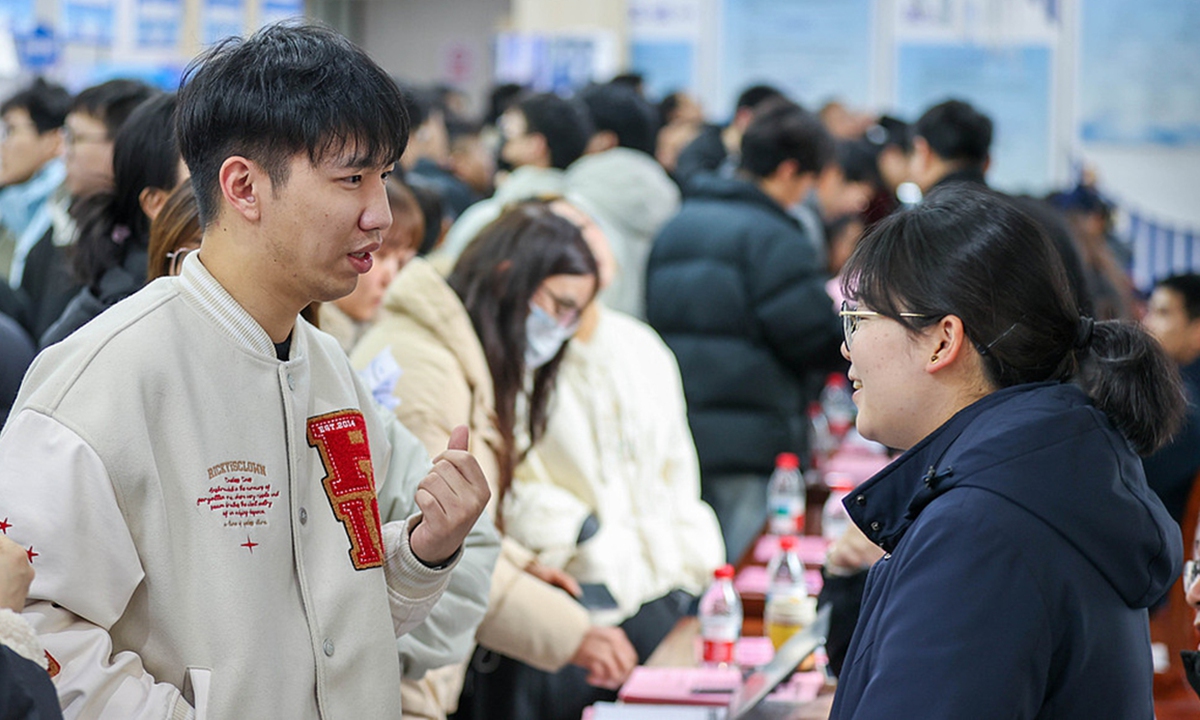
Job seekers review recruitment information at a job fair in Huzhou, East China's Zhejiang Province, on March 2, 2026. Photo: VCG
A total of 6.95 million new urban jobs were created in China in the first half of this year, unchanged from the same period last year. The average surveyed urban unemployment rate stood at 5.2 percent, indicating that the overall employment situation remained generally stable, Cui Pengcheng, director-general of the policy research department and spokesperson of the Ministry of Human Resources and Social Security, said at a press briefing on Wednesday.
In the first six months, Chinahasintensified efforts on a number of aspects, including introducing policies to stable employment, as well as promoting the formulation of adevelopment plan for human resources development during the 15th Five-Year Plan period (2026-30), andthe action plan for stabilizing and expanding employment, according to Cui.
The ministry has alsostrengthened large-scale vocational skills upgrading training. In collaboration with industry departments and mass organizations, it has carried out targeted training programs in five key areas-- artificial intelligence, advanced manufacturing, new energy vehicles, elderly care services, and the low-altitude economy.
In the first half of the year, subsidized training programs benefited more than 5.5 million participants.
In early July, the department released a development plan for human resources development during the 15th Five-Year Plan period (2026-30), setting seven major goals and 18 quantitative indicators, including a target that the number of newly created urban jobs should reach a considerable size during the period.
On targets for reemployment, the plan sets a target of helping 25 million unemployed urban workers find new jobs and keeping the urban surveyed unemployment rate within 5.5 percent over the next five years.
Global Times
RELATED ARTICLES