Does flexible employment equal intermittent unemployment?: Global Times editorial
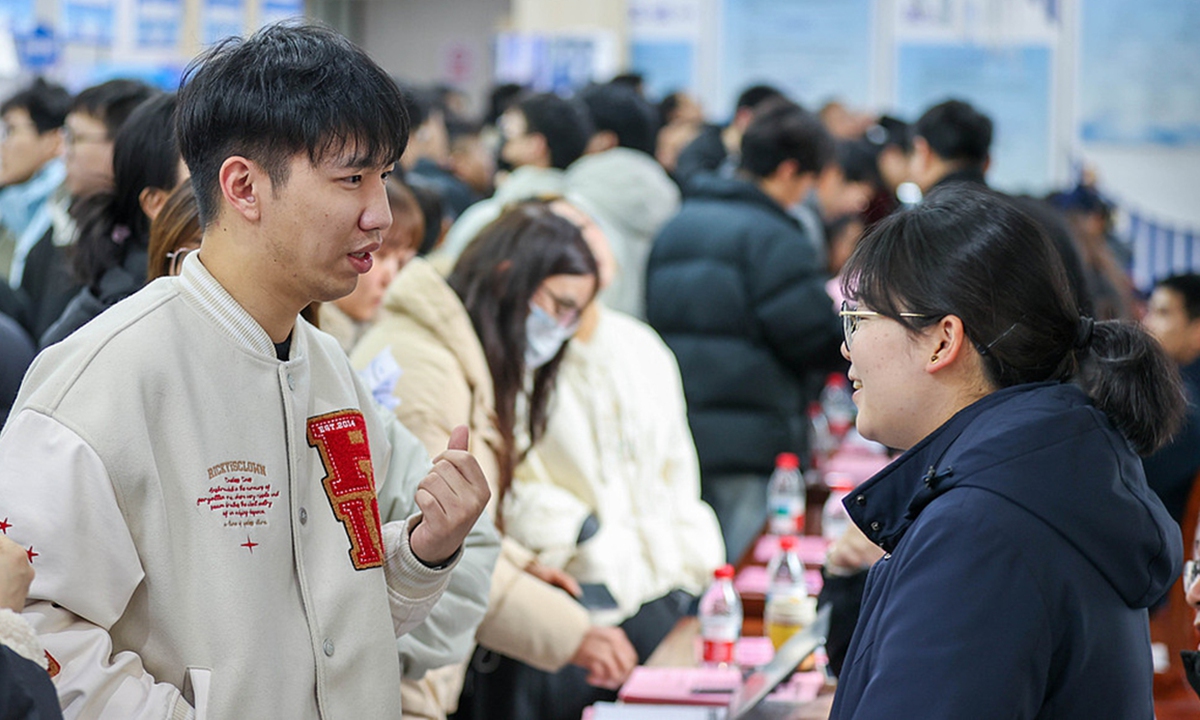
Job seekers review recruitment information at a job fair in Huzhou, East China's Zhejiang Province, on March 2, 2026. Photo: VCG
Editor's Note:
Currently, China's economy is steadily advancing along the path of high-quality development, even as domestic and international circumstances become increasingly complex. Some Western media, due to misunderstanding or bias, have repeatedly questioned or even distorted China's economic development. Accordingly, the Global Times launches the "Q&A on China's Economy" column to publish opinion pieces to present facts and clarify perceptions.
Recently, a media report claiming that the number of flexible workers in the Chinese mainland is expected to surpass 300 million has gained much attention. Some worry that the surge in flexible employment may signal economic downturn and difficulty in finding jobs. Some people also take the term at face value and simply equate flexible employment with "intermittent unemployment," and even made the alarmist assertion that "of the more than 700 million employed people, 300 million are in flexible employment," which means China's unemployment rate is as high as "40 percent."
This data came from the recent publication of the 2025 China Blue-Collar Employment Research Report by the China New Employment Forms Research Center. This annual report, based on 28,450 valid samples, studied the changes in China's blue-collar employment market from 2024 to 2025, and concluded that in the era of digital economy, blue-collar workers are transitioning from "survival employment" to "development-oriented employment."
Regarding flexible employment, the report noted that by 2025, China had 280 million flexible workers, with a forecast of 320 million in 2026, accounting for over 40 percent of urban employment, marking a shift from being a "supplementary form" to an "important pillar" of the employment market.
This is a sampling survey report by one institution. Due to differences among institutions in statistical caliber, sample range, and extrapolation methods for flexible employment, the relevant data cannot be directly compared with employment and unemployment indicators released by the National Bureau of Statistics of China. It is even more inappropriate to infer an "unemployment rate" from such figures, as doing so not only violates statistical principles but may also amplify public anxiety.The main reason many associate it with unemployment is that they equate flexible employment with the traditional "gig work," which stereotypes flexible employment as an unstable state, leading to the term "intermittent unemployment."
Flexible employment cannot be equated with intermittent unemployment. The main reason is that intermittent unemployment is a passive outcome, where workers have the willingness and ability to work but are forced to lose job opportunities. It is not a voluntary pause; rather, it is characterized by a temporary inability to engage in paid labor due to a mismatch between labor supply and demand. In contrast, flexible employment is a mode of work chosen by workers based on factors such as time freedom, career preferences, and skills matching. Even if their working hours do not follow the traditional "9-to-5" schedule, they continue to provide labor and earn legitimate income. The only difference is that their wage settlement cycles and employment contracts are more flexible.
Why has the number of flexible workers in China increased sharply in recent years? The main reasons are the advent of the digital economy and rapid development and application of artificial intelligence (AI) technology, which have fundamentally changed people's lifestyles and ways of travel. The change in employment forms is a result of lifestyle changes. Especially with the rise of the platform economy, diverse labor relationships such as "one-to-many," "many-to-one," and labor cooperation models have gradually taken center stage, even becoming leading forms.
Therefore, at this stage, flexible employment is no longer the low-level "gig work" of decades ago. From the perspective of employment groups, some reports showed that 121,400 young people under the age of 24 participated in flexible employment, and more than 60 percent of them had a bachelor's (or associate's) degree or above. In terms of employment forms, in addition to express delivery and food delivery, ride-hailing, and domestic services, flexible employment also includes a large number of technical service positions with relatively high skill requirements, covering knowledge-intensive fields such as IT development, AI support, cloud services, and data analytics. These positions include freelance software engineers, algorithm consultants, AI trainers, and technical operations for cross-border e-commerce, among others.
Flexible employment has evolved from traditional "gig work" to high-skill, project-based, platform-oriented new occupational forms. The emerging "One Person Company" (OPC), based on AI technology innovation and application, indicates a new form of flexible employment entering the economy. As of June 2025, the number of OPCs nationwide exceeded 16 million.
In terms of income, that of flexible workers is growing rapidly. The aforementioned report showed that high-income groups include maternity matrons (10,128 yuan/month), delivery workers (8,325 yuan/month), truck drivers (8,279 yuan/month), all with monthly incomes exceeding 8,000 yuan. In fact, the reason why more and more people are joining flexible employment, besides its appeal to young people, is also because of its "high cost-effectiveness."
Previously, a market research and analysis report of China's flexible employment in 2022 conducted by iiMedia showed that in China, 43.8 percent of flexible workers earn less than 5,000 yuan per month, while 56.2 percent earn more than 5,000 yuan, with 10.4 percent earning over 10,000 yuan. Therefore, flexible workers are by no means low-income groups, and their basic social security systems are already established, with 91.5 percent participating in basic medical insurance and 86.2 percent covered by work injury insurance.
Certainly, it is also necessary to recognize that such income is often closely linked to labor intensity, working hours, order cycles, and skill and experience. It cannot be assumed that a relatively high income in any single month represents the annual average income. This, in turn, places higher demands on vocational training, social security, and the protection of workers' rights and interests.
In fact, flexible employment is not unique to China. According to the International Labour Organization, the trend of non-standard forms of employment is on the rise. In 2023, 38 percent of the US workforce (approximately 64 million people) were engaged in flexible employment. Therefore, the view that flexible employment equals intermittent unemployment and workers are "forced" is not only wrong, but also reflects a lack of understanding of employment form changes under the new economy and new technological development.
In the outline of the 15th Five-Year Plan (2025-30), promoting high-quality and full employment is an important goal for the next five years. Supporting the healthy development of flexible employment is one of the important ways to expand employment opportunities and improve quality. Moving forward, with the vigorous implementation of the "AI+" initiative, it is essential to fully harness its positive potential in promoting employment and creating more high-quality jobs.
RELATED ARTICLES