Illustration: Xia Qing/GT
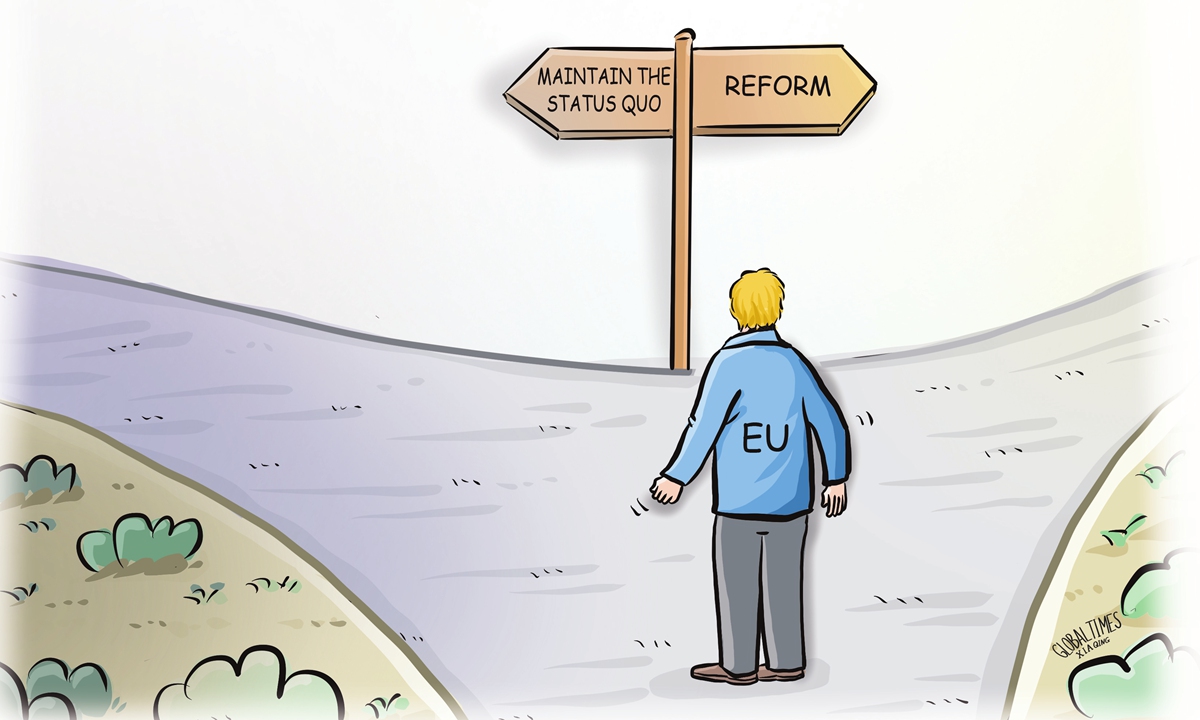
The European Union (EU) has been the most ambitious and, for decades, the most successful project of supranational governance the world has ever seen. It has brought peace and prosperity to hundreds of millions of citizens, and become a model for regional integration across continents. Yet now, the EU is far from the vision its founders imagined, and meaningful reform is more urgent than ever.
The European project, beginning as the European Community and later evolving into the EU, was built on two historic objectives. After centuries of wars that tore the continent apart and culminated in the unprecedented catastrophe of World War II, it aimed to finally secure lasting peace.
At the same time, as the Treaty of Rome declared, it sought to "ensure the economic (…) progress" of its member states, promising not only peace, but shared prosperity.
For most of its existence, the European project exceeded expectations. Borders softened through Schengen, monetary integration followed with the euro, and economic growth spread across the continent. Joint industrial ventures like Airbus proved that Europe could compete on the global stage.
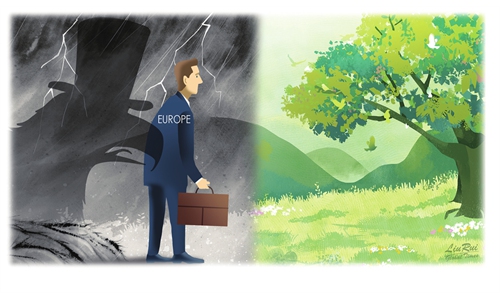
For decades, the EU was synonymous with stability and progress. Then, over the years, something broke.
First, the promise of shared prosperity has vanished. In 2024, nearly 100 million Europeans, over 20 percent of the EU population, were at risk of poverty or social exclusion, with children disproportionately affected.
Across European OECD countries, 45 percent of working-age households are financially fragile, unable to withstand even short-term income loss. Wealth remains highly concentrated, with the top 5 percent of households holding almost half of all household wealth. On nearly every measure, including child poverty, inequality, and food security, the trends are moving in the wrong direction.
Europe's industrial base, long the backbone of its social systems, is under severe strain. Years of neoliberal offshoring and deindustrialization, compounded by soaring energy costs following the imposition of sanctions on Russia, have left European industry in ruins. Since 2000, Europe's industrial production has increased modestly, with an average annual growth of about 0.6 percent - compared with around 2 percent in the early 2000s. This decline is even more pronounced in emerging sectors, including the manufacturing of solar panels, electric vehicle batteries, and advanced semiconductors.
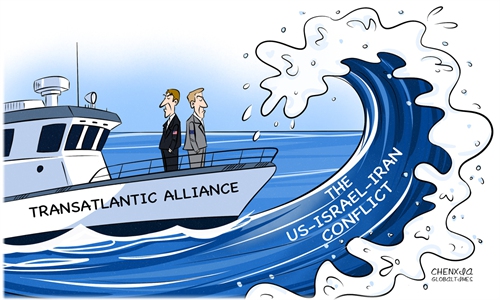
Whether by sidelining diplomacy in Ukraine or bowing to Washington and Tel Aviv in backing their brutality in the Middle East and beyond, the EU has largely failed to advance peace globally, earning the well-deserved contempt from much of the Global South.
Of course, not all of this is the EU's fault, and member states bear significant responsibility. Still, it would be unwise to assume the EU is unrelated to these failures. To judge whether the EU is still able to play a positive role in Europe's development, we must look at the direction it is taking. And Brussels' answer to these crises - militarization - is deeply troubling.
While the EU does not control national armies, it has been pushing member states to invest heavily in military capabilities. Total defense spending by EU countries reached 343 billion euros ($370 billion) in 2024, the highest ever, with equipment purchases alone rising 39 percent in a single year, mostly from US manufacturers. The "ReArm Europe Plan/Readiness 2030" aims to mobilize another 800 billion euros across the Union. This includes allowing countries to exceed normal EU fiscal limits; an exemption that would be unthinkable for investments in social programs, innovation, or climate action.
It is up to us to imagine what could be achieved if these hundreds of billions were redirected to civilian priorities. Europe could eliminate child poverty, end homelessness, and ensure universal access to quality healthcare. It could support hundreds of world-class research institutes and universities, or fully meet its climate targets, benefiting not only its citizens but the world.
"War is a racket," said US General Smedley Butler in 1935. Then, as now, it is not primarily about defending countries or ideals but about enriching a small group of people and corporations at the expense of ordinary taxpayers. This was echoed by Member of the European Parliament Ondrej Dostál, who told me that "all this defense spending will, in the end, make Europe less safe, less prosperous, less able to compete with other industrial powers, and less able to contribute to the global fight against climate change and environmental destruction."
The EU has drifted far from its original mandate. It, therefore, must rediscover its commitment to peace, diplomacy, and social progress.
The author is an advisor at the European Parliament. opinion@globaltimes.com.cn
RELATED ARTICLES