China shares desertification-control expertise at UNCCD COP17 in Mongolia
By Published: Aug 17, 2026 03:52 PM


Picture of the venue of the 17th Session of the Conference of the Parties (COP17) to the United Nations Convention to Combat Desertification (UNCCD), which opened in Ulan Bator, capital of Mongolia, on August 17, 2026. Photo: courtesy of China's National Forestry and Grassland Administration.
A Chinese delegation proposed establishing an International Grassland Day at the 17th Session of the Conference of the Parties (COP17) to the United Nations Convention to Combat Desertification (UNCCD), which opened in Ulan Bator of Mongolia on Monday. China also pledged to share its expertise and experience in combating desertification with other countries during the event.China shared its experience in science-based desertification control, grassland restoration, technological innovation and livelihood development at the event, while highlighting regional achievements under China-Arab States, China-Mongolia and China-Central Asia cooperation mechanisms on desertification control, the Global Times learned from China's National Forestry and Grassland Administration (NFGA).
China has contributed about 25 percent of the world's newly added green areas and taken the lead in achieving zero growth in land degradation.
Held under the theme "Restoring Land, Restoring Hope," COP17 brings together representatives from 197 parties, as well as UN agencies, international organizations, research institutions and businesses, to discuss issues including the restoration of degraded land, sustainable land management, drought resilience and grassland conservation.
The conference will also feature plenary sessions, implementation review meetings and high-level ministerial dialogues, with a focus on innovative financing, drought resilience, grassland restoration and pastoralists' well-being. Interactive forums on water resources, food systems and other topics will also be held.
Hosting COP17 in Ulan Bator is expected to place an international spotlight on Mongolia's land restoration priorities, including approaches that safeguard livelihoods, strengthen food security and protect ecosystems in dryland regions.
The conference is also taking place during the United Nations International Year of Rangelands and Pastoralists 2026 (IYRP 2026), declared by the UN General Assembly and championed by Mongolia. The year provides an important opportunity to advance the sustainable management, restoration and conservation of rangelands and to highlight the needs of pastoralist communities whose livelihoods depend directly on these ecosystems, according to Xinhua News Agency.
Desertified land accounts for about one-quarter of China's total land area. After more than half a century of sustained efforts, China has achieved a historic shift from "advancing sands and retreating people" to "expanding greenery and retreating deserts," with both desertified and sandy land areas continuing to decline, according to the NFGA.
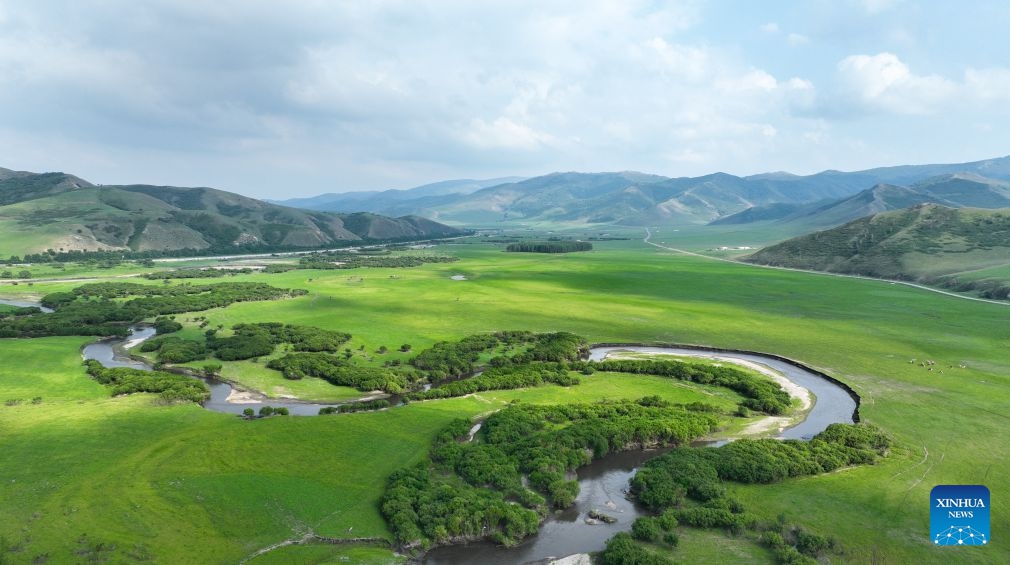
An aerial drone photo taken on June 28, 2026 shows a view of the Wulanmaodu pasture in Horqin Right Wing Front Banner, Hinggan League, north China's Inner Mongolia Autonomous Region. (Xinhua/Bei He)
China has become the first country in the world to achieve zero growth in land degradation, with 53 percent of its treatable sandy land effectively restored.Over the past five years, China has completed 36.6 million hectares of land greening, raising its forest coverage rate to more than 25 percent and contributing about 25 percent of the world's newly added green areas, statistics from the NFGA show.
Moreover, China attaches great importance to international cooperation on desertification control. It has established the China-Mongolia Desertification Prevention and Control Cooperation Center, the China-Arab International Research Center for Drought, Desertification, and Land Degradation, and the China-Central Asia Desertification Prevention and Control Cooperation Center, providing Chinese solutions and expertise to the global fight against desertification, according to China's National Forestry and Grassland Administration.
For example, hundreds of wells drilled by Chinese teams have turned sandy areas into farmland in Egypt, supporting desert reclamation. China has supplied drought-resistant saplings to Mongolia's "Billion Trees" campaign. Africa's own "Great Green Wall" initiative, inspired by China's National Forestry and Grassland Administration, has also gained support from China, Xinhua reported last year.
RELATED ARTICLES