US president’s order to scale back military exercises with S.Korea signals intention to ease tension on Korean Peninsula, return to ‘direct diplomacy’ with Pyongyang: experts
By Published: Aug 17, 2026 05:34 PM Updated: Aug 17, 2026 11:13 PM

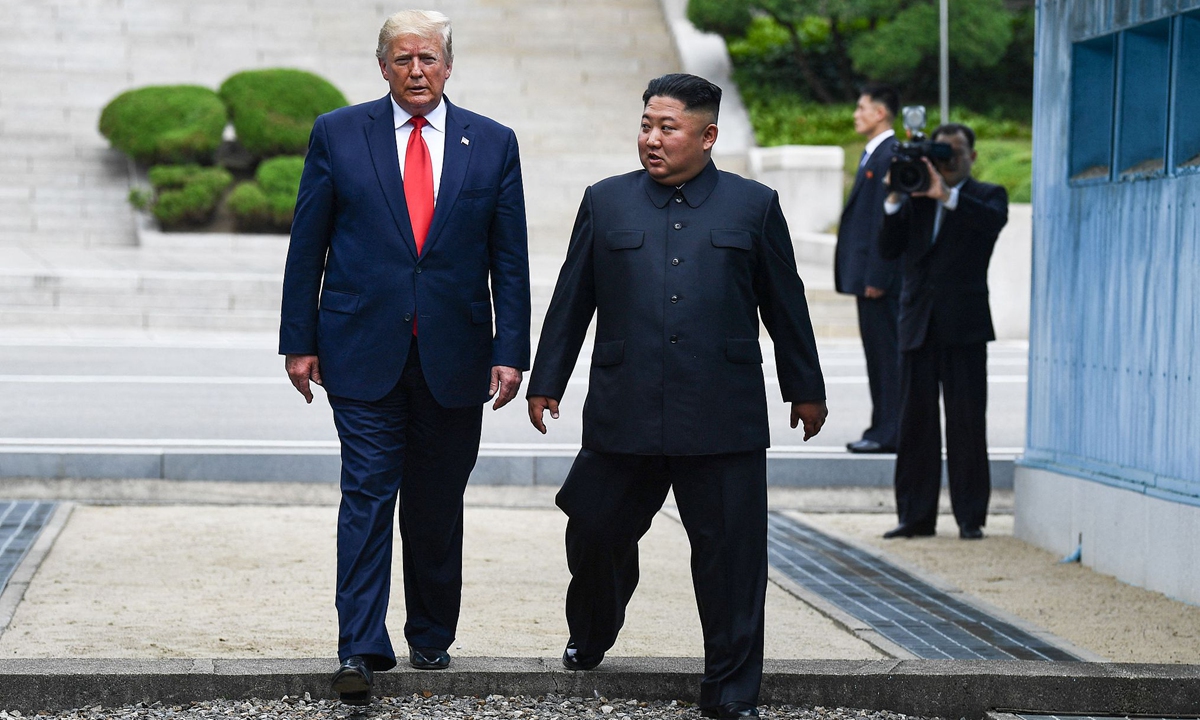
North Korea's leader Kim Jong Un and US President Donald Trump cross south of the Military Demarcation Line, after Trump briefly stepped over to the northern side, in the Joint Security Area (JSA) of Panmunjom in the Demilitarized zone (DMZ) on June 30, 2019. Photo: VCG
Just hours before a military exercise between the US and South Korea due to get underway on Monday, US President Donald Trump announced that Washington would reduce military exercises with key regional ally Seoul, citing his positive relationship with the North Korean leader and South Korea's lack of assistance with Iran, CNN reported.
Chinese experts see Trump's sudden decision to scale back military drills with South Korea as a signal of his intention to ease tensions on the Korean Peninsula and possibly return to direct diplomacy with Pyongyang. However, they warned that a carrot-and-stick approach may not work with Pyongyang, which has already seen Washington renege on its commitments. If Trump sincerely seeks peace on the peninsula, returning to the negotiating table with a genuine willingness to engage should be the first step.
Writing on Truth Social on Sunday, Trump said "based on my very good relationship with Kim Jong Un, of North Korea, I am not happy with the fact that the United States has, long ago, agreed to participate in Joint Military Exercises with South Korea."
"These exercises are not only costly, with much of these costs paid for by the United States of America (as usual!), but send a signal that is totally inappropriate and hostile, to a Country that, as long as Donald J. Trump has been President, has been unthreatening and respectful," wrote the US president, noting that since it was too late to cancel the exercises entirely, he had asked Defense Secretary Pete Hegseth to "substantially reduce" US participation.
The 11-day exercise, known as Ulchi Freedom Shield, was expected to involve about 18,000 South Korean troops. According to the US military, South Korean and US forces planned to conduct live-fire drills to test precision-strike and maneuver capabilities under complex operational scenarios, as well as river-crossing operations and the deployment of pre-positioned military supplies, South Korea's Chosun Ilbo reported.
Trump also reiterated his request for South Korea to help with the US war against Iran. "While somewhat unrelated, I recently asked the President of South Korea if they would like to join us in the Denuclearization of the Islamic Republic of Iran, and they said, 'No thanks!'" Trump wrote.
At a press conference of China's Foreign Ministry on Monday, a reporter also raised Trump's claim to "substantially reduce" joint military exercises between the US and South Korea, citing the cost of the drills and his "very good relationship" with North Korean leader, and asked how China would support the renewed dialogue between the US and North Korea. Chinese Foreign Ministry spokesperson Lin Jian said, "we noticed relevant reports. A peaceful and stable Peninsula and a political settlement of the Korean Peninsula issue are in the interest of all parties."
South Korean media Yonhap News Agency reported that Trump's instruction came as the situation on the Korean Peninsula remained tense again. The media noted that Trump's move can be seen as a conciliatory gesture toward North Korea, after the White House repeatedly affirmed that Trump remains open to dialogue with Pyongyang "without any preconditions."
Trump has long sought to ease tensions on the Korean Peninsula, but his first-term diplomatic efforts produced few substantive results. The decision to scale back military exercises with South Korea may therefore signal an intention to send goodwill and return to direct diplomacy with North Korea, an unfinished piece of business from his first term, Song Zhongping, a Chinese military affairs expert, told the Global Times.
Long-standing tensions between the US and North Korea are a major source of instability on the Korean Peninsula, Lü Chao, an expert on East Asian studies at the Liaoning Academy of Social Sciences, told the Global Times, noting that the fundamental way to address these tensions is for the two sides to return to the negotiating table and resolve their differences through peaceful dialogue, rather than escalating tensions through displays of military force.
On August 13, a spokesperson for the Foreign Ministry of the Democratic People's Republic of Korea responded to the scheduled military drills between South Korea and the US. The spokesperson said that "it is our consistent principle of ensuring security to respond to a new level of a threat with a new level of a deterrent. DPRK remains steadfast in its will to frustrate outsiders' hostile acts with the most powerful and overwhelming force and absolutely defend the supreme interests of the state security," according to official Korean Central News Agency (KCNA).
On Saturday, Trump shared a photo of himself with Kim Jong Un, the top leader of the DPRK on Truth Social, and wrote that he and the North Korean leader "get along GREAT!"
During Trump's first presidential term, he and Kim first met in Singapore in June 2018, marking the first-ever US-DPRK summit. They met again in Hanoi, Vietnam in February 2019, and later that June in the inter-Korean border village of Panmunjom, according to Xinhua News Agency.
North Korea's past dealings with the US, particularly the breakdown of bilateral negotiations without substantial progress, have eroded Pyongyang's trust in Washington, Lü said.
Therefore, if Trump genuinely wants to leverage his relationship with the North Korean leader to address tensions on the Korean Peninsula, emphasizing their personal ties alone will not be enough. Washington will need to demonstrate genuine sincerity and back its words with concrete action, according to the expert.
RELATED ARTICLES