China’s Arctic shipping route sees soaring demand, igniting ‘sour grapes’ mentality in West: Global Times editorial
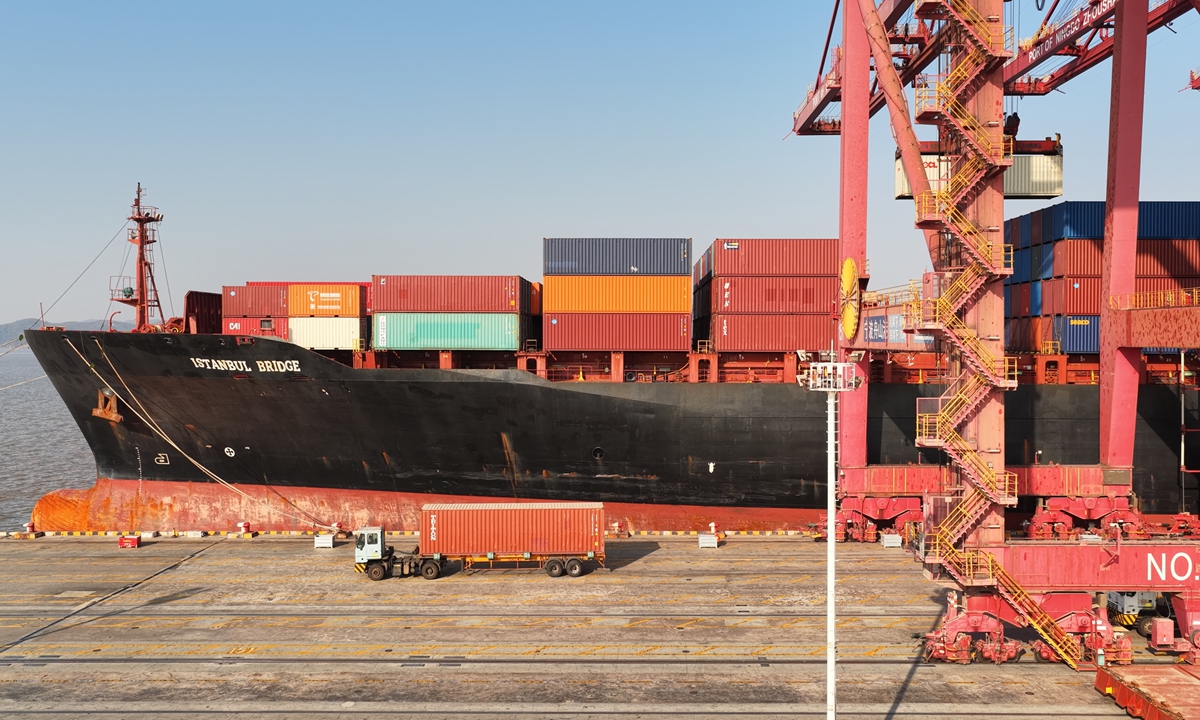
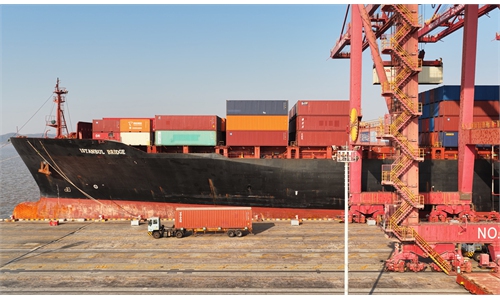
The first cargo ship of the China-Europe Arctic Express berths at Ningbo Zhoushan Port in East China's Zhejiang Province on December 6, 2025. Photo: VCG
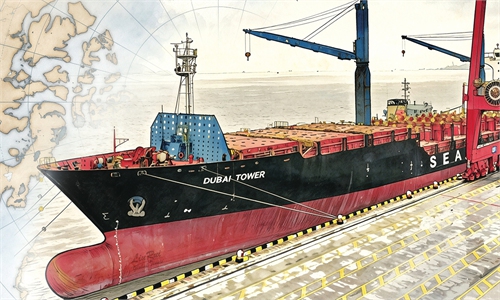
Recently, as the Chinese cargo ship Dubai Tower departed from Ningbo-Zhoushan Port, the China-Europe Arctic shipping route entered regular weekly operations for the summer season. From last year's maiden trial voyage to this year's new phase of weekly operations, it took this major route - offering direct delivery to Europe in about 20 days - less than a year to reach regular service. China's first regularly operated Arctic shipping route not only opens up a fast, efficient, green, low-carbon, and resilient northern logistics corridor for China-Europe trade, but also injects a rare measure of certainty into a global supply chain frequently disrupted by various shocks.
China is the world's largest trading nation in goods and has enormous trade volumes with Europe. This has directly generated commercial demand for an Arctic shipping route. At the same time, cooperation between China and Russia in areas such as route management, icebreaking services, and port connectivity has further improved the accumulation of navigation safety data and the level of operational support, reducing risks for participating partners. It is therefore no surprising that the route has attracted strong interest.
According to media reports, demand for bookings this year has exceeded expectations: the first two voyages were fully loaded, while orders for subsequent sailings have continued to pour in. Most of the cargo consists of high-value-added exports from the "new three" industries. Meanwhile, container freight rates have risen sharply, with this year's rates roughly twice those of last year's maiden voyage.
The surge in orders has prompted some Western media outlets to once again resort to "sour-grapes" rhetoric. Some have labeled China an "environmental destroyer," others a "geopolitical expansionist," while still others have accused it of "weaponizing supply chains." These narratives essentially share the same logic: In their eyes, China's mere participation in Arctic shipping is "aggression."
Yet the countries actually enjoying the convenience of Arctic routes are precisely some of the loudest Western critics. In 2025, there were 206 voyages carrying LNG from the Yamal LNG project to Europe, compared with just 50 from the Chinese mainland. If navigation itself is an "original sin," perhaps those countries that have used the route extensively for years should be the first to reflect on their own conduct.
The Arctic is a shared region of the world. As long as they comply with international law, including the United Nations Convention on the Law of the Sea (UNCLOS), respect the legitimate jurisdiction of Arctic coastal states, and take the protection of the Arctic environment into account, all countries have a legitimate right to participate in the development and commercial operation of Arctic shipping routes.
The freedom of navigation and the right to use Arctic shipping routes to which all countries are entitled under international law should be safeguarded. Western countries are actively expanding their presence in Arctic shipping, yet they baselessly portray China's participation in Arctic routes as a "threat" - a clear case of double standards and hegemonic thinking.
Against the backdrop of intensifying geopolitical conflicts, global logistics routes are becoming increasingly vulnerable. Global maritime trade currently depends heavily on a small number of strategic chokepoints, including the Suez Canal and the Strait of Malacca.
Any disruption to these routes could have a major impact on global trade. China's Arctic shipping route provides a new option for Asia-Europe trade, helping diversify risks and improve efficiency.
It cuts the China-Europe voyage by roughly half and reduces carbon emissions per trip by nearly half, offering clear benefits in lowering both logistics costs and carbon emissions. This represents an optimization of the global shipping system, and China's participation makes that optimization more reliable.
China is increasingly becoming a reliable partner in Arctic affairs in terms of both capabilities and credibility. This is the fundamental reason behind the strong reception for the regular operation of the China-Europe Arctic shipping route.
In its white paper titled "China's Arctic Policy" published in 2018, China stated that it was willing to work with all parties to jointly build a "Polar Silk Road" through developing the Arctic shipping routes.
Over the years, China has consistently invested in polar scientific expeditions, proactively shared research findings, and conducted joint scientific research with countries around the world, providing critical data for the study of Arctic climate change. The exploration of the Arctic by Chinese shipping companies has also accumulated valuable commercial experience and safety standards for polar navigation.
The regular operation of the China-Europe Arctic shipping route is itself an important international public good generated by the development of the "Polar Silk Road."
The future of the Arctic should not be a chessboard for geopolitical rivalry, but a new frontier for international cooperation.
China has consistently advocated green, low-carbon, and sustainable navigation in Arctic affairs, strictly complied with the relevant environmental protection requirements of the International Code for Ships Operating in Polar Waters (Polar Code), and actively promoted practical cooperation on climate change.
Rather than weaving false narratives and fueling confrontation, it's better to return to a rational approach and work together to explore how this new route can better serve economic connectivity and sustainable development across Eurasia and the wider world, while protecting the Arctic's fragile environment.
RELATED ARTICLES