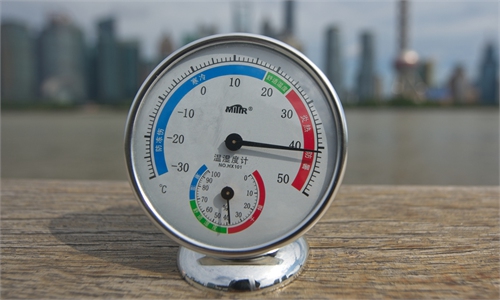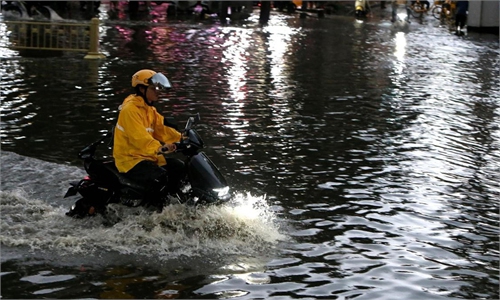
Researchers track coastal climate and ocean conditions to detect El Nino-related shifts. Photo: VCG
As sea surface temperatures in the equatorial central‑eastern Pacific are expected to peak around November to December, potentially leading to a record-strong super El Nino event, China has already experienced typical El Nino-related climate patterns this summer, the China Meteorological Administration announced on Tuesday. These include two major rain belts in eastern regions that caused widespread and intense storms with overlapping impacts, as well more frequent and stronger typhoons delivering prolonged wind and rain.
The central and eastern equatorial Pacific entered an El Nino phase in May, and sea temperatures have since surged. The monitoring region’s sea surface temperature index 2.09 C in July, up 0.49 C from June. By mid-August, it had climbed to 2.64 C, signaling an unusually fast warming trend, the CMA said.
However, according to China’s national standard, a super El Nino event has not yet officially formed.
Given the current pronounced warming trend, a super El Nino event is highly likely to occur, with its intensity potentially exceeding that of the three strongest events on record in 1982-83, 1997-98, and 2015-16 and making it the strongest one ever observed, according to the CMA.
Since the start of summer, China’s abnormal climate patterns have reflected the typical impacts of the El Nino. The western Pacific subtropical high and the monsoon trough have shifted farther north and become stronger, while upper-level cold vortices have repeatedly moved into northern China, resulting in two major rain centers in the north and south, the CMA said.
A stronger summer monsoon has contributed to more frequent and intense typhoon activity, bringing heavier rainfall to southern China and the lower Yangtze River. In northern China, the northward-shifted subtropical high, frequent cold vortices and long-range moisture transport through the typhoons have contributed to repeated strong winds and heavy rain, according to the CMA.
According to CMA, as El Nino continues to develop rapidly and its impacts tend to lag behind its development, the National Climate Centre will strengthen monitoring and forecasting efforts, while closely tracking its future evolution and potential impacts on China’s climate.
Global Times
RELATED ARTICLES