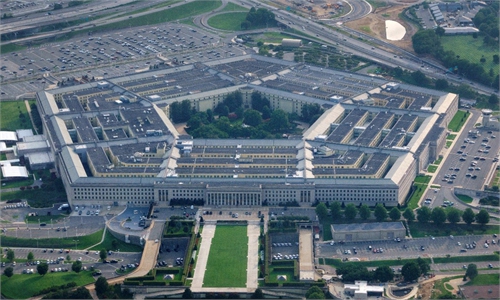
Pentagon’s ‘national security’ audit deadline for US universities is also a countdown to a crisis for US scientific innovation
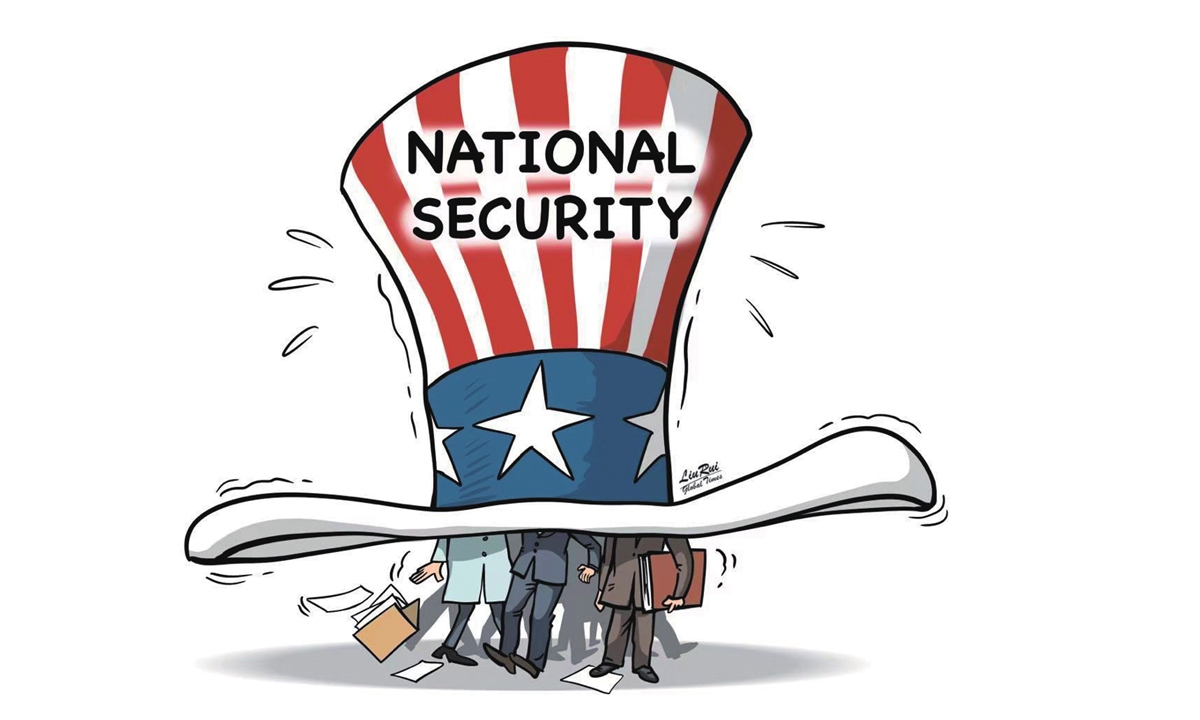
US national security. Illustration: Liu Rui/GT
August is a season when students around the world race to meet deadlines for papers and assignments. This year, however, more than 30 leading US universities have been handed a "national security" audit deadline - one set by the Pentagon.On Monday, the US Department of War issued formal notifications to 30 US universities to complete comprehensive audits of all their academic, financial and research collaboration with China, Russia, Iran and other countries within two weeks. Where necessary, they must terminate "problematic partnerships," or risk losing eligibility for future federal research funding. Although the Pentagon did not disclose the specific names of the 30 universities, reports indicate that leading institutions such as the Massachusetts Institute of Technology and Harvard University are among them.
The move shows how far Washington has stretched the "national security" label,from a pretext for targeting specific technologies and institutions to a catch-all tool for policing ordinary academic ties. In the name of protecting national security, Washington is effectively putting academic freedom and scientific exchange under security lockdown.
At a time of intense AI competition, when the US technology sector is increasingly concerned about its declining attractiveness to top talent, the Pentagon's move is making things worse. Rather than strengthening a "robust" US scientific and research ecosystem, it risks further weakening it - and could ultimately become the real deadline for America's scientific and technological edge.
Not long ago, Moonshot AI's release of Kimi K3 sparked global attention, along with a heated discussion in the US tech industry over "why the US couldn't keep Yang Zhilin." Beyond personal ambitions, the US' declining appeal to top talent is increasingly seen as a factor. A survey conducted by the STAT and MassINC Polling Group found that 14 percent of biomedical scientists and postdoctoral researchers had been forced to turn down offers to work in their labs due to "changes in immigration policies," while 13 percent had moved to other countries as a result of US research funding changes.
The Pentagon's claims about preventing the so-called "technology transfer" and "intellectual property theft," and America's anxiety over its declining talent appeal, are two sides of the same coin. At their root lies Washington's growing anxiety over its weakening position in technological competition. Washington fears losing its long-held technological advantages, yet keeps building higher walls in the name of protecting it - only to risk driving away the talent, ideas and cooperation that sustain innovation. That is the paradox: The more Washington tries to secure its technological edge through isolation, the more it risks undermining its competitiveness.
China opposes the overstretching of the concept of national security and the politicization, weaponization and instrumentalization of scientific research cooperation. The more the US chooses isolation and builds walls, the more firmly China should embrace openness. China should accelerate efforts to become a global hub for talent and innovation, attract top talent from around the world to work and launch businesses, strengthen world-class research universities, and cultivate talent in frontier fields.
China has the world's most complete industrial system, a vast market, abundant application scenarios, rapidly advancing engineering capabilities, and increasingly mature capital and industry-academia-research collaboration. The more turbulent the global environment becomes, the more valuable these advantages will be to innovators.
The Pentagon can set an audit "deadline" for US universities, but it cannot set a "deadline" for global scientific exchange. The tide of people-to-people exchanges between China and the US will not be reversed by a Pentagon order, nor can the objective laws of scientific and technological exchange be held hostage by narrow security paranoia. Cooperation channels blocked today will ultimately find new openings in the broader movement toward open innovation.
If Washington continues to treat normal academic cooperation as a national security risk, the countdown it should truly worry about may be for America's own scientific and innovation edge.
RELATED ARTICLES