China unveils ‘super brain’ enabling robots to autonomously carry out long-horizon tasks
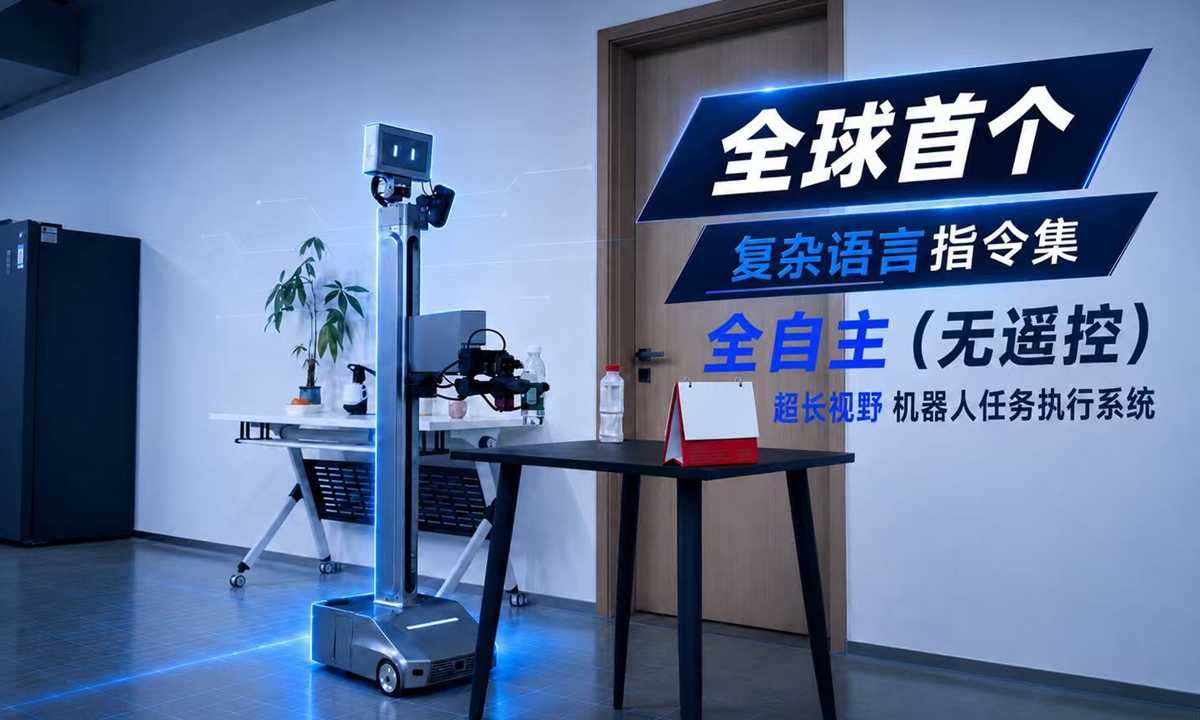
China releases the world's first fully autonomous robot task system that can follow complex language commands. Photo: Screenshot from the Science and Technology Daily
China has released the world's first fully autonomous robot task system capable of following complex language commands. The "super brain" has addressed the longstanding challenge of robots being unable to independently perform decision-making and planning in unfamiliar environments, enabling them to operate in complex, dynamic real-world scenarios, the Science and Technology Daily reported on Tuesday.
The task execution system, developed by the Chengdu Humanoid Robot Innovation Center, integrates a range of popular technical approaches, including world models and Vision-Language-Action models, into a unified framework. Related technologies have already been granted invention patents.
In the demonstration video, it is observed that the Chengdu-developed humanoid robot, equipped with the system, receives a single complex instruction and then independently completes three sequential sub-tasks. The entire process involved no remote control and no staged setups, showcasing the robot's fully autonomous operational capabilities.
According to researchers, the core value of the execution system does not lie in how many models it stacks, but in establishing a complete closed loop from task understanding to skill selection to action execution. It solves the real-world problem in which robots cannot autonomously complete task decision-making and planning without prior data adaptation to the relevant scenarios, thereby giving robots the genuine ability to independently carry out long-horizon tasks in unfamiliar environments.
Once humanoid robots leave the laboratory and enter real production and daily-life environments, they confront a world far more complex than any lab setting. In the real world, robots face incomplete observations, unknown environmental dynamics, semantic ambiguity in tasks, among other factors. Therefore, evaluating whether a robot is truly "intelligent" cannot be limited to basic motor metrics such as standing, walking, or grasping, it must further examine the robot's capabilities in long-horizon tasks including state estimation, strategy selection, and closed-loop recovery, said the report.
With continuous technological iteration, humanoid robots will no longer be mere "exhibits" in laboratories, but will truly enter factories and homes as intelligent assistants, researchers said.
Global Times
RELATED ARTICLES