ARTS / CULTURE & LEISURE
‘Pay to suffer’: German fitness race Hyrox taps China’s appetite for fitness and social connection
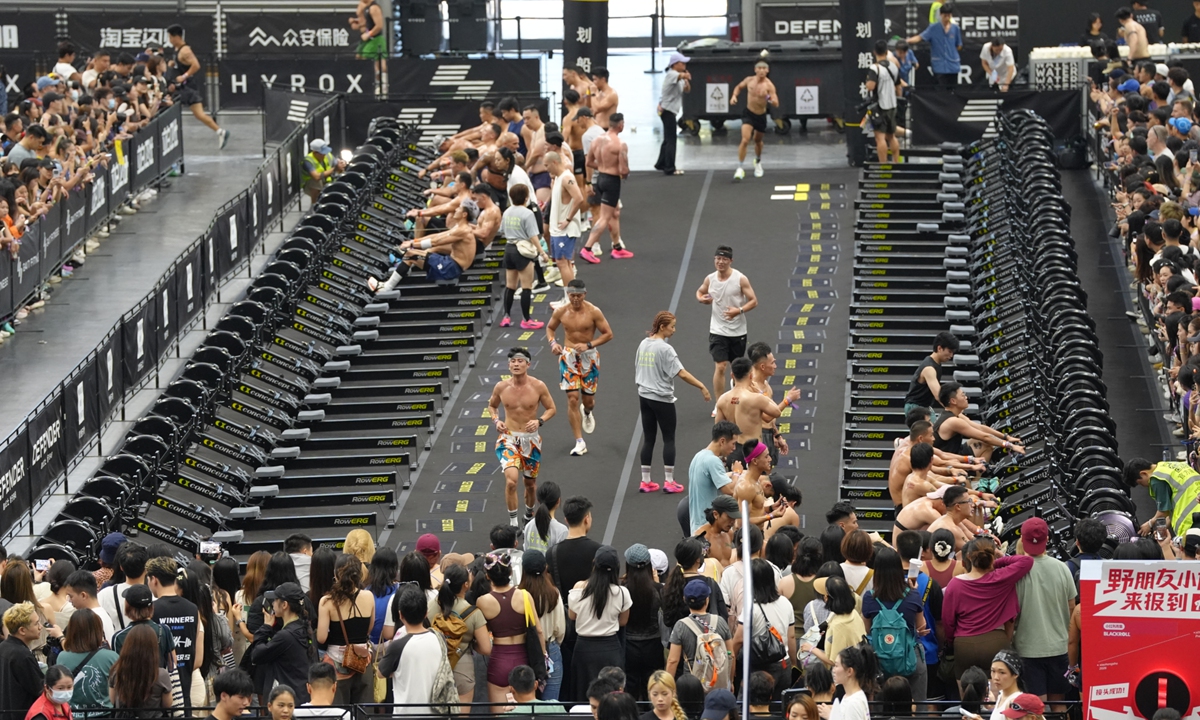
Hyrox Photo: VCG
From fewer than 1,700 participants at its first Beijing event to around 12,000 in a recent Shenzhen event, Hyrox is rapidly becoming one of China's newest fitness crazes.Over the weekend, participants from across China packed the Shenzhen World Exhibition and Convention Center for the German fitness race, according to HYRESULT, a platform that tracks Hyrox race results. The event was one of the Chinese stops of the 2026-27 Hyrox season.
Originating in Hamburg, Germany, in 2017, Hyrox was designed as a fitness competition for gym-goers. It combines eight 1-kilometer runs with eight functional workout stations, including sled pushes, indoor rowing, burpees, farmer's carries and wall balls.
Pronounced "high‑rocks", the brand has never formally disclosed where its name originates. Yet it is widely understood to be a portmanteau blending "hybrid" and "rockstar", a nod to the mix of endurance and raw strength demanded by its race format.
Hyrox has experienced remarkable growth in Europe and the US, with some events attracting over 50,000 athletes and 35,000 spectators. After entering the Chinese market in 2024, the sport has expanded rapidly, with more than 500 affiliated gyms now operating in the Chinese mainland, according to the Xinhua News Agency.
This rapid growth reflects Hyrox's appeal as something more than a workout. By combining standardized physical challenges with competition, measurable results and group training, the sport has turned fitness into a social experience for a growing number of young Chinese professionals.
A fitness enthusiast surnamed Zhang who competed in the Shenzhen race for the first time is one of them.
Before the event, he trained about five times a week, with sessions including sled pushes, indoor rowing and running. He also maintained a daily 5-kilometer running routine.
He entered the "open" category and finished in about 2 hours. For him, however, the result was only part of the experience.
"It is not only about seeing what I have achieved through fitness," he told the Global Times. "Seeing so many disciplined people training and competing together gives you a sense of belonging."
That sense of community is becoming a defining feature of Hyrox in China, where a growing number of young people in major cities are swapping the couch for the gym.
Guo Xin, a sports commentator in Beijing, told the Global Times, "In the past, many people went to the gym to lift weights or run, but their goals could be relatively vague. Hyrox gives them a clear challenge: finish the race and improve their time."
For people who may find it difficult to make new friends after entering the workforce, training together also offers a natural way to build new social circles.
That structure is particularly appealing to young people who want exercise to be both purposeful and social, Guo said.
Many participants train in groups, sharing workout plans, encouraging one another and meeting outside the gym.
According to Xinhua, Shanghai-based IT professional Zhang Lin, 27, said she initially signed up simply to join the fun. What kept her returning was her training group, where people from different professions trained together, talked about races and had meals on weekends.
The sport has also found a natural home on Chinese social media.
Training check-ins, race-day crowds, finish-line celebrations and photographs of exhausted competitors are easily turned into shareable content. The popular phrase "pay to suffer" has become something of a rallying cry among Hyrox participants, capturing the willingness of young people to spend money to put themselves through an intense physical challenge.
"The atmosphere of the competition, the ritual of crossing the finish line and hitting the gong, and training check-ins are all easy to share on social media," Guo said. "The process of working hard and then seeing the result is itself very infectious."
For many participants, the appeal is not necessarily about winning.
The global ranking system gives amateur athletes a way to see how their performances compare with others around the world, while still allowing them to focus on personal improvement.
The rapid expansion of Hyrox has also attracted attention from China's sports industry. But Wang Dazhao, a sports commentator, cautioned that even though Hyrox has successfully tapped into young people's demand for fitness and social connection, it is ultimately a commercial sports business.
Its long-term development in China remains to be seen, he said.
There are also safety considerations as the sport attracts newcomers. Although Hyrox promotes itself as a competition "for everybody," the races involve sustained high-intensity exercise and can place considerable demand on the cardiovascular system and muscles.
Pacing is key to competing in Hyrox. For recreational athletes who do not exercise regularly, pushing too hard from the start in pursuit of a fast time can carry significant risks. Elite athletes chasing records also face heightened risks as they push their physical limits.
Guo advised beginners to build a basic fitness foundation before chasing race times, gradually improving their running ability, core strength and lower-body strength.
Participants should also pay attention to warm-ups and recovery, particularly around the knees and lower back, and familiarize themselves with the proper form for exercises such as sled pushes and wall balls.
RELATED ARTICLES