European consumers embrace Chinese robotic mowers through real-world experience
Different lawns, shared tech gains
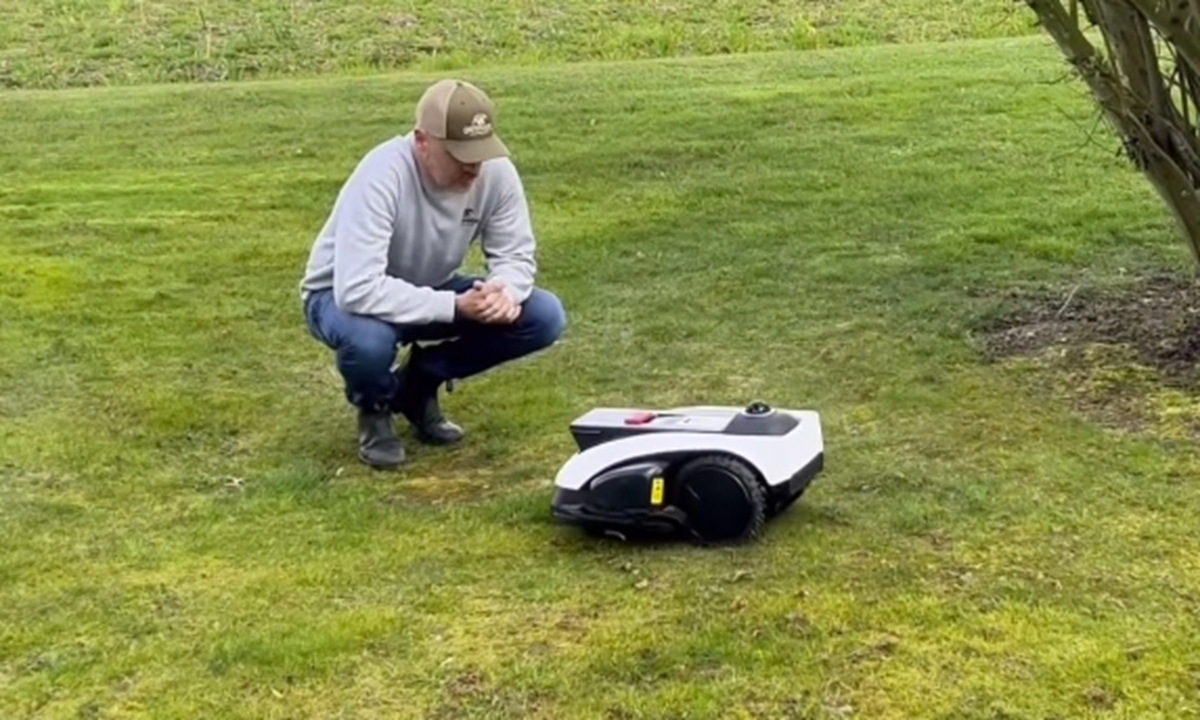
A European consumer uses an Ecovacs robotic lawn mower. Photo: Courtesy of Ecovacs
As heatwaves sweep through Oxford, the UK in July and August, keeping the lawn under control has become a headache for Qiao Yukai, a 45-year-old local resident, with professional mowing services costing as much as 200 pounds ($270) an hour during the peak summer season. What surprised him, however, was the solution offered by his British friend George: buy a Chinese robotic lawn mower.
"He told me it worked really well and could save a lot on labor costs," Qiao told the Global Times. "At first, neither of us paid much attention to the brand. It was only later that I realized a Chinese company made it. I was surprised, and also felt quite proud." According to Qiao, George had not even noticed the mower was Chinese - he cared little about the brand or origin, and solely focused on its performance.
As brand origin becomes less central to purchasing decisions, performance, user experience and technology are increasingly what win consumers over. Chinese smart manufacturing is entering European and US households not through grand slogans, but through products that work — with consumers casting their votes, one order at a time.
In recent years, China's strong push for technological innovation and advanced manufacturing has given rise to a new generation of sophisticated, cutting-edge products. Through open trade and expanding global markets, these products are reaching households worldwide, allowing more consumers to share in the opportunities created by China's technological and manufacturing progress.
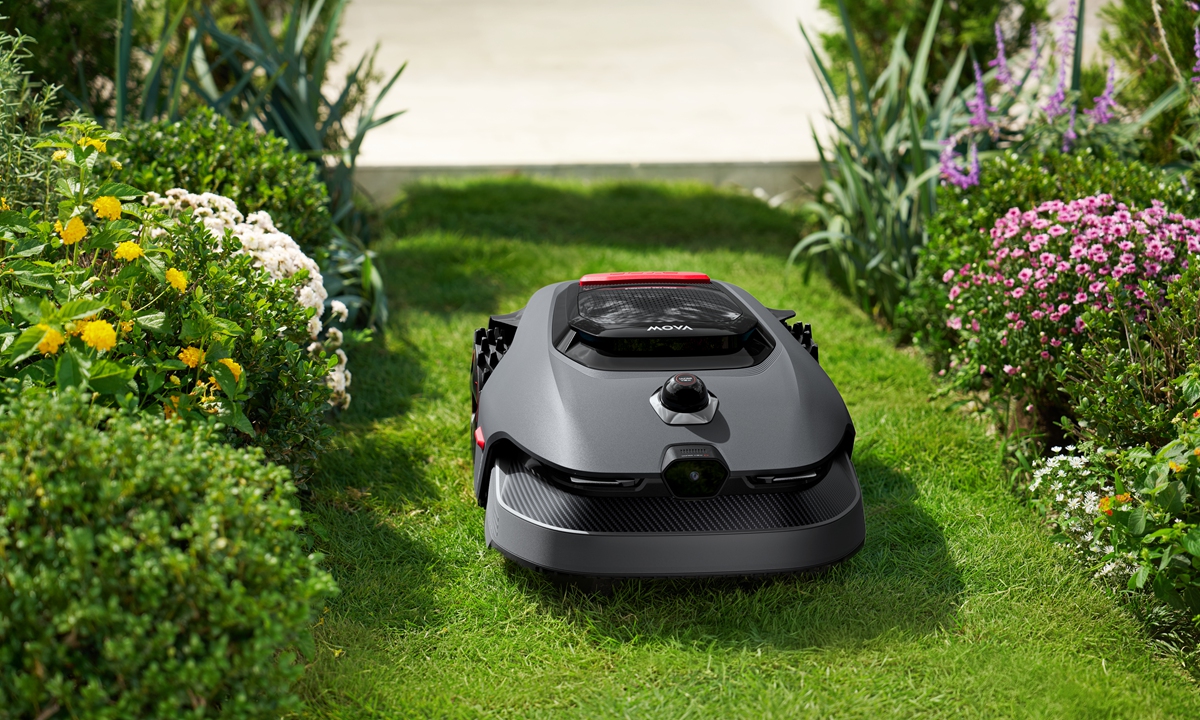
A MOVA robotic lawn mower operates on a lawn. Photo: Courtesy of NexLawn Intelligent Technology
Consumers' votes
George's recommendation also prompted Qiao to notice just how widely Chinese robotic lawn mowers had already entered the UK market. "You can find them at major retailers such as B&Q and COSTCO. I bought mine on Amazon — place an order today and it can arrive in two or three days," Qiao said.
What Qiao did not realize was that the trend extended well beyond the UK. Across Europe, consumers had already taken notice of a new wave of Chinese-made smart products — and were casting their votes, order by order, for the ones they preferred most.
Over the past six months, Dreame and MOVA, robotic mower businesses under NexLawn Intelligent Technology, an intelligent lawn-mowing robot maker, have maintained rapid growth in the European market, Li Jian, president of the company, told the Global Times.
Data showed that in the first quarter 2026, Dreame and MOVA accounted for 27.63 percent of global robotic mower shipments and 29.06 percent of global sales revenue, covering dozens of countries and regions, including Germany, France, the US and Australia. Li said their products have achieved top rankings in Amazon Best Sellers lists across multiple countries and secured the top position in several Bauhaus markets.
Ecovacs, another major Chinese robotic mower maker — the brand that George had unknowingly recommended to his friend — has also seen similarly strong sales momentum.
Over the past six months, Ecovacs' GOAT robotic mowers have sustained the strong growth seen in previous years, with key markets including Germany, France, Italy and the Nordic countries, as well as parts of Eastern Europe such as Poland, the Czech Republic, Slovakia and the Baltic states, the company told the Global Times. This year, building on its existing 32V platform, Ecovacs introduced the TruEdge Trimmer function to address a longstanding pain point — uncut grass along lawn edges. The feature has been well received by consumers.
Notably, many UK households still rely on conventional push mowers that require in-person operation, according to Qiao. Robotic mowers, by contrast, can map the lawn, set mowing zones and be controlled remotely through a smartphone, allowing them to keep working even when homeowners are at work or away on holiday.
"It works much like a robotic vacuum cleaner in China, but for many local users, that level of automation is still quite striking," Qiao said.
The automation and convenience Qiao described are precisely what make these Chinese technologies stand out.
From mapping a lawn to understanding how a household actually uses it, Chinese companies are turning capabilities accumulated in smart homes, robotics and supply chains into product features tailored to real-life needs.
The foundation behind this experience is the integration of advanced technologies, including LiDAR and AI vision, into outdoor lawn care scenarios, according to Li. These technologies enable robots to quickly understand their surroundings, automatically create maps, and intelligently plan mowing routes, significantly lowering the barrier to adopting smart robotic mowers.
Bian Yongzu, executive deputy editor-in-chief of Modernization of Management magazine, said Chinese companies have won over European and US consumers by combining strong supply chains and technological capabilities with a rapid response to local demand. The internet has amplified that advantage, allowing consumers to compare products through videos, specifications and, crucially, real user reviews rather than relying largely on brand reputation or in-store marketing.
"This has made the strengths of Chinese products much easier to see," Bian said. "Their competitiveness is no longer just about prices, but increasingly about performance, quality, technology, service and the ability to respond quickly to what consumers actually need."
As online reviews become more influential, he added, consumers can make more direct comparisons between brands, giving competitive Chinese products greater visibility in overseas markets.
Technological revolution
Robotic lawn mowers are just one of a growing range of products born from Chinese companies' sustained pursuit of technological innovation. They embody the country's commitment to harnessing technology to improve everyday life, as well as Chinese companies' commitment to meeting the needs of consumers across different markets worldwide.
Customs data released in July showed that China became a net exporter of industrial robots for the first time in 2025, with exports surpassing imports. In the first half of 2026, industrial robot exports reached 6.29 billion yuan ($633 million), up 18.6 percent year-on-year, with products shipped to 141 countries and regions worldwide.
Against this backdrop of technology-driven export growth, Chinese companies are taking overseas markets not just machines, but also a more mature ecosystem of technology, services and user-oriented solutions built around real consumer needs, Chinese experts said.
Li told the Global Times that European users place particular emphasis on a mower's ability to free itself when it gets stuck and to trim lawn edges cleanly, adding that new models launched this year will address and improve these functions through robotic-arm technology.

Photo: VCG
After sustained engagement with users and distributors in Europe, Ecovacs found that consumers increasingly want robotic mowers that are easier to set up, more reliable in complex gardens and better at handling obstacles and lawn edges. In response, the company introduced a string trimmer that can reach grass along walls and fences that conventional cutting discs often miss, reducing the need for manual edge trimming and bringing robotic mowing closer to fully automated lawn maintenance.
According to the Xinhua News Agency, China's robot exports are moving steadily up the value chain, from cleaning robots, which account for more than 70 percent of exports, to fast-growing industrial robots and emerging intelligent humanoid robots, becoming a new bright spot in the country's foreign trade growth.
As China's technology exports expand, the gap between political debates over Chinese manufacturing and consumers' actual choices is becoming increasingly apparent.
Bian said there is a clear gap between some political criticism of Chinese supply chains and consumers' actual choices. "Politicians may view Chinese products through political and strategic calculations, but consumers care more about whether a product works, offers good value and meets their needs," he said. "If Chinese brands are competitive in performance, quality, price and service, consumers will vote with their wallets."
"I don't pay too much attention to which country a product comes from when choosing this kind of technology," George said.
"I usually look at sales and customer reviews online. If a product sells well and the feedback is consistently positive, it is usually a safe choice — consumer reviews are based on real experience," he said.
RELATED ARTICLES