Japan’s jitters over Chinese fishing vessels reveal a guilty mind: Global Times editorial
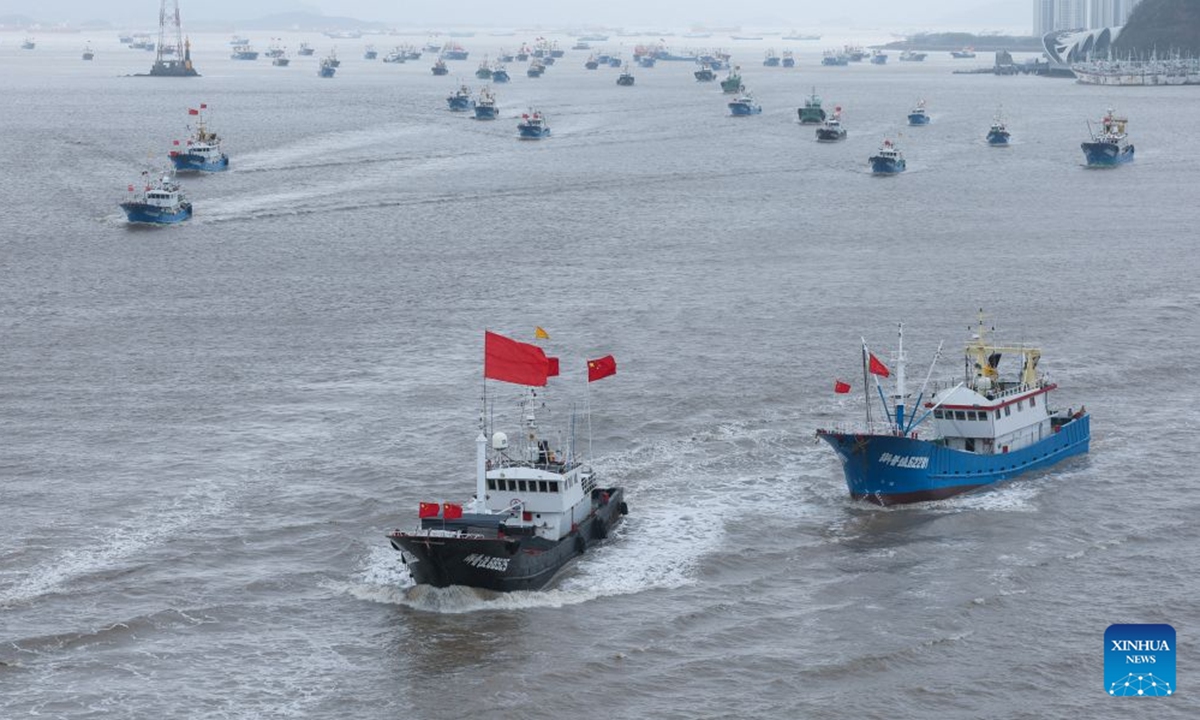
Fishing boats set sail for fishing from Shenjiamen Port in Zhoushan, east China's Zhejiang Province, Aug. 11, 2026. Four types of fishing boats with special permission set sail on Tuesday after a three-month summer fishing ban in the East China Sea. The opening of the fishing season was delayed from the originally scheduled Aug. 5 due to Typhoon Dolphin. (Xinhua/Xu Yu)
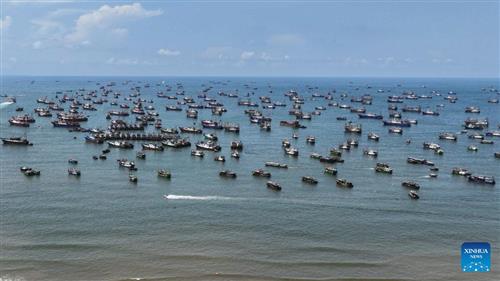
The summer fishing moratorium in the East China Sea has partially ended, and the fishing season has officially opened in the South China Sea. During this time, social media is awash with videos of fishermen showing off their fully loaded catches as they return to port, while tourists make special trips to taste "the first fresh catch of the fishing season" - a common yet heartwarming scene of bountiful harvests along China's coastline.
However, some Japanese media outlets are watching this bustling scene with a suspicious eye. They claim that the Japanese government is closely monitoring the movements of these Chinese fishing vessels, suggesting that the large-scale departure of fishing boats might be part of the so-called "militia training" - forcibly linking these scenes of everyday life to tense, confrontational conflict.
In recent years, at the end of the time of China's fishing moratorium, Japanese media have almost always followed a fixed playbook: First, they forecast that "large numbers of Chinese fishing vessels are about to set sail"; next, they report that "the Japan Coast Guard is stepping up vigilance"; and immediately afterward, they circulate unverified reports such as "suspicious vessels entering the contiguous zone" or "suspected militia vessels gathering." This formulaic approach has long strayed from basic facts, evolving into a political narrative that has been repeatedly rehearsed.
The Diaoyu Island and its affiliated islets are an inherent part of Chinese territory, and most of the nearby areas constitutes traditional fishing grounds where Chinese fishermen have fished for generations. China's summer fishing moratorium in the East China Sea and South China Sea is a domestic management measure implemented to conserve marine fishery resources and promote sustainable development, and it is in line with international practice.
Every year after the fishing moratorium ends, fishermen travel in groups and fish collectively - a traditional practice designed to address maritime risks and share information on fishing seasons. Japanese media have concluded that Chinese fishermen are "militiamen" based solely on the fact that they operate on a "large scale" and in "neat formations"; such speculation lacks even the most basic factual basis.
The root cause of the fisheries dispute between China and Japan lies in the fact that Japan's unilaterally demarcated "exclusive economic zone" overlaps extensively with China's claims, while Japan attempts to restrict the lawful operations of Chinese fishermen under its domestic laws.
In recent years, Japan has repeatedly taken law enforcement actions against Chinese fishing vessels in the disputed waters. In February of this year, Japan seized a Chinese fishing vessel and arrested its captain within the "exclusive economic zone" it unilaterally claims. In response, China lodged a solemn protest. China requires its fishermen to operate in accordance with laws and regulations, while resolutely safeguarding their legitimate rights and interests and handling such matters in a rational and restrained manner. The Japanese side's coercive law enforcement, coupled with its refusal to acknowledge the existence of the dispute, constitutes in itself a lack of respect for bilateral relations.
Why does Japan continue to play up the so-called "threat posed by Chinese fishing vessels"? There are four main motives behind it. First, it seeks to provide a veneer of legitimacy for expanding maritime law-enforcement capabilities, strengthening military deployments on the southwestern islands, and increasing defense spending. Second, it attempts to forcibly link the normal gathering of Chinese fishing vessels to a "Taiwan contingency," speculating that China might use civilian vessels to "block shipping lanes" or "disrupt resupply," thereby laying the groundwork in public opinion for Japanese intervention in Taiwan Straits affairs. Third, it seeks to align with the US strategy of containing China by framing China's legitimate actions as those of a "rule breaker," thereby making it easier, in moral and political terms, for the US and Japan to adjust their military deployments in the Western Pacific. Fourth, it seeks to internationalize China-Japan fisheries disputes and create a false impression that China is engaged in fisheries conflicts throughout its neighboring countries, in an attempt to cobble together a united front to pressure China.
Japan frequently criticizes China over maritime issues, but in reality, Japan itself has repeatedly become embroiled in international controversies. China is one of the countries with the broadest coverage and most rigorous implementation of seasonal fishing bans. China actively participates in regional and global fisheries governance and has adopted a series of robust measures to combat illegal, unreported, and unregulated (IUU) fishing, while engaging in various forms of fisheries cooperation and dialogue with neighboring countries. China has also continued to develop marine ranching and explore a transition toward a model of "replacing fishing with aquaculture," while steadily advancing efforts to help fishermen transition to new industries and occupations. These efforts and achievements have been recognized by many international organizations and countries. Japan, by contrast, has long portrayed itself as a "protector of the marine environment," yet its actual conduct on issues such as whaling, dolphin hunting, overfishing, and the forceful discharge of nuclear-contaminated water stands in stark contrast to this self-image.
Ultimately, Japan's fixation on the issue of "Chinese fishing vessels" reflects a growing strategic anxiety in the face of China's continued development. China's maritime rights-protection capabilities are improving, while its regional influence is expanding. These objective changes have made it difficult for Japan to adjust.
Rather than viewing China's normal development on an equal footing, some in Japan have continued to fill the old "China threat" narrative with new material. But such short-sighted behavior will only further erode the already fragile foundation of mutual trust between China and Japan and increase the risk of miscalculation and friction at sea. Peace and stability in the East China Sea serve the common interests of both countries and are also the shared expectation of countries across the region. Instead of indulging in unfounded speculation, Japan should face up to history and respect the facts, allowing the sea to return to its natural role as a realm of peace and cooperation.
RELATED ARTICLES