Modern intelligent technology helps breathe new life into Northwest China’s ancient Ningxia irrigation system
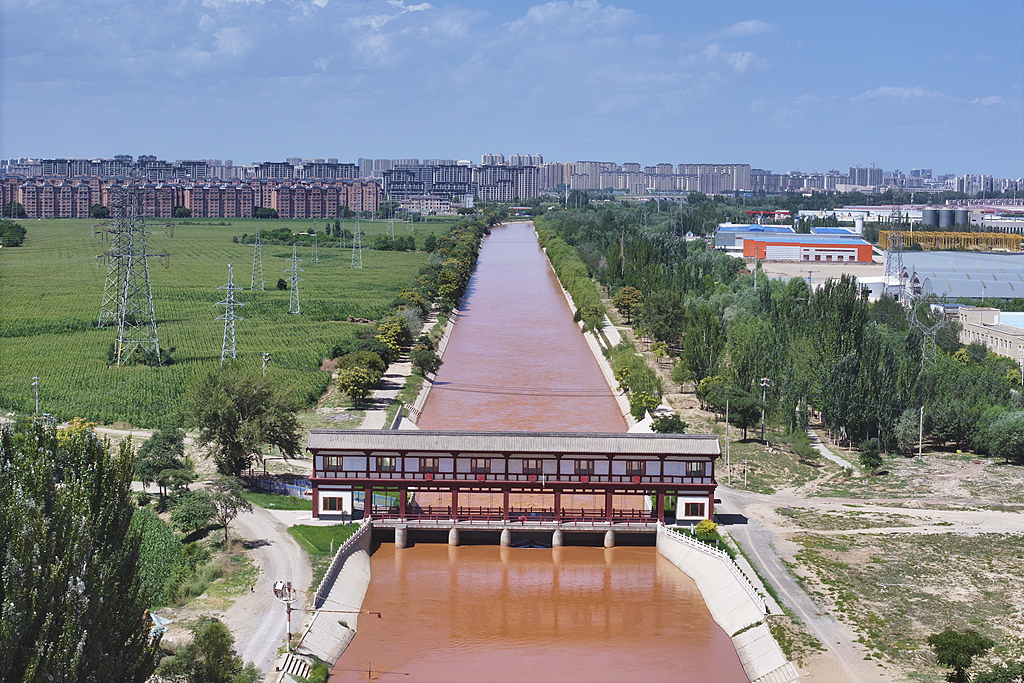
A view of Tanglai Canal in Yinchuan, Northwest China's Ningxia Hui Autonomous Region, on July 20, 2026 Photo: VCG
Across the Ningxia Plain in northwestern China, Yellow River water flows through channels like veins, reaching farmland. Along the Daqing Canal, water moves silently through newly rebuilt rectangular concrete flumes, its surface smooth as a mirror.
“The route of the canal hasn’t changed, but everything inside has,” said Bai Lu, head of the Qingtongxia Irrigation Area modernization project team under the Ningxia Hui Autonomous Region Water Conservancy Engineering Construction Center, crouching by the canal wall and tapping the sturdy concrete lining.
“In the past, it was earth canals or precast slab canals, and seepage and siltation were problems every year. Now it has been fitted with this ‘reinforced concrete shell’ — water is conveyed faster, and less is wasted.”
The Qingtongxia Irrigation Area is one of China’s six mega irrigation areas and an important part of the World Heritage-listed Ningxia Yellow River Ancient Irrigation System. In March 2025, the modernization project officially began, giving this ancient irrigation district a “digital brain.”
“An ancient irrigation area is not a museum relic. It is a tool that can be put to use,” Bai said.
Old channel upgraded
The Daqing Canal was first excavated during the reign of Emperor Kangxi of the Qing Dynasty (1644-1911), and its route has remained almost unchanged ever since. But the canal itself has long been under strain.
“At first, this section was just an earth canal, dug by hand, and seepage was serious,” said He Qiang, project manager of Section 6 of the Daqing Canal works. Later, hexagonal precast slabs were installed, but they did not last long either. Peeling, sand shedding, and frost heave damage became routine, and half the canal was clogged with silt. “The irrigation of 89,000 mu (59.33 hectares) of farmland was always under pressure. Every irrigation season, we had to rely on dredging boats,” he said.
Winter temperatures are too low for construction, leaving only two workable windows each year: more than 40 days before spring irrigation from March to April, and about 50 days after autumn irrigation from September to October. “All told, we only have about a hundred days a year to work,” He said.
This time, the team introduced a factory-based prefabricated reinforced concrete rectangular canal design. On site, rows of concrete components were neatly arranged. The prefabrication plant can produce and shape these components in 28 days before transporting them for assembly.
During installation, expansion waterproof strips are inserted between each slab, and epoxy resin mortar is applied to the outside as well. As He demonstrated with a level at the joint, the surface was flat and the seams were almost invisible. “It’s a double-layer anti-seepage system, and the concrete can fully withstand severe cold.”
He calculated that for a 5-kilometer canal, traditional cast-in-place construction would require 300 workers, while prefabricated assembly needs only 150. In addition, earthworks and prefabrication can proceed in parallel, without waiting for concrete to cure.
The Daqing Canal renovation started September in 2025 and was fully completed in April in 2026 “With traditional cast-in-place methods, we would have had to wait for the construction window until the end of August. Now, with prefabricated slabs assembled on site, efficiency has doubled,” He said.
The new canal also brought unexpected benefits. The rectangular canal takes up less land than a trapezoidal one, reducing the need to cut down trees on both sides. Reserved holes at the top of the canal can be fitted with steel railings, which are safer and more attractive than the old roadside wave barriers. The smooth inner wall of the concrete increases flow speed and stabilizes water movement.
“Look, the water is moving fast but there are no splashes, which means higher conveyance efficiency and less siltation,” He said, pointing at the canal. “Before, half the canal was mud. Now the bed is much cleaner.” If a single prefabricated slab is damaged, it can be replaced independently, reducing maintenance costs.
“Prefabricated assembly is especially suited to the next phase of the Qingtongxia Irrigation Area’s overall renovation,” Bai said, looking at the water surging through the new canal. “We upgraded the old canal in place, without changing the alignment or the distribution pattern. What changed was only the material and the construction method.”
Preserving heritages
The Hui Nong Canal was excavated 300 years ago and passes through six counties and districts. Longmen Bridge Headgate is the key control project downstream of the canal head.
Today, the headgate bottom slab and frame were built in the 1970s, but the lower structure remains relatively intact. At the inlet, the rough gate slots are clearly visible.
“Clearing silt every year is a major challenge,” said Bai Zhanbin, project manager of Section 1 of the Hui Nong Canal works. “The silt in front of the gate is over a meter deep, and the flow loses momentum here. The old gate piers are right next to the village production road, which also creates safety risks for people and vehicles.”
The original plan had been to demolish and rebuild on the same site. “The old gate bottom slab and frame are relatively intact. If we demolished them, it would be a pity for the water heritage,” Bai said. After repeated discussions during the planning stage, the team decided to move the new gate 75 meters upstream and build it at a new site, while preserving the old gate as it was.
On the construction platform of the new gate, the frame has already taken shape, and workers are installing the gates and solar panels. The new gate has been reduced from nine bays to seven, while the effective water conveyance width has been expanded from 27 meters to 35 meters, greatly improving control capacity. More importantly, it is adjacent to the existing drain gate, allowing the two gates to operate in coordination. A connecting corridor has also been designed for the gate chamber.
“During wet seasons or when water is shut off, the drain gate can be used to flush out the silt in the upstream section. In the future, there won’t be silt buildup between the old gate and the drain gate,” Bai said.
The relocation also adds a layer of safety. “Now the new gate operates independently, cleanly and efficiently, avoiding interference with the adjacent road,” Bai said. The new gate is equipped with solar control panels, using clean energy to power lighting in the gate house, adding a green element to the ecological irrigation area.
Standing between the old and new gates, Bai looked at the World Irrigation Heritage marker for the Ningxia Yellow River Ancient Irrigation System, standing quietly nearby. “Let the old gate carry historical memory, and let the new gate shoulder modern functions. Both are for making the ancient irrigation district better serve today’s life,” she said.
Smarter water management
At the dispatch center of the Qin-Han Canal management office, a large electronic screen shows in real time the water levels, flow rates, and operating status of every controlled gate along the eastern main canal.
During last spring’s irrigation season, the center carried out a “point-and-click water dispatch”: with a mouse click, the operator issued a command, and within 30 minutes dozens of gates along the eastern main canal had all been adjusted.
The flow deviation was controlled within 0.02 cubic meters per second, and water level fluctuations were accurate to the millimeter. In the past, starting the spring irrigation system required dozens of people on site and took at least two hours.
This is far from the only digital upgrade.
Along the Qingtongxia Irrigation Area modernization project route, sensors for seepage and deformation are constantly monitoring beneath the aqueducts; water level gauges and video surveillance cameras are installed along the canals; gates and pumping stations are all connected to control systems. Tens of thousands of sensing points have formed a three-dimensional monitoring network.
“Previously, the six canal management offices in the irrigation district worked independently, and data were not shared, and dispatch relied on phone calls and patrols on foot,” said Bao Xiaoming, director of the Science and Information Technology division of the Ningxia Water Resources Department.
This information upgrade integrates mature digital twin modules from the Qin and Han canals, as well as the “forecast, pre-simulation, early warning, and contingency plan” system from the Hanyan Canal. In the end, it establishes a unified irrigation district management and control platform, enabling a leap from “experience-based decision-making” to “data-driven decision-making.”
Once the platform is completed, artificial intelligence (AI) can be used for functions such as supply-demand analysis and dispatch simulation. “By inputting meteorological and other data, the model can automatically simulate the optimal gate adjustment plan, accurate to the hour,” Bao said. In one pilot test, the system precisely coordinated headgate flows, allowing nearly 10,000 mu of corn to receive timely irrigation during the jointing stage.
“Before, water releases depended on the seasoned judgment of veteran workers. Now, with a tap on a big screen, the model starts running and the sluice gates move on their own — saving water and improving efficiency.”
The completion of integrated, district-wide digital infrastructure marks a key step in the Qingtongxia Irrigation Area’s transition from “water management” to “smart water management.”
According to statistics, since the system overhaul began in 1998, the volume of water diverted from the Yellow River by the Qingtongxia Irrigation Area has dropped from 6.64 billion cubic meters to 3.206 billion cubic meters. Even without any reduction in irrigated area, this has strongly supported urbanization and ecological water use.
After the latest modernization project is completed, the district’s high-efficiency water-saving irrigation rate is expected to reach 44 percent, saving 53.79 million cubic meters of water annually and boosting grain output from an estimated 1.92 million tons to 2.24 million tons.
As evening fell and the sun dipped westward, water in the Daqing Canal continued to flow quietly. Newly installed laser water-level gauges and smart cameras operated silently, sending real-time data back to the dispatch center.
“Using modern technology to breathe new life into a centuries-old irrigation district — that is what true heritage is about,” Bai said.
RELATED ARTICLES