Does large exports and a big surplus equal 'overcapacity'?: People's Daily
Untangling logical fallacies of so-called 'China overcapacity' narrative (IV)
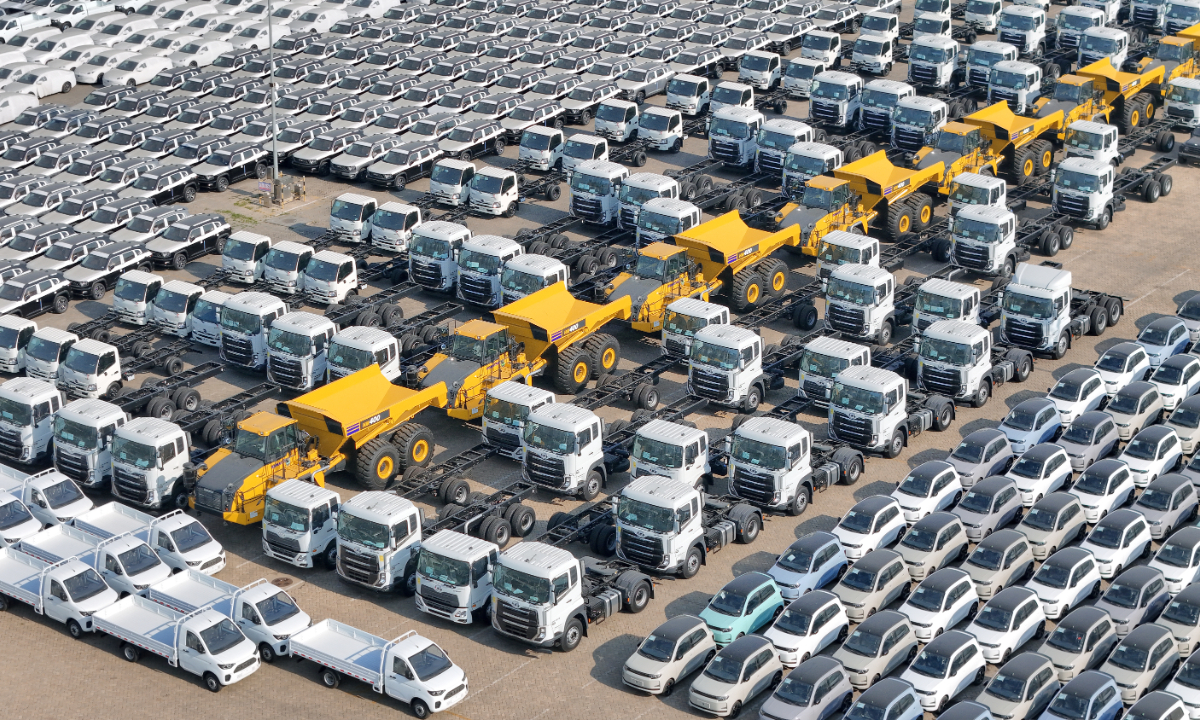
Domestically produced vehicles await loading for export at Yantai Port, Yantai, East China's Shandong Province, on May 1, 2026. Photo: VCG
For some time, certain economies, anxious about their own industrial competitiveness, have shifted blame for domestic structural problems onto China. They have promoted the one-sided claim that "large export volumes and high trade surpluses equal overcapacity," using it to justify protectionist measures that pit industries against one another and disrupt global supply chains.
Does a large export volume or surplus automatically mean overcapacity? The answer is clearly no.
In basic economic theory, a trade surplus mainly reflects the gap between domestic savings and investment. It is the product of technological innovation, industrial upgrading, global division of labor, and evolving supply-demand structures. Overcapacity, by contrast, is a dynamic market phenomenon of temporary imbalance between production capacity and demand. A surplus does not equal overcapacity - it is the result of the joint effect of global industrial division of labor and the structure of supply and demand.
History shows that virtually every major industrializing economy has run trade surpluses, while countries such as the UK, the US, Japan and Germany all maintained long periods of surplus. Germany and Japan frequently recorded current-account surpluses above 6 percent of GDP. Some 80 percent of US chips are exported, and about two-thirds of Boeing's commercial aircraft are sold outside North America. In 2025, the European Union ran surpluses of $92.2 billion in automobiles, $214.6 billion in pharmaceuticals and $11.6 billion in cosmetics. Emerging markets such as Indonesia and Mexico have also become surplus countries, while Brazil and Vietnam have posted trade surpluses for 10 consecutive years. If large surpluses necessarily signal overcapacity, should these industries and products also be labeled "overcapacity"?
China's export growth responds to real global demand driven by green transition and industrialization. For example, exports to Europe have concentrated in photovoltaics, new-energy vehicles, lithium-ion batteries and chemicals - reflecting Europe's energy transition and the higher production costs caused by the energy crisis. Here's another example. China's deeper industrial integration with ASEAN has boosted the trade of intermediate goods: in the first half of 2026, China's intermediate goods trade with ASEAN reached 2.86 trillion yuan ($424 billion), up 24.5 percent year-on-year, including a 42.9 percent rise in electricity exports that supported regional industry and livelihoods. It can be said that China's export growth responds to the world's needs and precisely matches global demand. How can this be called overcapacity?
More importantly, "the surplus is recorded in China, but the benefits are shared by all." In 2025 foreign-invested enterprises accounted for 27 percent of China's exports and 16 percent of its surplus, with both surplus and profits growing faster than those of domestic firms. In the first half of 2026, a substantial share of China's exports continued to be produced by foreign-invested companies - nearly 30 percent of exports to the EU and 40 percent to South Korea. China's export growth stems from economies of scale and rising innovation capacity. By expanding the global economic pie through shared development, China injects greater certainty and new momentum into international trade.
Viewed more broadly, China's overall external accounts remain balanced. While goods trade shows a surplus, services trade and investment income register deficits. The current-account surplus stands at roughly 3.7 percent of GDP - well within the internationally accepted reasonable range.
China does not deliberately pursue surpluses. It is orderly expanding independent and unilateral opening-up and actively promoting more balanced import-export growth. This is a deliberate choice based on its vast domestic market and the laws of global industrial division of labor, as well as a major economy's commitment to mutual benefit and dynamic trade equilibrium.
China has been the world's second-largest importer for 17 consecutive years and the main export destination for nearly 80 countries. It has granted zero-tariff treatment to 63 countries and is the first major economy to offer full zero-tariff coverage to all African countries with which it has diplomatic relations and to all least-developed countries with which it has diplomatic ties. It is also the only country that hosts a national-level import-themed expo - China International Import Expo, now in its eighth edition, with cumulative intended deals exceeding $580 billion. During the 14th Five-Year Plan (2021-25) period, cumulative imports surpassed 90 trillion yuan. China is not only the "world's factory" but also a major "world market."
Facing a new wave of technological and industrial transformation, countries should meet one another half way, uphold the global free-trade system, and promote balanced and sustainable trade. Only then can global industrial and supply chains remain stable and the benefits of development reach people in every country.
This was compiled and translated by the Global Times English edition based on an article published in the "Chisu Jinsheng" economic commentary column of the People's Daily on August 11, 2026.
RELATED ARTICLES