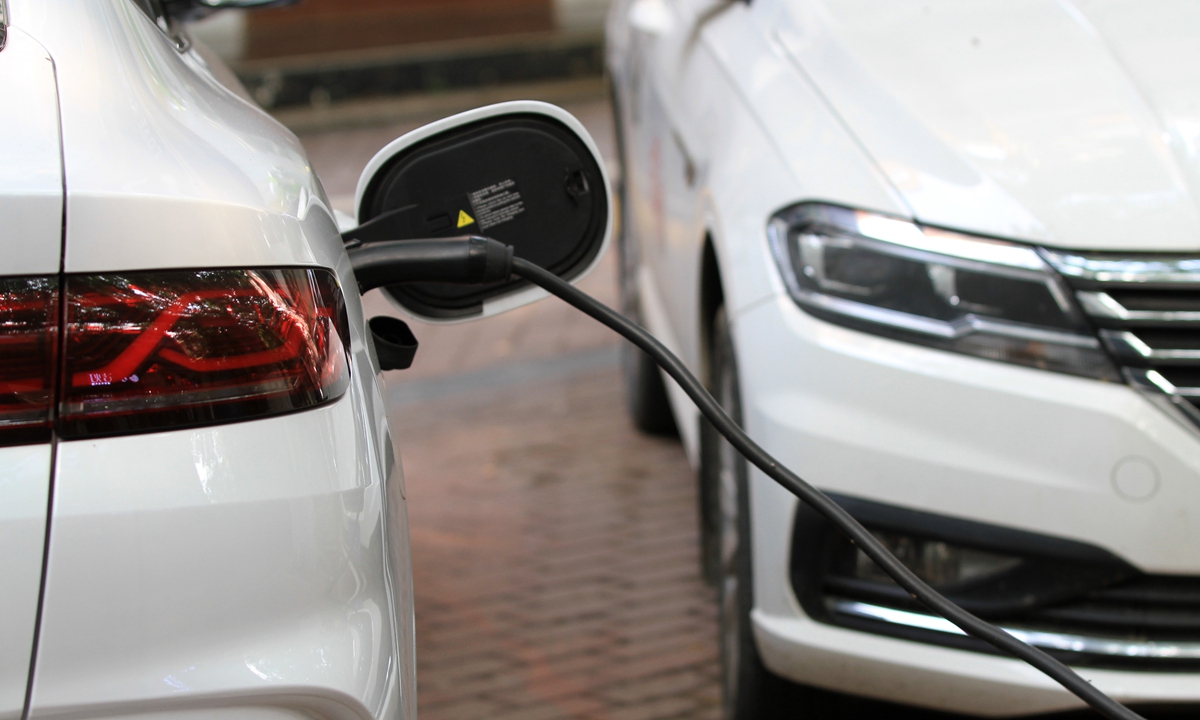
New-energy vehicles charge at a charging station in Huai'an, East China's Jiangsu Province on June 24, 2026. Photo: VCG
The European Commission has cleared Chinese automaker Seres Group's entry into a high-power charging joint venture established by BMW and Mercedes-Benz in China, bringing the three automakers into an equal-shareholding partnership in a market where they also compete for premium electric-vehicle (EV) buyers.
The deal suggests that China-Europe auto cooperation is moving deeper into the EV value chain, from traditional manufacturing and component supply toward shared investment in infrastructure and services, even as competition between carmakers becomes more intense, analysts said.
The European Union (EU) on Tuesday (local time) formally published its clearance of the transaction, under which Mercedes-Benz Group China, BMW Brilliance Automotive and Seres will jointly control Beijing-based EV charging operator Beijing IONCHI New Energy Technology Co, according to the EU's Official Journal.
The European Commission decided on August 12 "not to oppose" the transaction, finding it compatible with the EU internal market and noting its limited impact on competition in the European Economic Area. The case was reviewed under the bloc's simplified merger procedure, according to the commission.
The transaction mainly concerns IONCHI's operation of public high-power EV charging infrastructure and charging services in China. The company was previously jointly controlled by Mercedes-Benz and BMW, according to an EU filing.
The investment was first announced on April 17, with Seres set to join IONCHI as a new investor, leaving Mercedes-Benz, BMW and Seres each with a 33.3-percent stake, Xinhua News Agency reported.
In the announcement, BMW and Mercedes-Benz welcomed the move, saying they would work with the new partner to explore further opportunities for IONCHI, particularly in expanding network coverage, strengthening deployment in key regions and advancing service innovation.
BMW, Mercedes-Benz and Seres compete in China's fast-moving premium new-energy vehicle market while also joining forces in charging infrastructure. Jian Junbo, director of the Center for China-Europe Relations at Fudan University's Institute of International Studies, said the deal reflects a broader shift in thinking about competition and cooperation in the auto industry.
"As Europe's auto industry faces growing competitive pressure, protectionist measures alone cannot address the underlying challenges to its competitiveness," Jian told the Global Times on Wednesday. A more effective approach, he argued, is to deepen cooperation through joint ventures, investment and closer integration of industrial and value chains, he said.
BMW Brilliance Automotive and Mercedes-Benz Group China announced their original 50-50 charging joint venture in late 2023, with a target of building at least 1,000 high-power charging stations and around 7,000 charging points across China by the end of 2026. The cooperation is intended to elevate customer public charging experience, according to BMW's official website
Seres' entry therefore goes beyond simply giving AITO users access to another charging network. The April announcement said that the three sides would use the partnership to expand network coverage, strengthen deployment in key regions and pursue service innovation, according to Xinhua.
Jian described such cooperation as a form of deeper industrial integration. "China has developed strengths in areas including batteries, electrification, charging infrastructure and large-scale market applications, while European automakers retain advantages built over decades in engineering, vehicle design, brands and skilled talent," he said.
"The way forward is not to view the entire auto industry as a zero-sum contest, but to identify more specialized parts of the value chain where the two sides can complement each other," Jian noted, adding that deeper integration can bind interests more closely and allow both sides to draw on strengths they do not necessarily possess on their own.
The deal also comes as China and Germany have stepped up efforts to deepen industrial cooperation and keep supply chains stable, even as broader China-EU trade frictions persist.
At a meeting in late June, Chinese Commerce Minister Wang Wentao and German Economy and Energy Minister Katherina Reiche said the two economies remain closely linked through industrial and supply chains, with broad room for further cooperation. They called for making better use of complementary strengths, deepening cooperation in industrial upgrading and emerging sectors, and safeguarding stable global supply chains, according to China's Ministry of Commerce.
Wang also met Hildegard Müller, president of the German Association of the Automotive Industry, on April 27, with talks covering China-Germany auto cooperation, global automotive supply chains and EU trade restrictions. Müller said German automakers would continue expanding investment, R&D and localization in China, and supported deeper integration of China-Germany and China-EU automotive supply chains.
Jian said China-Europe auto cooperation still has considerable room to grow, particularly in areas where the two sides have complementary strengths. He also urged the EU to avoid discriminatory and protectionist measures against Chinese companies, saying a more open policy environment would support deeper investment and industrial cooperation.
RELATED ARTICLES