Why China’s idea of peace begins with a good meal?
By Published: Aug 19, 2026 08:12 PM
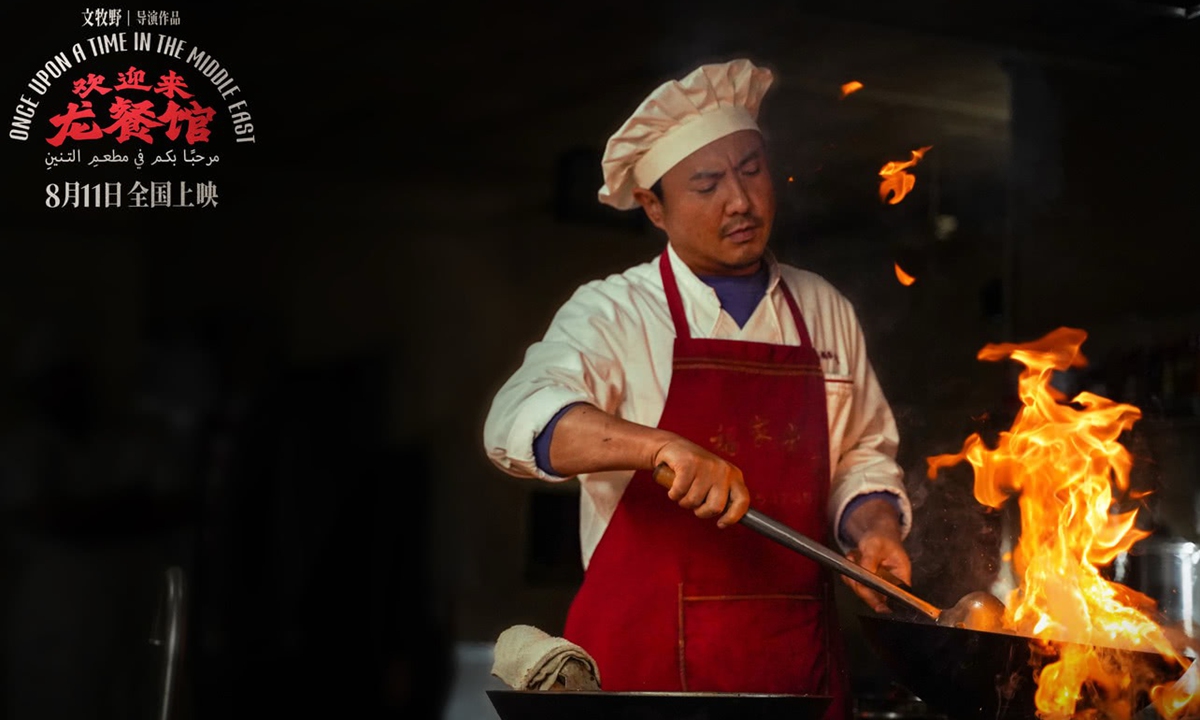
A still from the movie Once Upon a Time in the Middle East starring Shen Teng Photo: IC
There is a scene near the end of the Chinese war drama Huanying Lai Longcanguan - released internationally as Once Upon a Time in the Middle East - that has stayed with me. The film follows Xu Fu, a Chinese chef played by Shen Teng, who runs a small restaurant in a Middle Eastern country when war breaks out around him.In the scene, amid rubble and ruin, Xu sets up a makeshift stove and cooks a pot of rice for a group of orphaned children. Their faces, gray with dust, flicker briefly with hope. It is a quiet moment. It carries more weight than the battle sequences that dominate most war films.
When the movie was released in China this month, many viewers wondered why a film about war would center its emotional core on cooking a meal. But this, I think, is precisely the point, and it reveals something distinctly Chinese about how ordinary people understand war and peace: not through maps or strategy, but through a bowl of rice.
In Chinese, the most common greeting is not "How are you" but "Have you eaten?" It is a small ritual of care, one that presumes that as long as the fire in the kitchen is still burning, life continues.
In Chinese, "food" is never simply carbohydrates. It is shorthand for life itself, for the small, unglamorous continuity of getting through the day. This may sound modest, even trivial. But it carries an outsized moral weight: the idea that the quiet satisfaction of daily life matters more than any grand ideological narrative.
This is why, in the Chinese imagination, war is understood first through the household - a room, a stove, a family - but not the battlefield. War extinguishes the cooking fire before it topples a country. And the phrase "rice bowl" - a common Chinese expression for one's livelihood - is never just about crockery. It signals dignity, self-reliance, the right to stand upright in the world.
Bombs destroy bridges and buildings, but what devastates a person is watching the bowl they have carried through half a lifetime shatter, and realizing they can no longer put food on the table for their children.
This logic scales up naturally from the individual to the nation. China's modern historical trauma is remembered not only in terms of territory lost, but in the memory of hundreds of millions of people who went hungry. This is why, in the decades since, China's language around development has so often returned to a simple formulation: holding one's own rice bowl firmly in one's own hands. Food security is treated as a matter of national strategy because there is a hard-won understanding that if your rice bowl depends on someone else, peace is only ever borrowed.
None of this is uniquely Chinese, of course. It is a sentiment that could belong to any nation, any family, anywhere. Peace, in this sense, is not something declared. It is a mother cooking dinner without fear, a farmer finishing his midday meal in the field without listening for aircraft overhead. It is the simple right to eat without dread.
This is also why the film resists easy categorization as an anti-war statement. Xu is no strategist, no soldier, no symbol. He is simply a cook who, faced with suffering, chooses to light a fire rather than pick up a weapon. His instinct - to feed rather than to fight - reflects a broader belief that runs through much of Chinese thinking about conflict: That development exists to let people eat well, and that peace is the precondition for development, not its reward.
For international audiences unfamiliar with this sensibility, the film offers an unusually intimate entry point into how war is experienced by those who have no stake in it - only the desire to survive it, together, over a shared meal. Overseas viewers will soon have the chance to see this for themselves, as the film's global distribution is already underway.
The author is a senior editor with the People's Daily and currently a senior fellow with the Chongyang Institute for Financial Studies at Renmin University of China. dinggang@globaltimes.com.cn. Follow him on X @dinggangchina
RELATED ARTICLES