From the stage to the shop floor: China's embodied AI shines at WRC 2026
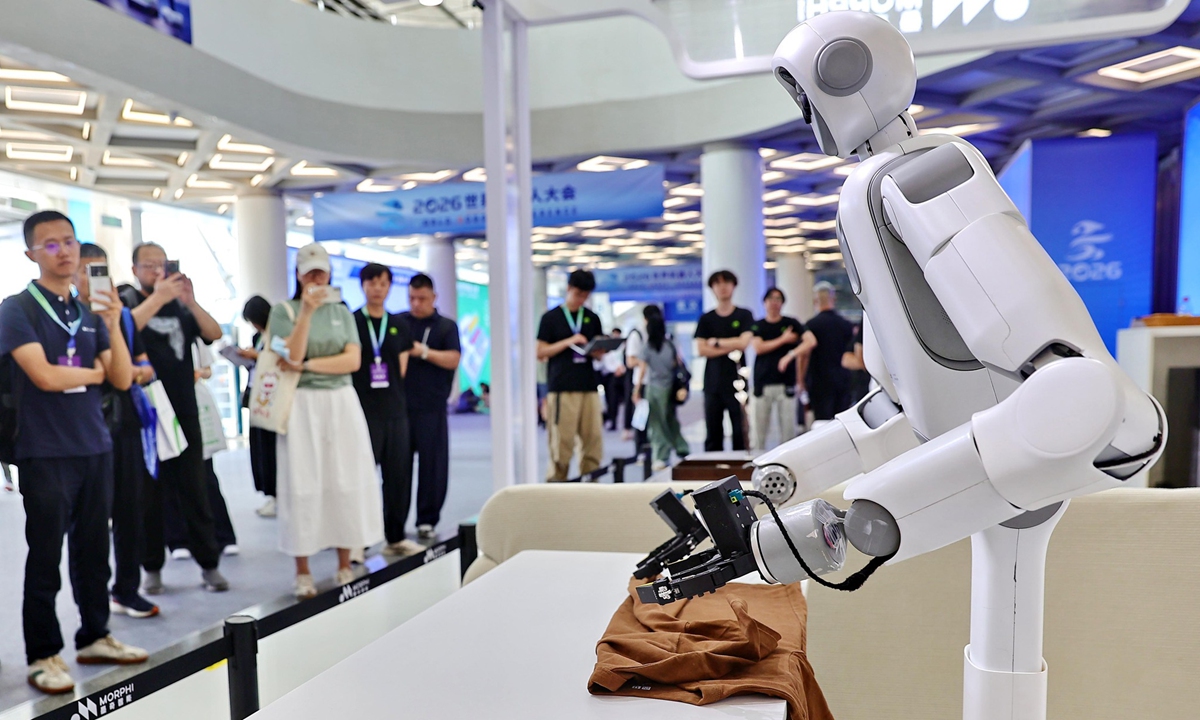
Visitors watch a robot folding clothes at the 2026 World Robot Conference in Beijing, August 19, 2026. Photo: VCG
More than 30 screens cover one wall of a booth at the 2026 World Robot Conference (WRC). Not one shows a robot dancing. Each carries a live feed from a different Chinese city: a robot in traffic-police uniform at an intersection, another in a car dealership, another out on patrol. The robots on the screens are not at the show. They are at work.
The 2026 WRC opened on Wednesday at the Beijing Etrong International Exhibition & Convention Center in southeastern Beijing's Yizhuang and runs through August 23. More than 300 companies are exhibiting, up 36 percent year-on-year, with over 2,000 exhibits and more than 150 products making their debut, according to co-host the Chinese Institute of Electronics. A zone for 49 centrally administered State-owned enterprises showing 12 application scenarios has been added for the first time, alongside a robot consumption street staffed by robot chefs.
It opened on the same day Unitree Robotics became the first humanoid robot maker to list on China's A-share market. Its shares closed up 460.34 percent, valuing the Hangzhou company at more than 340 billion yuan ($50.42 billion). Unitree shipped over 5,500 humanoid robots in 2025, the most of any vendor worldwide.
"The most obvious change this year is that the whole industry has moved from simply showing off tricks toward industrial logic and real deployment," Xiong Youjun, CEO of the Beijing Humanoid Robot Innovation Center, told the Global Times at the venue. The sector is "on the eve of embodied AI's 'ChatGPT time,'" he said, with companies shifting their attention from technical specifications to systematic capability - research, supply chain, scenario engineering and after-sales service.
That shift is happening under a new constraint. In late July, the US Federal Communications Commission (FCC) moved to bar new foreign-made humanoid and quadruped robots from the US market on national security grounds. The restriction will cost the country that imposed it, experts said. Shutting the door leaves the US with nothing to learn from and will not make itself stronger, said Xiang Ligang, director-general of the Zhongguancun Modern Information Consumer Application Industry Technology Alliance. "It may miss this wave."
Scenarios get specific
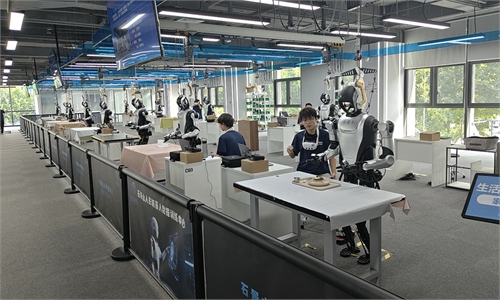
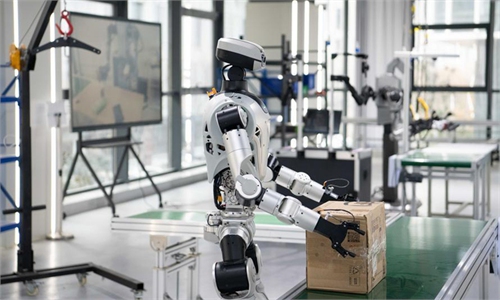
UBTech built no display set this year. "We moved the scenes we are actually deploying onto the show floor," Jiao Jichao, vice president of UBTech, told the Global Times at the booth, adding that the robots run continuously rather than in timed demonstrations. They no longer hang from an overhead rail but stand up out of their own shipping crates. An unmanned sorting system UBTech built with a listed logistics firm is running at that firm's customer sites in South Korea and Australia, and manufacturers including Huawei and Foxconn began buying robots for their lines this year, Jiao said.
Not all of it is humanoid. DEEPRobotics has pushed its S10 quadruped into the 100,000-yuan price class to serve smaller sites such as industrial parks and security patrols. "More and more robots have started to interact with the real world - folding clothes, carrying, sorting. This is real now," said Qiao Xin, who heads the company's technology solutions business. Its robot dogs can now run a task end to end, leaving a delivery station, carrying a parcel to a customer's door and returning alone.
The robots on that wall of screens belong to AiMOGA Robotics, backed by automaker Chery. Its traffic-police robots are on duty in 31 cities across seven provinces, directing traffic in coordination with signal lights, flagging riders without helmets, warning off illegally parked cars and answering questions at impound lots. "We did not spend much of the booth showing off our so-called core technology," said Zhang Guibing, general manager of AiMOGA and president of Chery International. Foreign outlets have asked whether Chinese robots can only sing and dance, he said, "but our robots are already working in these cities."
None of that makes the dancing pointless, executives said. Robots built for the stage are accumulating data for product iteration, and the emotional value of singing and dancing is a legitimate commercial demand in itself, Xiong said.
Juha Röning, vice president of euRobotics and professor of embedded systems at the University of Oulu in Finland, reached the same conclusion. Every time a robot goes into a realistic environment, something is learned, he told the Global Times, recalling a European robot trial in Switzerland where a site he had scouted a year earlier was unrecognizable after a week of rain.
A half marathon "is not a work," he said, "but there you can prove that your engine and batteries can work long time. So it's making your system more reliable and robust."
Scenarios, not import bans, decide what comes next
For robots to genuinely serve people, the binding constraint now is scenarios rather than machines, analysts said. China's first advantage is its complete supply chain, Xiang said: a firm needing a particular servo motor or reducer finds a supplier nearby and iterates with it, while a lone company elsewhere must solve everything itself. The second is aiming at usefulness. "If you don't have the ability to be useful, the robot just keeps doing backflips," he said, adding that users raise problems manufacturers never anticipated.
On July 28, the FCC announced a ban on imports of humanoid robots. It didn't mention any country, but China is the dominant supplier of humanoid robots. The US cited national security concerns for their ban. When asked for comment on the issue, Chinese Foreign Ministry spokesperson Mao Ning said that China firmly opposes the US overstretching the concept of national security and going after Chinese companies. "Protectionism does not make the US more competitive and will only hurt the interests of US companies and consumers. China will continue to do what is necessary to firmly defend the legitimate and lawful rights and interests of Chinese companies,'' the spokesperson said.
Jeff Burnstein, president of the US-based Association for Advancing Automation, said the restrictions are framed around national security and are not aimed only at China. The US has struggled to build a resilient supply chain, depends heavily on foreign components and wants to bring manufacturing home, he told the Global Times. He added that it is not yet clear whether the humanoids sold in China are doing meaningful work - but that putting them out there is itself the point. "One advantage of just getting them out, doing work, is that they learn. That's an advantage China has."
Röning said China's effort is "tremendous" and that it could be first in many application areas - though the hardest ones, he added, will still call for global collaboration.
RELATED ARTICLES