China vows to protect firms after US robot, inverter import bans
Impact seen limited, in sharp contrast to China's open-source drive: analysts
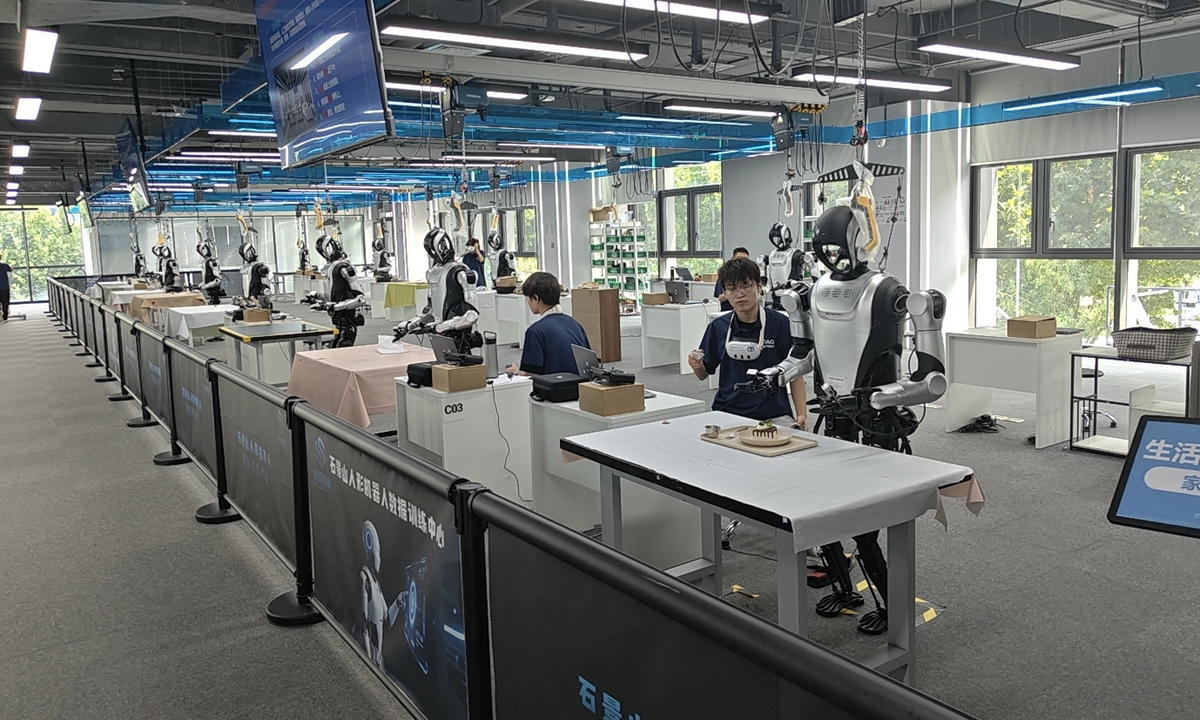
Workers train robots at the Humanoid Robot Data Training Center in Shijingshan district, Beijing on July 22, 2026. Photo: Zhang Yiyi/GT
Washington has tightened technology restrictions on China on two fronts in less than a week. On Tuesday local time, the US Federal Communications Commission (FCC) added advanced robots and power inverters to its Covered List, barring imports of new models.It came after on July 23, the US Department of Defense published an updated "1286 List," claiming to "counter unauthorized technology transfer to foreign countries of concern," with the list identifying 130 academic and research institutions located in China, Russia and Iran, a move China's Ministry of Commerce slammed as politicizing, weaponizing and instrumentalizing research cooperation, obstructing exchanges between the two countries' research communities and running counter to the global trend of sci-tech innovation cooperation.
The two moves target opposite ends of the same chain, analysts said: one cuts channels for China-US research cooperation, while the other blocks Chinese products from the US market. The latest US approach reflects anxiety over China's technological rise and a desire to preserve sci-tech hegemony rather than an effective strategy. Analysts said the "small yard, high fence" approach has never halted China's progress, but instead risks undermining innovation and disrupting the global technology ecosystem, including in the US.
Self-defeating move
The US Federal Communications Commission (FCC) on Tuesday local time updated its "Covered List" to include two new categories of devices - "advanced robotic devices" (defined as mobile robots, such as humanoids and quadrupeds) and, separately, connected power inverters produced in foreign countries.
An FCC announcement claimed that "these devices could create supply chain vulnerabilities that could disrupt US economic and national security and could create a cybersecurity risk that threatened American critical infrastructure."
The announcement did not point out China but foreign media, including Reuters, reported that the new bans, while framed as applying to foreign-produced devices, "target imports of new Chinese robots and power inverters, seeking to protect the US AI buildout from national security threats and reshore key industries slated for explosive growth."
Following Tuesday's actions, the FCC is expected to exempt many non-Chinese suppliers from the restrictions, as it has done with recent bans on foreign drones and routers, Reuters reported, citing four additional sources.
Responding to the FCC ban, Chinese Foreign Ministry spokesperson Mao Ning said at a regular press conference on Wednesday that China firmly opposes the US overstretching the concept of national security and going after Chinese companies.
Protectionism does not make the US more competitive and will only hurt the interests of US companies and consumers, she said, adding that China will continue to do what is necessary to firmly defend the legitimate and lawful rights and interests of Chinese companies.
Humanoid and quadruped robots are still in their early stages, and imports would allow mutual learning and progress. Banning them would force American firms to operate "behind closed doors," slowing innovation, Xiang Ligang, a veteran telecom industry analyst, told the Global Times.
Zhang Xiaorong, director of the Beijing-based Cutting-Edge Technology Research Institute, told the Global Times on Wednesday that "in emerging fields like humanoid robots which are still far from mature global mass adoption, such isolation prevents learning and benchmarking, harming US development."
"Similarly, power inverters are critical for artificial intelligence (AI) data centers and renewable integration. Rejecting cost-effective Chinese options could raise electricity costs and slow AI progress due to supply or pricing issues," Zhang said.
"The US currently faces prominent problems in its energy system, with insufficient power support for AI development. If Chinese inverters are not adopted, other options either have unstable supply or excessively high prices, clearly not a wise move," Xiang said.
Limited impact
The FCC's Covered List already includes numerous Chinese companies, such as Huawei, ZTE, Hytera, Hikvision and Dahua for telecom and surveillance equipment since 2021, as well as China Mobile, China Telecom and China Unicom for telecom services since 2022. More recent additions in 2026 cover foreign-produced routers, power inverters and advanced robotic devices, as showed on the FCC website.
However, a quick, practical hit on Chinese firms is unlikely, and the US faces capacity pressures of its own, observers said.
Humanoid robots illustrate the point. A report released by Counterpoint Research in January showed about 16,000 humanoid robots were installed worldwide in 2025, with China accounting for more than 80 percent. The top five suppliers together held about 73 percent, four of them Chinese.
According to a CNN report, the ban could disrupt Chinese companies' US sales in the short term, said Lian Jye Su, chief analyst for AI and humanoid robots at research firm Omdia. But given long-standing geopolitical tensions between the two countries, he expects the overall impact to be minimal. Chinese firms have a clear-eyed view of their opportunity in the US market and of the current reality, he said, and the ban matches what they had expected. Many Chinese vendors are looking to Europe as their prime destination, he added.
For power inverters, an FCC official said that the US power inverter industry has the capacity to meet domestic demand, due to the Inflation Reduction Act of 2022 and the One Big Beautiful Bill Act of 2025 that cut taxes and incentivized production.
Yet the commission's own determination points the other way. An FCC announcement published on Monday said that in 2020, only seven percent of US inverter shipments came from US headquartered manufacturers. It also cites a 2024 Idaho National Laboratory analysis finding that about 80 percent of solar inverters in the US were imported from countries such as China and Germany, and attributes that dependence to limited domestic manufacturing capacity in the face of rising demand.
Xiang described the latest US approach as erratic policymaking born out of anxiety, rather than effective strategy. He argued that the long-standing "small yard, high fence" strategy rests on a misjudgment: the belief that the US can maintain technological superiority through isolation. However, recent years have shown US leads eroding in areas such as chips, 5G, drones and robotics.
In sharp contrast, China has consistently striven to provide global public goods in the AI sector, vigorously nurturing open-source ecosystems and promoting the global sharing of technological progress.
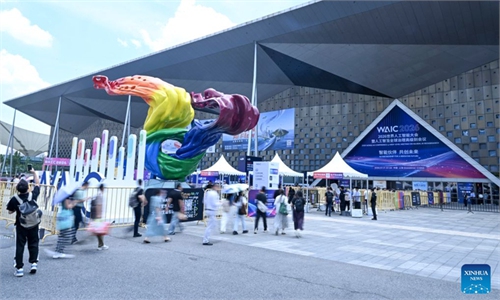
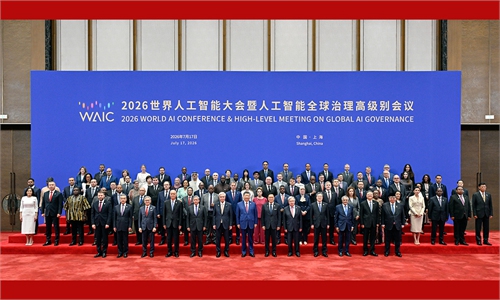
Through its Global AI Governance Initiative proposed at the recently concluded World Artificial Intelligence Conference in Shanghai, China calls on all countries to collaborate on risk prevention and the development of governance frameworks, norms, and standards based on broad consensus. This ensures that AI technologies are more secure, reliable, controllable and equitable, the Xinhua News Agency reported.
Chinese AI start-up Moonshot AI on Monday released the model weights and technical report for its closely watched new model Kimi K3 and open-sourced the key infrastructure behind its training, saying the move would accelerate the spread of frontier intelligence and advance artificial general intelligence (AGI) research. Chinese experts described it as the latest case of a Chinese company open-sourcing a near-frontier model, putting capabilities once confined to a handful of closed-source giants within reach of more countries, smaller teams and independent researchers.
If Washington continues to place administrative barriers ahead of competitiveness, it risks building a "greenhouse" rather than a competitive industry, experts said. Shielded firms face less pressure to improve, leaving US consumers paying more for technology that trails what is freely available elsewhere with US innovation itself paying the price.
RELATED ARTICLES