From Fields Medal to AI breakthroughs: China's young talents step onto global stage
By Published: Jul 24, 2026 10:45 PM

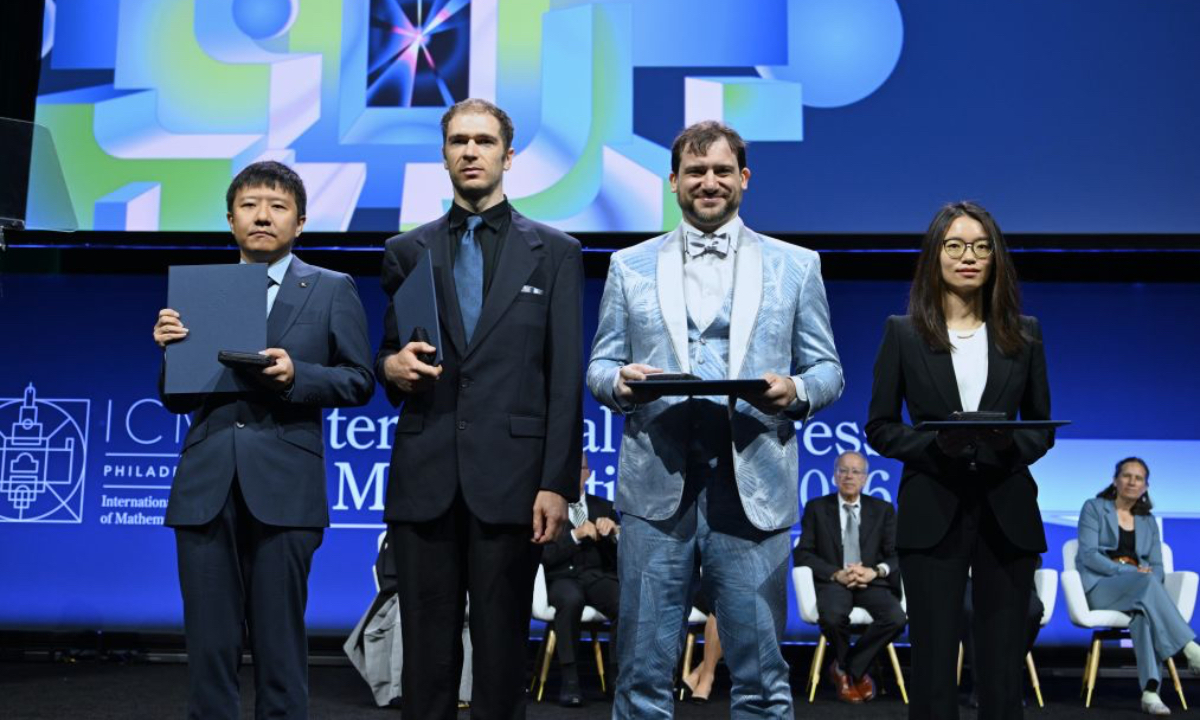
Fields Medalists Deng Yu (1st L) and Wang Hong (1st R), both Chinese mathematicians, John Pardon (2nd L), an American mathematician, and Jacob Tsimerman, a Canadian mathematician, pose for a group photograph at the opening ceremony of the 2026 International Congress of Mathematicians in Philadelphia, the United States, July 23, 2026. (Xinhua/Li Rui)
A series of breakthroughs in fundamental science and cutting-edge technologies have recently put China's younger generation of scientists and innovators under the global spotlight.
At the 2026 International Congress of Mathematicians in Philadelphia on Thursday local time, Peking University alumni Wang Hong and Deng Yu were awarded the Fields Medal, marking a historic breakthrough for Chinese mathematicians.
Meanwhile, Kimi K3, a 2.8 trillion-parameter open-source large language model developed by Moonshot AI, a startup co-founded by Tsinghua University alumnus and post-1990s entrepreneur Yang Zhilin, drew global attention in the artificial intelligence (AI) sector.
Also, discussions surrounding DeepSeek founder Liang Wenfeng's views on the development path of artificial general intelligence (AGI), AI ecosystems and domestic technological innovation have sparked widespread interest.
From breakthroughs in mathematical theory and advances in AI to university researchers and technology entrepreneurs, these young innovators represent a broader trend: China's new generation of science and technology talent is moving closer to the global innovation frontier and playing an increasingly important role in international academia, technological competition and industrial transformation, according to Chinese observers.
Unlike the earlier stage of development characterized largely by learning and catching up, today's young scientists and entrepreneurs are pursuing original breakthroughs in more fields, reflecting China's transition from leveraging scale advantages to strengthening its innovation capabilities, they noted.
From followers to frontiers
At the opening ceremony of the congress, held at the Pennsylvania Convention Center, the International Mathematical Union announced that Deng won the medal for his work in partial differential equations (PDEs), while Wang won the medal for her work in harmonic analysis and geometric measure theory, Xinhua said.
The Fields Medal is a top international mathematics prize awarded every four years to two to four young researchers under the age of 40 in recognition of their outstanding mathematical achievements in existing work and their promise of future achievement, Xinhua said.
Wang earned her bachelor's degree in mathematics from Peking University in 2011 before pursuing advanced studies in France, where she obtained a master's degree in mathematics and applications from Université Paris-Saclay in 2014 after studying at École polytechnique, according to the website of the Institut des Hautes Études Scientifiques (IHES).
She received her PhD from the Massachusetts Institute of Technology (MIT) in 2019 and later conducted postdoctoral research at the Institute for Advanced Study in Princeton. Wang joined UCLA as an assistant professor in 2021, became an associate professor at New York University (NYU)'s Courant Institute in 2023, and has served as a permanent professor at IHES and a professor at NYU since September 2025.
Deng, born in 1989, has often been described as a "math prodigy." His mother is a doctor and his father works in the computer-related field, according to media reports. Feng Yuefeng, Deng's math competition coach at Shenzhen High School, said that Deng had demonstrated exceptional mathematical talent since middle school and gradually advanced to the higher levels of mathematical research, according to the reports.
Deng is also known as a scholar with a wide range of interests beyond mathematics. According to media reports, his passion for anime has lasted for more than a decade; after going abroad for further studies and finding himself away from family and friends, he began spending more time watching anime and reading novels, covering genres ranging from romance to science fiction, and even tried his hand at writing poetry. Chess is another long-standing hobby that he has maintained for many years.
"Although their landmark achievements were made overseas, both Wang and Deng received their foundational education and undergraduate training in China, which laid a solid academic foundation for their later success," Tian Gang, an academician of the Chinese Academy of Sciences and director of the Beijing International Center for Mathematical Research, was quoted as saying in media reports on Friday.
Their achievements also demonstrate the effectiveness of China's early-stage cultivation of mathematical talent, Tian said.
Beyond individuals
Besides the prestigious breakthroughs made by young Chinese mathematicians, the recent launch of Kimi K3, the latest open-weight AI model from Chinese startup Moonshot AI, has drawn attention in Silicon Valley, with its 34-year-old CEO and co-founder Yang Zhilin becoming a focus due to his international academic background and decision to return to China to pursue AI innovation.
Born in 1992 in Guangdong, Yang graduated from Tsinghua University before earning a PhD at Carnegie Mellon University under renowned AI researchers Ruslan Salakhutdinov and William Cohen, and later worked at leading US AI companies before co-founding Moonshot AI with fellow Tsinghua alumni, according to open records.
Taken together, the stories of Yang Zhilin, Wang Hong, Deng Yu and Liang Wenfeng offer a glimpse into a broader transformation in China's science and technology landscape, Ming Jinwei, a former journalist and media commentator, told the Global Times on Friday.
In AI, Yang's Kimi K3 highlights the growing capabilities of Chinese developers in building advanced open-source models; in fundamental science, Wang and Deng's achievements demonstrate the rise of Chinese-trained researchers on the global academic stage; and in the technology industry, Liang's strategic vision reflects a new generation of entrepreneurs seeking long-term breakthroughs, Ming noted.
"Their achievements across different fields point to a broader trend: China's young scientists and innovators are becoming increasingly active participants in shaping the future of global technology and research," he said.
The rise of young Chinese scientists and entrepreneurs is not merely a story of individual achievement, but also reflects the evolution of a broader innovation ecosystem, according to Chinese observers. Behind the breakthroughs of those figures lies a long-term effort to strengthen talent cultivation, expand high-level universities, and support research in fundamental sciences and emerging technologies, they noted.
China's innovation capacity today is built on a comprehensive system, including strong infrastructure, industrial chains and a mature innovation ecosystem, Xiang Ligang, director-general of the Zhongguancun Modern Information Consumer Application Industry Technology Alliance, told the Global Times on Friday.
"These advantages are not confined to one field but provide broad support for breakthroughs across emerging technologies and new areas of development," he said.
RELATED ARTICLES