OpenClaw of today still a playable version, not yet ready for real commercial use, production: NPC deputy
By and Chen Zishuai Published: Mar 12, 2026 11:00 PM

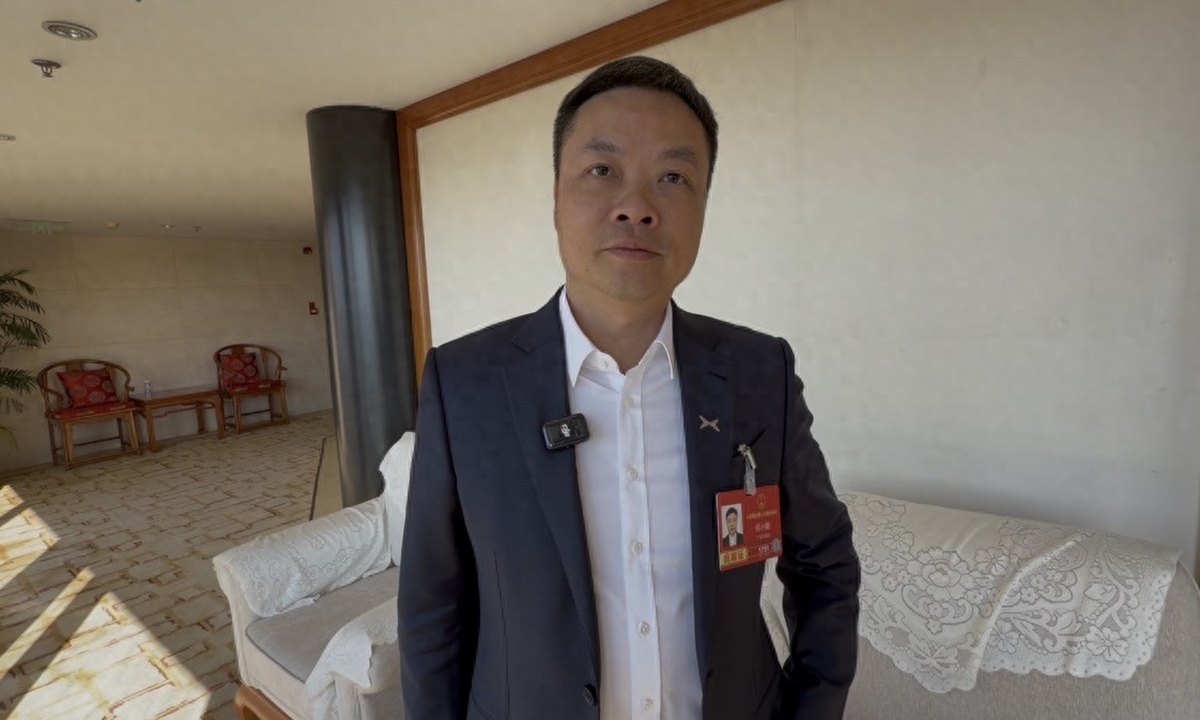
He Xiaopeng, a deputy to the 14th National People's Congress (NPC) and chairman of Chinese electric vehicle maker XPENG. Photo: Chen Qingqing/GT
"Inside our company we also use OpenClaw. I think it is just an exploration in the digital AI field. It can do something interesting, but it lacks breadth, and its security and fundamental risks have not been resolved. The current version is only a playable version and it isn't yet ready for real commercial or production use," He Xiaopeng, a deputy to the 14th National People's Congress (NPC) and chairman of Chinese electric vehicle maker XPENG, told the Global Times in an exclusive interview on Wednesday when asked about his view on the open-source AI agent OpenClaw, also known as "crayfish."
OpenClaw, created by Austrian developer Peter Steinberger, is designed to allow large-language models to operate computers autonomously, controlling files, executing commands and interacting through messaging applications such as WhatsApp and Telegram, according to the Xinhua News Agency.
Recently, China's Ministry of Industry and Information Technology issued a security risk alert regarding OpenClaw. According to a Wednesday report from Xinhua, a Chinese expert said the system features autonomous decision-making and the ability to access, call and utilize system resources. Coupled with "blurred trust boundaries" and the lack of strict examination and verification mechanisms in the current "skills package" marketplace, the technology still presents a number of potential security risks.
He Xiaopeng told the Global Times that he paid close attention to this year's Government Work Report. First, the Report mentioned for the first time creating "new forms of smart economy," which, he said, reflects the Chinese government's forward-looking understanding of global technological changes. Second, the Report highlighted the government will "pursue full integration between technological and industrial innovation," which, in his view, can leverage China's systemic, economic and institutional advantages. Third, the Report categorizes industries into emerging industries, industries of the future and traditional industries, which he believes will help propel sci-tech companies forward.
He added that the Report devoted considerable attention to the roles of state capital and private sector investment, as well as guidance on investment, financing and public listings. These will significantly facilitate China's technology sector and emerging service industries to go global.
During this year's "two sessions," He Xiaopeng also said in media interview that physical AI is going to become a key force driving the development of the smart economy.
Physical AI refers to artificial intelligence technologies that deeply integrate AI with the physical world. He Xiaopeng told the Global Times that XPENG plans to focus on developing large-scale physical-world equipment such as vehicles, robots and aircraft, and combining them with AI to make them "smarter."
"In the future, when a car runs low on power, it will go recharge itself and even choose the cheaper charging station. Humanoid robots will better understand me - when I get home, they may already have prepared my favorite meal," He Xiaopeng said.
OpenClaw, created by Austrian developer Peter Steinberger, is designed to allow large-language models to operate computers autonomously, controlling files, executing commands and interacting through messaging applications such as WhatsApp and Telegram, according to the Xinhua News Agency.
Recently, China's Ministry of Industry and Information Technology issued a security risk alert regarding OpenClaw. According to a Wednesday report from Xinhua, a Chinese expert said the system features autonomous decision-making and the ability to access, call and utilize system resources. Coupled with "blurred trust boundaries" and the lack of strict examination and verification mechanisms in the current "skills package" marketplace, the technology still presents a number of potential security risks.
He Xiaopeng told the Global Times that he paid close attention to this year's Government Work Report. First, the Report mentioned for the first time creating "new forms of smart economy," which, he said, reflects the Chinese government's forward-looking understanding of global technological changes. Second, the Report highlighted the government will "pursue full integration between technological and industrial innovation," which, in his view, can leverage China's systemic, economic and institutional advantages. Third, the Report categorizes industries into emerging industries, industries of the future and traditional industries, which he believes will help propel sci-tech companies forward.
He added that the Report devoted considerable attention to the roles of state capital and private sector investment, as well as guidance on investment, financing and public listings. These will significantly facilitate China's technology sector and emerging service industries to go global.
During this year's "two sessions," He Xiaopeng also said in media interview that physical AI is going to become a key force driving the development of the smart economy.
Physical AI refers to artificial intelligence technologies that deeply integrate AI with the physical world. He Xiaopeng told the Global Times that XPENG plans to focus on developing large-scale physical-world equipment such as vehicles, robots and aircraft, and combining them with AI to make them "smarter."
"In the future, when a car runs low on power, it will go recharge itself and even choose the cheaper charging station. Humanoid robots will better understand me - when I get home, they may already have prepared my favorite meal," He Xiaopeng said.
RELATED ARTICLES