When the West is struggling with direction, China’s robotics takes another step forward: Global Times editorial
Listen
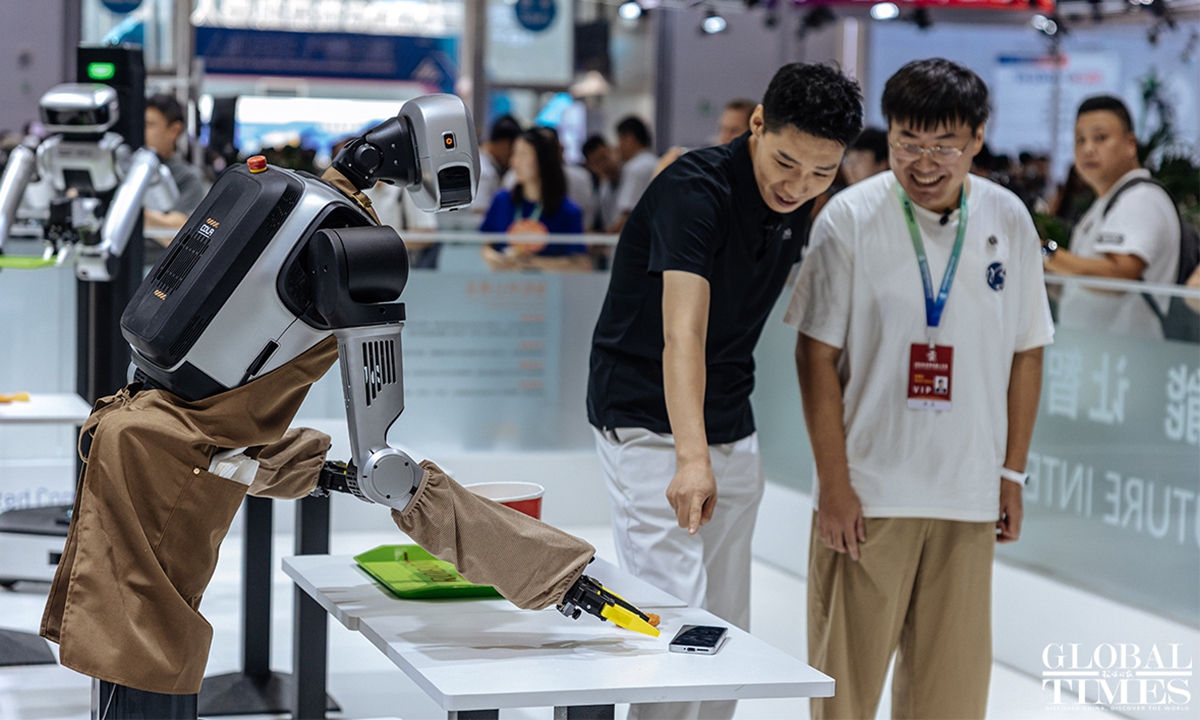
The 2026 World Robot Conference officially opened in Beijing on August 19. Boasting expanded scale, the five-day event gathers over 300 exhibitors (up 36% y-o-y), more than 2,000 exhibits and 150 debut products. It features over 60 themed activities, double the number from last year. Photos: Li Hao/GT
While Western public discourse is still endlessly debating the pros and cons of different robotics paths, China, focused on "running its own affairs well," has already moved ahead. The US and Europe have advantages in foundational algorithms, while Japan and South Korea have accumulated expertise in precision components. China, however, combines large-scale manufacturing capabilities with a vast and diverse range of application scenarios, allowing it to rapidly turn technological prototypes into mass-produced commercial products. This is the core source of competitiveness for China's robotics industry.
On Wednesday, the 2026 World Robot Conference opened in Beijing's Economic-Technological Development Area. On the same day, Unitree Technology listed on the STAR Market, becoming the first humanoid-robot stock on the A-share market. A top-tier industry gathering and a landmark capital-market IPO together mark a critical window for China's robotics sector as it shifts from research breakthroughs toward scaled deployment.
Global artificial intelligence (AI) competition is now pivoting from virtual digital models toward physical-entity intelligence. Whoever succeeds in embedding AI into robotic bodies and achieving large-scale application in manufacturing, logistics, and everyday services will seize the initiative in the next round of industrial transformation.
The conference theme, "Human-Robot Symbiosis, Production Demand Convergence," sends a clear signal. Exhibition halls span the entire value chain, ranging from core components and complete machines to industry solutions and consumer products. Hundreds of Chinese and foreign companies are showcasing their latest offerings, with more than a hundred new products making their debut. The exhibits focus far more on real-world pain points - factory assembly, warehouse logistics, high-risk inspection, elderly care and companionship - pushing robots deeper into China's manufacturing system and realizing "human-machine symbiosis." Robots are no longer mere technological showpieces on exhibition stands; grounded in market demand, they are beginning to enter every sector and every corner of daily life.
Unitree's listing on the opening day of the conference may look coincidental in timing, yet it is, to a significant degree, the inevitable outcome of China's robotics industry advancing on multiple fronts after years of patient accumulation. Globally, the humanoid-robot sector remains stuck in the stage of "impressive prototypes, difficult commercialization." Most companies still rely on successive rounds of private financing for oxygen, lacking scaled shipments, stable revenue, and a public-market valuation benchmark. Capital has largely been underwriting technological visions and industry narratives. Going forward, evaluation of the humanoid-robot industry will no longer rest primarily on prototype demonstrations and fundraising scale, but on real orders, product delivery, and market returns. The entire sector is moving toward pragmatic commercial exploration.
While Western public discourse is still endlessly debating the pros and cons of different robotics paths, China, focused on "running its own affairs well," has already moved ahead. China has the world's most complete and comprehensive industrial system, enabling it to respond quickly to the practical demands of product iteration, cost reduction, and mass production. Unitree Robotics' ability to rapidly iterate complete robots and deliver them at scale owes much to its extensive domestic network of upstream and downstream suppliers. Likewise, the wide range of homegrown products showcased at the World Robot Conference is built on a complete supply chain. The US and Europe have advantages in foundational algorithms, while Japan and South Korea have accumulated expertise in precision components. China, however, combines large-scale manufacturing capabilities with a vast and diverse range of application scenarios, allowing it to rapidly turn technological prototypes into mass-produced commercial products. This is the core source of competitiveness for China's robotics industry.
A complete supply chain and a vast domestic market are further expanding the possibilities for the commercialization of robotics. AI is no longer confined to cloud-based conversations; through robots as physical carriers, it is making its way into the real economy. On factory floors, robots handle repetitive assembly, precision inspection, and material transportation, helping drive the intelligent transformation of manufacturing. In warehousing and logistics, mobile robots take on sorting and material handling missions, easing labor pressures. In high-risk environments such as power facilities and mines, robots can replace human workers in inspection tasks. In areas related to everyday life, service robots are gradually entering nursing homes and households, playing an increasingly important role in areas such as caregiving and assisted operations.
Even more significantly, the development of China's robotics industry transcends national borders and seeks to benefit people around the world. This year's conference launched the "Global Robot Application Exploration Program," making mass-produced robotic products freely available to outstanding innovation teams worldwide and promoting the sharing of technological achievements globally. China's well developed robotics supply chain not only serves the domestic market but also provides key components to robot manufacturers around the world. Chinese-made robotic products and solutions are expanding overseas, helping countries advance manufacturing upgrades, emergency response, and public services. As China strengthens its own industry, it is also contributing shared innovation resources to the global development of embodied intelligence through its supply chains, products, and open platforms.
The robotics industry is currently in a transitional phase, moving from pilot applications and demonstrations toward large-scale adoption, and has yet to experience a full-scale boom. Some products still face practical challenges, including high deployment costs and limited versatility. Amid both opportunities and challenges, China's robotics industry is steadily building its capabilities with a pragmatic approach and moving toward large-scale commercialization. We have every reason to wish it well - and every confidence in its future.
RELATED ARTICLES