River-to-sea vessel under development, expected to debut next year: executive of Pinglu Canal Group
By and Su Yaxuan in Nanning Published: Aug 20, 2026 09:18 PM

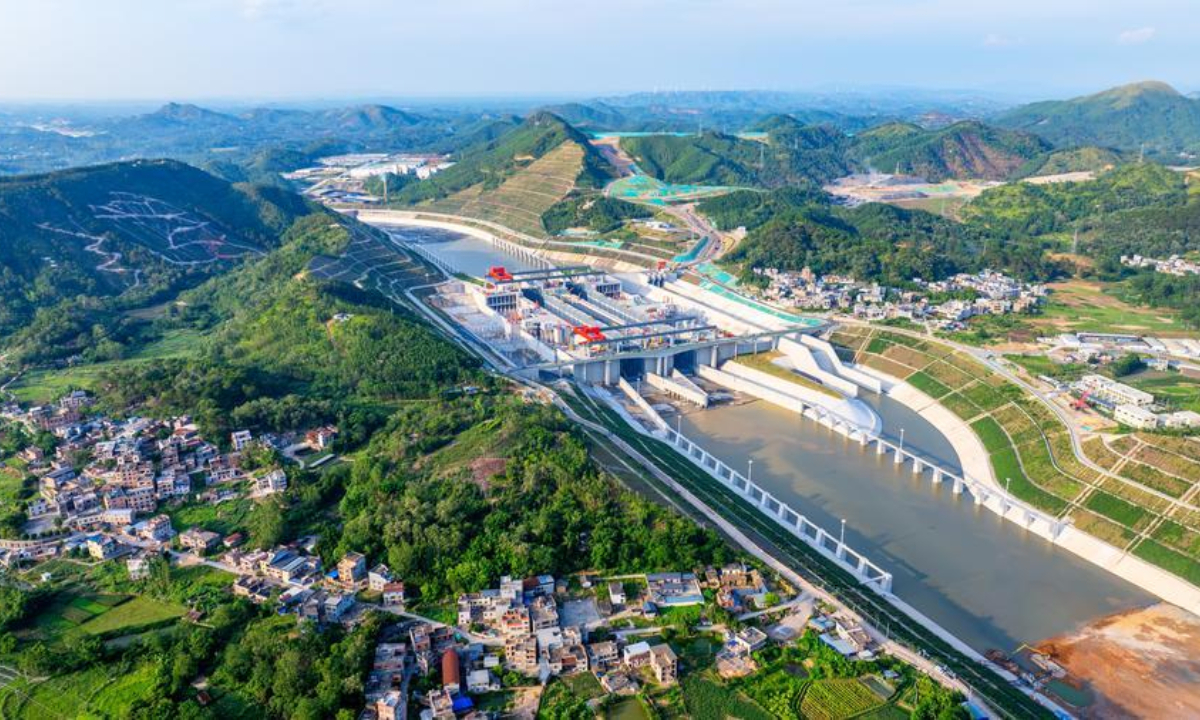
An aerial drone photo taken on June 3, 2026 shows water being pumped into the Madao hub on the Pinglu Canal in south China's Guangxi Zhuang Autonomous Region. (Photo by Zhao Zhenyu/Xinhua)
With the opening of the Pinglu Canal in South China's Guangxi Zhuang Autonomous Region in sight, a new river-to-sea direct transport mode is set to be made possible, allowing seagoing cargo to be shipped in river-sea multimodal transport. Moreover, specific cargo vessels that can sail both in the canal and also be seaworthy are under intense development, and will likely hit the waves by 2027 at the latest, an executive of the Pinglu Canal Group, builder of the mega project, told the Global Times on Thursday.
"We are now studying whether such a river-to-sea vessel that suits both the sailing conditions on the Pinglu Canal and the open sea should have a deadweight of 6,000 tons, 8,000 tons, or 10,000 tons. Whether the beam should be 17 meters, 18 meters, or 20 meters," He Junhui, director of the engineering management department of the Pinglu Canal Group, told the Global Times on Thursday.
It might be difficult to see the birth of such a vessel type this year as building the ship will take several months, but by next year, vessels with direct river-to-sea capability will certainly be launched, He said.
The 134.2-kilometer-long Pinglu Canal is a key project of the New International Land-Sea Trade Corridor. With total investment exceeding 70 billion yuan ($10.37 billion), the canal begins at the Pingtang River estuary in Hengzhou in Guangxi, and follows the Qinjiang River into the Beibu Gulf, according to the Xinhua News Agency.
Scheduled to open next month, it is China's first major river-to-sea canal project planned and coordinated at the national level since 1949 and is designed to accommodate vessels of up to 5,000 tons. Cheaper waterborne transportation enabled by the canal is expected to turbocharge trade and industrial chain integration between China and ASEAN.
This type of river-to-sea vessel will be able to sail directly from the Pinglu Canal to ports in the nearby island province of Hainan and other ports in the Beibu Gulf, or even in Vietnam, without the need for halfway transfers of cargo from smaller river-going vessels to larger ocean-going vessels, offering greater transport convenience with direct port-to-port service, He said.
Previously, there was no such demand in the market, and all river-going vessels left or picked up cargo at coastal ports and headed back to the rivers. But with the Pinglu Canal's opening in September this year, such demand has emerged, the executive said.
Technically, there are no major difficulties for Chinese shipyards. The key is to develop a vessel that can fit the canal's conditions and be economically viable, He said.
"We still need time to study what cargo these vessels are best-suited to carry and what shipping routes to take to ensure profitability, and economic feasibility is the biggest factor in deciding the fate of the new vessel."
As preparations for the official opening of the Pinglu Canal enter the final leg, regulatory work to ensure river-to-sea connectivity is also underway. On August 17, the Nanning Maritime Safety Administration issued the first batch of route endorsement certificates to nine seagoing crew members.
As a prerequisite, seagoing crew members must hold endorsements for the inland river route to navigate the Pinglu Canal, according to a statement the maritime authority sent to the Global Times.
On the manufacturing front, two river-sea demonstration vessels with a deadweight of 6,800 tons are under construction at the shipyard of the Guangxi Xijiang Heavy Industry Co, a local shipbuilder, the Global Times learned. After the launch, the vessels will conduct relevant tests to explore the river-sea going capability.
"Currently, river vessels do not venture far from nearshore waters after reaching river estuaries. In the future, cargo carried on river-to-sea vessels can go from Nanning, capital of Guangxi, directly to Yangpu Port in Hainan, or to ports in the Pearl River Delta in South China's Guangdong Province, or even directly to the Yangtze River estuary. It will be a significant addition of waterborne transport," He said.
RELATED ARTICLES