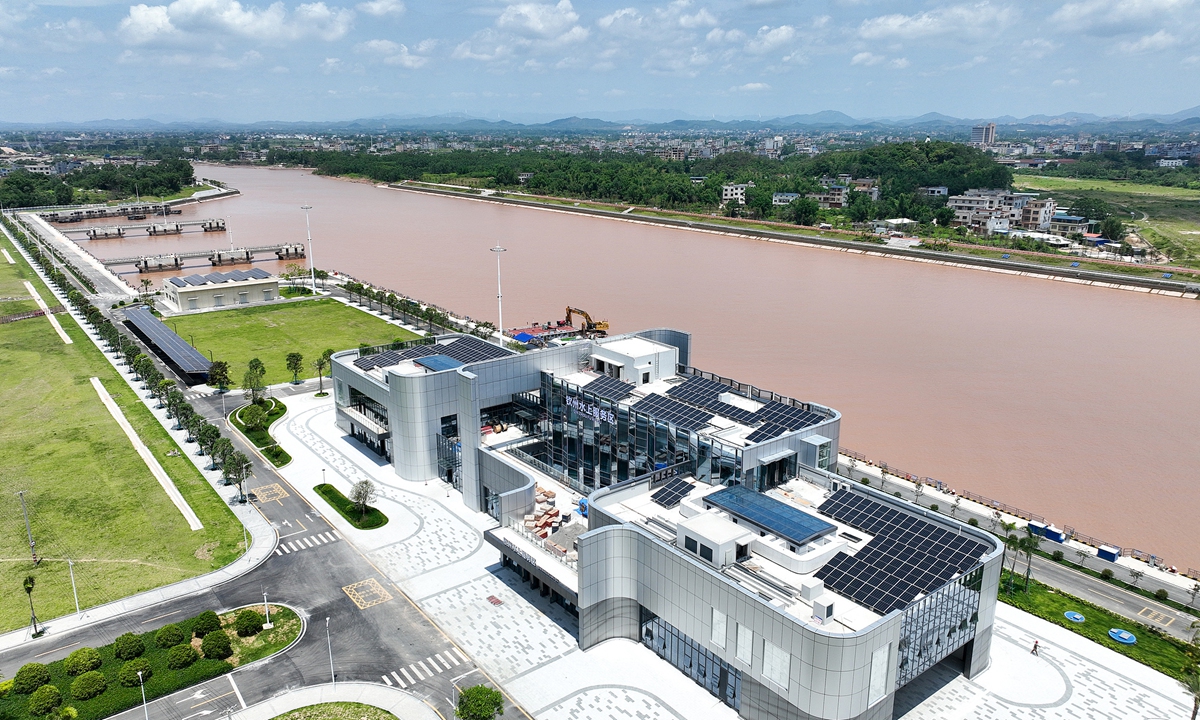
A service area along the nearly completed Pinglu Canal in Qinzhou, South China's Guangxi Zhuang Autonomous Region, on June 3, 2026. Photo: VCG
"We anticipate that seamless integration of inland waterways and sea transport will significantly improve transportation timeliness," said Huang Yujie, general manager of Guangxi Wuchan Cold Chain Logistics Co.
Huang, who for years has paid close attention to the development of the Pinglu Canal, a mega project that will give China's southwestern provinces their first direct river-to-sea route, said he was still excited by last week's big news.
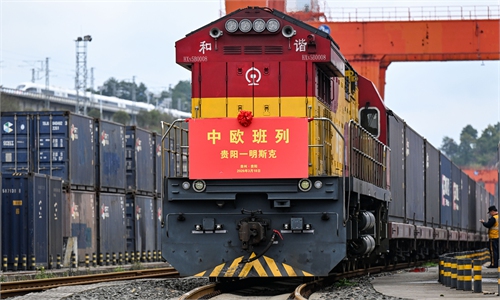
China's Pinglu Canal, a key project on the New International Land-Sea Trade Corridor, completed water impoundment on June 3.
The 134.2-kilometer-long waterway stretches from the Pingtang River in Hengzhou city, South China's Guangxi Zhuang Autonomous Region, to the Beibu Gulf in the South China Sea.
According to the Xinhua News Agency, once fully operational, cargo vessels from Guangxi and the broader southwest region will save more than 560 kilometers on their journey to the sea. The canal, now entering the water-testing phase, is scheduled to open to navigation by September this year.
Logistics boost
"With the canal entering service, we predict the water transport time from provincial capital Nanning to Qinzhou Port will take just one day, and fresh agricultural products exported to ASEAN member states can reach their destinations in just three days, with the shorter delivery time effectively reducing cargo damage and improving efficiency," Huang said.
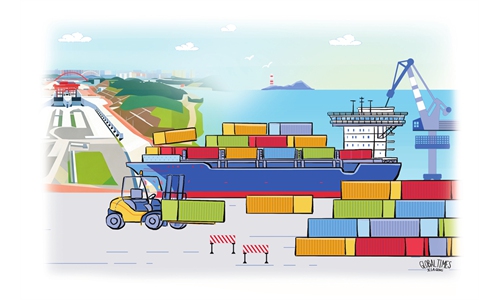
The main river-sea intermodal transport corridor encompassing the Xijiang River, the Pinglu Canal and the Beibu Gulf ports will greatly shorten sea transport distances and reduce overall logistics costs by 30 to 40 percent, directly benefiting related enterprises, Huang said.
As the canal nears full operation day, we have been prioritizing efforts to book and arrange cargoes in advance, Huang said. "Cold-chain logistics, refrigerated warehouses, rural logistics and storage capacity... a whole chain of products and services needs to be arranged before the canal's inauguration."
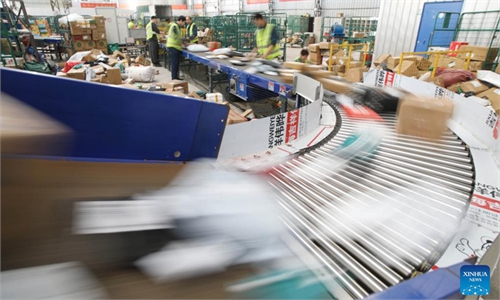
From foreign trade and shipbuilding to logistics and services, the Pinglu Canal is already reshaping the industrial landscape in Southwest China, with companies in various sectors beginning to align their development strategies with the canal's upcoming operation.
"The opening of the Pinglu Canal will be a monumental project that will reshape Guangxi's development landscape," an official with Guangxi's Fangchenggang city told the Global Times on Tuesday.
Fangchenggang is a major port city in southwestern of Guangxi, and the upcoming operation of the Pinglu Canal will greatly enrich the city's multimodal transport system and add growth momentum to existing industries such as steelmaking.
Leveraging these historic development opportunities, the city is accelerating the construction of a 300,000-ton waterway for the Fangcheng Port, a river-sea intermodal terminal, and the Nanning-Fangchenggang Railway extension, to boost handling capacity for an expected sharp uptick in goods trade, according to the official, who declined to be named.
"We fully recognize that the canal will bring not only changes to logistics routes, but also transformation in how we develop," the official said.
New businesses
Scheduled for operation by September, the Pinglu Canal is built to high waterway standards, accommodating vessels of up to 5,000 tons. Already, the canal is making an impact on the shipbuilding industry along its route.
A 4,000-ton cargo ship can carry loads equivalent to 125 heavy-duty trucks, with significant advantages in transport capacity, energy costs and freight rates.
According to a report by CCTV News, the canal's freight capacity is projected to reach 95.5 million tons a year by 2035 and 180 million tons by 2050.
According to a report by China Ship News in September 2025, green and intelligent vessel, particularly LNG-powered and electric ships are gradually becoming mainstream in the market as the canal approaches completion.
For instance, Guangxi Xijiang Heavy Industry Co, based in Guigang city, saw its operating revenue increase by 509.44 percent year-on-year, and its net profit grow by 173.79 percent in the first seven months of 2025, according to the report.
Notably, some orders have been placed for 5,000-ton vessels that use LNG as fuel, underlining a shift toward green, high-tech, low-emission vessels. Compared with traditional diesel-powered ships, they can reduce annual carbon dioxide emissions by 23 percent and sulfur emissions by 99 percent. They can save the ship owners approximately 1 million yuan in annual operating costs, the report noted.
In addition to shipbuilding, a vast array of industries is embracing the opportunities brought by the canal.
"In particular, we see tremendous opportunities in developing advanced steel materials, especially high-end export products such as shipbuilding steel and marine engineering steel," the Fangchenggang official said, noting that the city will capitalize on its overseas iron ore resources and access to the ASEAN shipbuilding market.
Wang Peng, a manager at Guangxi Jinzhong Software Co, told the Global Times on Tuesday that the shortened trade route brought by the canal and cost advantages brought by the canal are beneficial for the business environment in Southeast Asia and Belt and Road markets.
"Specifically, we believe the new transport link will further reduce shipping costs for products from South China's Hainan Island, which is already operate under a special customs regime as a free trade port," Wang said.
"For software companies like ours, while maintaining our core smart elderly care business, we are looking to leverage our resources to expand into areas such as smart management platforms for cultural tourism resources and elderly care and tourism, that is where we believe the opportunities lie with the operation of the canal," Wang said.
Lei Xiaohua, deputy director of the Institute of Southeast Asian Studies at the Guangxi Academy of Social Sciences in South China's Guangxi Zhuang Autonomous Region, told the Global Times on Tuesday that the Pinglu Canal brings about a change in the regions logistics landscape.
"Logistics expansion will drive industrial distribution and cultivate new types of services, which will directly benefit local residents," Lei said.