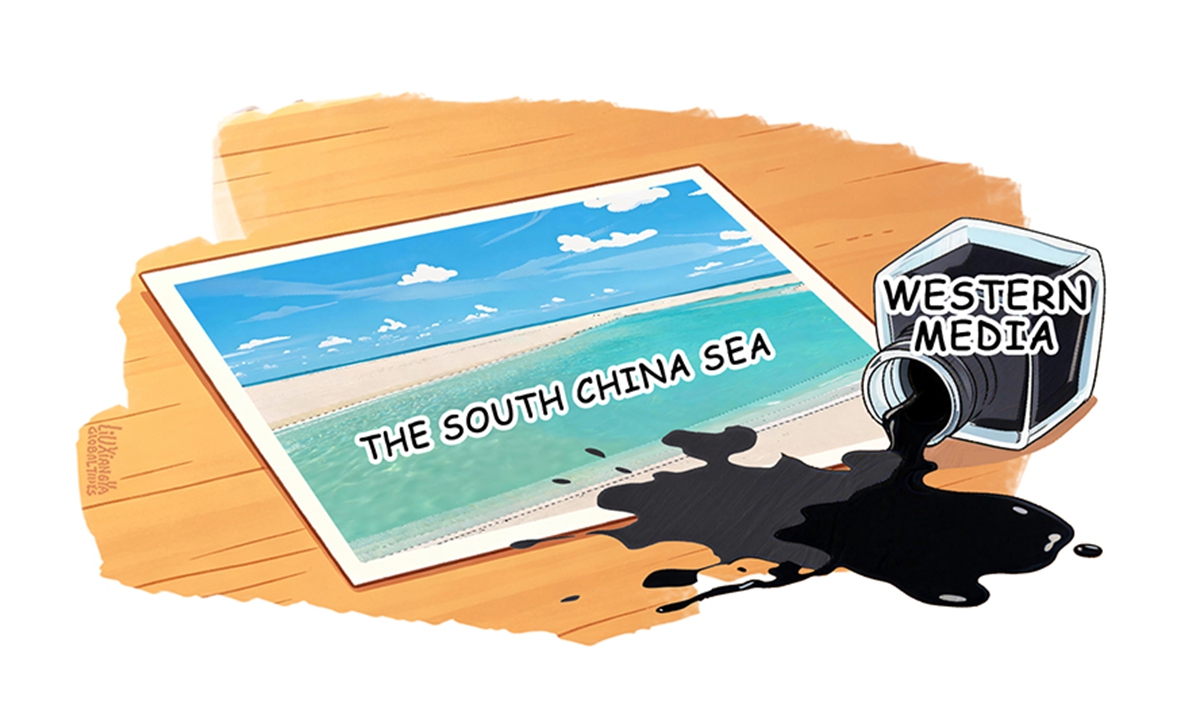
Illustration: Liu Xiangya/GT
A familiar narrative has resurfaced in parts of Western media, accusing China of "militarizing" the South China Sea because of infrastructure projects in Sansha. The accusation is loud, but it is analytically weak. A close look at the record tells a very different story.Since the founding of the People's Republic of China more than seven decades ago, China has never initiated a war or fought a proxy conflict abroad. This is not a slogan; these are the facts. In the Nansha Islands alone, over 40 Chinese islands and reefs are illegally occupied by other countries. China is also the only major maritime power whose access to the open ocean is tightly constrained by geography. Such a country hardly fits the caricature of an expansionist power.
Why, then, do some Western commentators still view every Chinese activity through a military-security lens? Some are trapped in a Cold War-era mindset, while others simply lack familiarity with China's history, national conditions or regional realities. There are also those who distort facts deliberately for geopolitical gain. China is willing to address genuine misunderstanding through dialogue and exchange, but it will not accept slander dressed up as analysis.
The construction now underway in Sansha is ordinary infrastructure development on Chinese territory. The projects are to improve living and working conditions on the islands. These projects reflect a long tradition of statecraft that values both defense and people's wellbeing. The Great Wall was built for protection, not conquest. The Dujiangyan irrigation system was designed to support agriculture and prevent floods. Neither was an instrument of expansion. Today's island construction follows the same philosophy: it serves practical needs without seeking hegemony.
For Chinese fishermen who have long operated in the South China Sea, the practical benefits are immediate. They endure harsh conditions - intense heat, high humidity, sudden storms and weeks at sea. Until now, reliable places to seek shelter, resupply and repair vessels have been scarce. Improving island infrastructure is first and foremost about protecting these workers and their livelihoods. It reflects a governing philosophy that puts people first.
Beyond national welfare, better infrastructure enhances China's capacity to provide public goods that serve the international community. Improved meteorological observation and navigational aids can make the South China Sea's busy shipping lanes safer. Stronger search-and-rescue capabilities can shorten response times and save lives. Research facilities can support marine ecological monitoring and scientific cooperation. These are contributions to regional governance, not threats to it. They also create a practical basis for low-sensitivity cooperation among littoral states - an incremental path toward building trust and, eventually, deeper maritime collaboration.
Security cannot be separated from this picture because national security includes the safety of territory and people. The South China Sea is not tranquil. Warships and military aircraft from outside the region frequently conduct close-in reconnaissance and exercises near Chinese islands. Some other claimants have expanded military facilities on features they illegally occupy. In response to these threats, China has deployed necessary defensive equipment on its own territory. This is a legitimate exercise of sovereign rights, not "militarization." There is a clear difference between building a lighthouse and building a forward military base, and China's record falls overwhelmingly into the former category.
Throughout the construction process, China has remained attentive to ecological and environmental protection in the relevant islands and surrounding waters. Guided by the concept of green engineering and eco-friendly islands and reefs, and after thorough research and rigorous assessment, China has adopted dynamic, full-process protective measures that integrate construction with environmental conservation. Environmental impacts have been monitored in real time throughout the construction period, and monitoring results have been regularly evaluated. The assessments indicate that the construction activities will not cause major pollution or significant harm to the marine environment.
This commitment is reflected in tangible outcomes. China operates on the principle that lucid waters and lush mountains are invaluable assets, and this applies as much to coral reefs as to forests. Between 2016 and 2021, Chinese institutions carried out coral restoration in the Xisha waters, planting around 30,000 coral colonies over nearly five hectares and raising survival rates from 30 percent to more than 85 percent. In 2023, Sansha launched a larger restoration effort that has since transplanted 240,000 young corals. At a time when coral reefs are declining globally, this is a meaningful contribution to marine biodiversity and a demonstration of development that respects ecological limits.
No amount of outside criticism can rewrite these facts or strip China of its legitimate rights. The South China Sea deserves calm, constructive engagement. Recycled "China threat" stories do nothing for the region's future. Those who habitually view China through a military prism should examine their own policies and military footprint in the region before pointing the finger. Ultimately, peace and stability in the South China Sea will be secured not by sensational headlines but by genuine dialogue, mutual restraint and practical cooperation.
The author is director of the Research Center for International and Regional Issues at the National Institute for South China Sea Studies. opinion@globaltimes.com.cn
RELATED ARTICLES