Germany urged to avoid politicizing trade issues after official’s remarks about ‘tough line’ on China
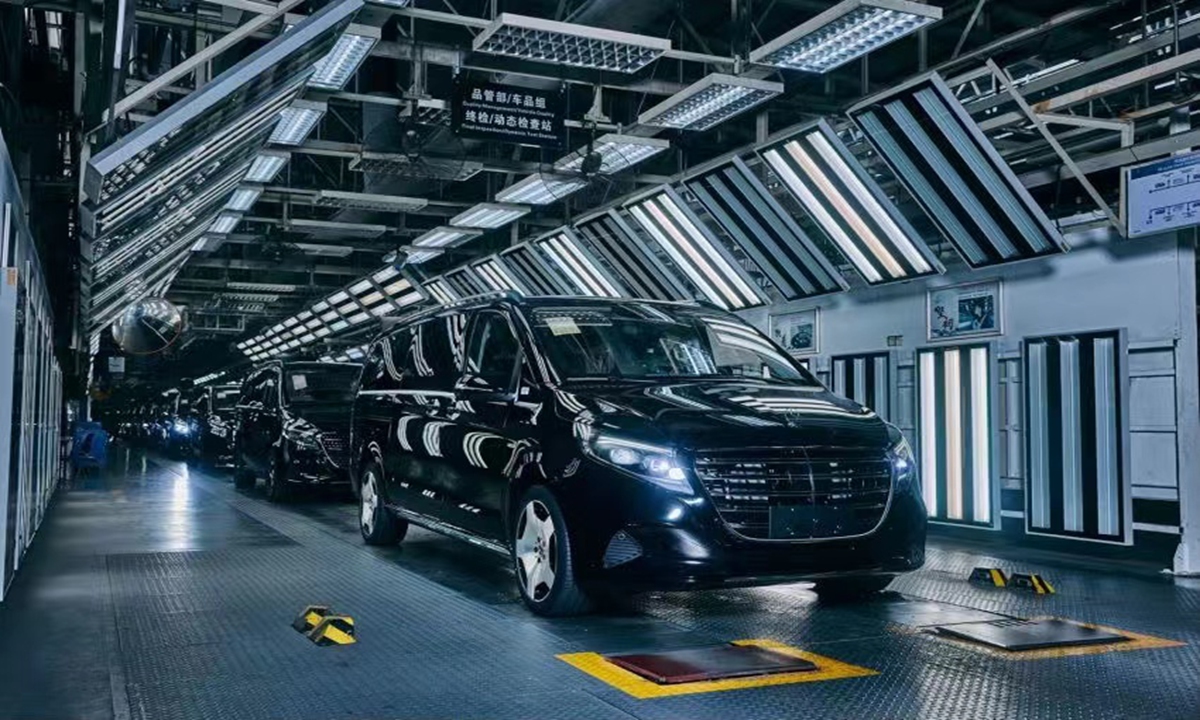
A view of a Mercedes-Benz factory in East China's Fujian Province. Photo: Courtesy of Mercedes-Benz
German Finance Minister Lars Klingbeil's recent call for a tougher line on China drew a sharp rebuttal from Chinese experts on Friday, who noted that resorting to trade protectionism will not resolve Germany's deep-seated issues and urged Berlin to avoid politicizing trade ties with China.
According to a report by Bloomberg on Friday, Klingbeil said that Germany is likely to adopt a "firmer stance" toward China, accusing Beijing of "not playing by the rules" in global trade and warning that sectors such as steel and automotive must become more resilient to protect jobs and counter Chinese competition.
Blaming China for Germany's industrial slowdown is, in part, an attempt to deflect attention from domestic competitiveness problems, Jian Junbo, director of the Center for China-Europe Relations at Fudan University's Institute of International Studies, told the Global Times on Friday.
Jian further noted that Germany should avoid politicizing bilateral trade ties and framing industrial setbacks as a simple case of "unfair competition," adding that China-Germany economic relations are deeply intertwined. "A tougher trade policy would not solve Germany's underlying industrial problems or revive German industries," he said.
According to Germany's Federal Statistical Office, the number of people employed at automotive manufacturing companies fell by 42,300, or 5.8 percent, in the first six months of the year compared with the same period in 2025. Following the decline, employment in Germany's automotive industry dropped to 691,500, the lowest level recorded since 2005, German media outlets reports.
Meanwhile, a June report by German think tank the Kiel Institute revealed that about one-third of Germany's market share losses in third-party markets could be traced to China, with the rest reflecting competitiveness problems "made at home". It warned that "blanket tariffs are poorly matched to the problem," according to South China Morning Post.Notably, Klingbeil's reported remarks came after Germany had previously sought to deepen ties with China. Klingbeil visited China in November last year and co-chaired the fourth China-Germany High-Level Financial Dialogue. After the dialogue, the two sides issued a joint statement outlining 27 points of consensus, including support for international and multilateral cooperation and opposition to unilateralism and trade protectionism, according to the Xinhua News Agency.
More recently, although some European countries like France advocate for a tougher line, Germany and Spain are more cautious, according to Reuters.
That contrast highlights the growing tension in Berlin's China policy: Germany remains economically dependent on China in many areas, but political pressure to show "toughness" is rising, Chinese experts noted.
However, if Germany adopts a tougher approach toward China, it will not only impact China-Europe economic and trade ties, but may also have a negative effect on the global economic order and market stability, further fueling trade protectionism, Zhou Mi, a senior research fellow at the Chinese Academy of International Trade and Economic Cooperation, told the Global Times on Friday.
Zhou noted that the two countries have extensive ties of mutual interest and a solid foundation for cooperation, and they should resolve concerns through dialogue rather than confrontation.
"We hope that the German side will not externalize its internal contradictions, or follow other countries' lead," Zhou said.
According to Zhou, weakening respect for existing commitments and consensus could erode the foundations of global trade, disrupt market confidence, and hurt Germany's own long-term interests.
RELATED ARTICLES